

Leaders say, “Somehow we never have the money to fund change management on our first try, but have a blank check on the 3rd try making the same change.”
Scott McAllister, CEO, Prosci
Dave Tabor 00:38
This is the ProCO360 podcast for people who love Colorado and love hearing from Colorado’s great entrepreneurs, entrepreneurs who have something special going on, something that drives my curiosity. I’m Dave Tabor, host of ProCO360 I’m a former tech entrepreneur, and I love having these conversations and sharing them with you. This will be a fun episode. Most leaders think change fails because the strategy was wrong. But what if it’s not that at all? What if the real reason is people today’s guest leads Prosci, a Colorado based company that’s built a global reputation around one deceptively simple idea, change only works if people actually buy in. So how do you make change feel natural instead of forced? And why do even the smartest organizations get this wrong? Let’s find out. Scott McAllister, CEO of proci, welcome to Proko. 360 Thanks, Dave. It’s great to be here. Thanks for having me. Yeah. Well, you’re welcome. And so why do even smart companies screw up change? Well, if you look at
McAllister 01:41
this, almost all of our effort goes into defining what is the solution. So we call this the technical side of change. Is it a process? Is it an acquisition? Is it a redesign? And we think that the perfectly designed solution is going to deliver the outcomes. And the reality is, almost every change is got a people dependency, where if the people don’t adopt and use the solution we don’t get to the benefits we expect. And I think most organizations have gloriously designed solutions somewhere in their graveyard of failed changes where it wasn’t that the buttons didn’t work on the technology, it’s they didn’t get the human beings to embrace and use the technology in the intended ways. They don’t get to the outcomes or the return on investment they expect.
Dave Tabor 02:20
Got it all right. So with that stage set, what does Prosci do?
McAllister 02:25
Yes, we’re a research organization in our core, founded by an engineer 30 years ago who really wanted to dive in deep on why some changes win and some changes don’t win in the market. And so at the core, we’ve been doing research for 25 plus years around what we call the people side of change. And so we help organizations build muscle and competency in dealing with change, whether it’s senior leaders that are growing capabilities to be more effective in the chair as a sponsor, whether it’s the specialist, we call it change practitioner, who’s going to be someone who practices applying a methodology on changes across the arc of decades of a career, or if it’s just the impacted groups that have to deal with changes in everyday experience, and how do they have a common language to be able
Dave Tabor 03:05
to communicate in the organization? Got it now, Scott, I’m going to share with you, and we share with listeners. I when I hear all this stuff that you say about change, used a number of terms and jargon around change, I am so cynical about systems that drive change. So listeners, if you are sharing my cynicism, the entire outline that I’ve created is designed to address my questions around a system. So bear with us, right? And so let’s start with to help with my cynicism. Well, you know, that’s not even the right word. I don’t know what the right word is, because I’m not cynical. I believe you, and I believe that by the time we’re done talking, that I’m going to be a believer. So that wasn’t the right word. I’m not sure what it is, but here we go. Give an example, Scott of of a company where that really illustrates that they had a difficult challenge they were struggling with, and then when professional change approaches were applied, it worked.
McAllister 04:08
Yeah. So Dave, to start, I’m a skeptic at heart, too. When I first got introduced to this stuff, I said, Look, I don’t sing songs and I don’t give hugs in my meetings, and so I don’t really need this stuff. I’ve also been in the discipline now for 30 years, and everyone’s got a little bit of a different flavor of how they do the work at Prosci, we’re focused almost maniacally on driving return on investment from times of change. And so it’s not the feel good kumbaya moments we’re shooting for. It’s how do we actually drive meaningful business value? I’ll give you an example, working with a large technology client, and they said, somehow we never seem to have money to fund change management on our first try, but we seem to have a blank check mentality on the third try with the same change. And so my lesson to leaders is you’re going to pay for change whether you want to admit it or not. I propose it’s a lot more effective to pay a small dose proactively than it is to play a multiplier effect when you have to take a second or third. Or a fourth swing at the same change. That makes sense.
Dave Tabor 05:03
So give an example, though, of like to paint a picture of how of the difference of what it looks like for a company that’s failing at change and a company that is succeeding at change, like, what are they doing differently? I know that’s a that’s like a five hour conversation, but like,
McAllister 05:21
paint that picture. Yeah. So if you look every change has a current state where we are today, and a desired future state of where we want to be in the future. And we’ve got this dicey transition that sits in the middle. We look at this from a sort of two sides of the same coin. On one side, you’ve got the technical side of the change, what is the design, develop, deliver of the solution? On the other side, you’ve got the people side of change. How do we get the human beings to embrace, adopt and use the solution? And so I’ll use an example. In my past, we were implementing a new CRM system, and we were going from a home built, Excel based, sort of Frankenstein thing, to salesforce.com which is an industry leading platform. And the boss thought, well, we’re buying the best platform in the market. We’re going to just stick it in and turn it on and make people use it. And the reality is that every single one of us were hard coded in the current state to deal in this Excel environment, and so just because we have a new piece of software that has got all the buttons we need and all the buttons work, doesn’t mean that we were willing to let go of our Excel system, and so 18 months later, we were still battling the shadow system of Excel, instead of using the platform the way it was intended. Why?
Dave Tabor 06:30
What? What is it about people that and what was it about you and your team at that time? Said like this, I we know you must have known this was better in in theory and at an intellectual level. So why didn’t you embrace it?
McAllister 06:45
It’s because of the comfort with the current state, right? Even if it’s dysfunctional, it’s familiar. And in large organizations, we often know all of the workarounds. I know who I can call in my friendship network in the organization to help me get access or turn on passwords or whatever I know the shift f8 backdoor that gets me to the screen I’m familiar with so I can get my job done. And so even if the future state is way better from a technical perspective, in the current state, just because we being bring a better technical solution doesn’t mean human beings are going to drop their familiar way of working and pick up the new way by accident. And so in our example of not adopting the CRM, very effectively, it started with me as the sales leader, because I was still enabling the Excel usage. I wasn’t leading by example, showing active sponsorship for the change. And so a lot of people said, well, if I’m not getting on board, they don’t have to get on board either. And so there was a lot of bad behavior that shadowed a lot of the role modeling
Dave Tabor 07:43
that I wasn’t doing as a leader. Okay, so wouldn’t another approach be get Salesforce figure out who’s using it, fire the people that aren’t, and bring in new people who will use it? Wouldn’t that be an effective way to
McAllister 07:59
make change? David used to work quite well in my early part of my career. I grew up on a model when the boss asked jump, or said, jump, you asked how high I travel all over the world and ask this question to leaders, you know, you say, jump, what’s the response you get? And almost every leader’s first response is, why? Or I’ll think about that and get back to you next week if I feel like jumping. And so I think this command and control style of leadership that I grew up early in my career is faded in terms of its effectiveness, especially with the multi generational workforce we’re dealing with, it feels like we’re still trying to apply a 1980s model to change when we’ve got a lot more empowerment assumed in the chair at the individual contributor level. So are you saying,
Dave Tabor 08:39
okay, that makes actually, it makes actually, it makes perfect sense. But I’m just going to ask for clarity. Are you saying that in 1980 the kind of change management that you are bringing to your clients was unnecessary?
McAllister 08:51
I don’t. There wasn’t a lot of change management work going on in 1980 I guess, change mandate, mandating. Yeah, there was forcing change into an organization, and a lot of because I told you so style command and control leadership, or the famous one in my household, was, don’t make me tell you twice, right? Yeah. And if you look at that, that just isn’t an effective leadership style today. I also think a lot of the reason why change management is a discipline that’s sort of seen as a professional way of working is in large part because of a lot of the failed technology implementations. At the end of the 1990s I was looking at lots of big ERP implementations where organizations were spending 10s or even hundreds of millions of dollars on these platforms, and they would spend years getting the organ, the platform, ready for the organization, and almost no time getting the organization ready to use the platform. Yeah. So then they turn it on and say, everyone has to use the new ERP system, and everyone is so familiar with the current state, often in an offline Excel environment, that people stopped using the platform enough where they’d eventually turn it off and say, we’ve got to do something different if we’re going to go at
Dave Tabor 09:56
this again. Wow. You know that does resonate, because I. I do remember, like massive, multi million dollar software implementations of ERP systems and other complex systems and and what do you think that the cost ad, let’s say it was a $10 million deployment of a software what would have been a cost ad to get the people properly conditioned and ready, and are you looking at another
McAllister 10:22
10% in the research that we’ve done at pro sine the 15 years I’ve been here? Is range best practice in terms of the ones that produce good or excellent outcomes, or investing 12 to 16% of the overall budget.
Dave Tabor 10:35
So still not, not a big and if they do it for the first time, then it’s only 12 to 16% and not all the other costs associated with failure. Absolutely. Let’s say
McAllister 10:44
hypothetically, we take a $10 million ERP implementation, and we push all of the money in, we pay the integrator to build the process and the platform for us, and we turn it on and no one uses it. That’s not a zero ROI. That’s a negative ROI, because a lot of times what we underestimate is the scar tissue that we create around a failed change in the organization. And we talked about cynicism earlier. The biggest response we hear from employees on the front lines when we get engaged to help support change is, oh, if I stick my head in the sand, this too shall pass. Call this the corporate ostrich effect, because they’ve seen lots of changes come and go beforehand, where if you ignore it long enough, it’ll go away. Wow. All right,
Dave Tabor 11:24
so I think we’ve painted a good picture. Now you’ve got a system, which to me, sounds like it came from Star Trek. ADKAR. So explain that in a short way, because I know you know this is a multi month or year for everything.
McAllister 11:41
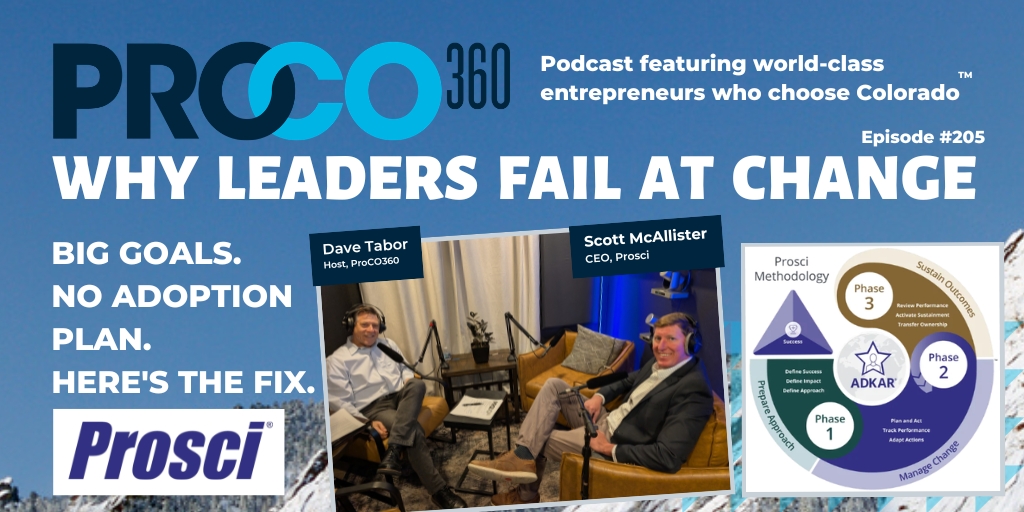
But what is ADKAR? Yeah, so the beauty of ADKAR is common sense on steroids. ADKAR is a five lever acronym which describes an individual’s change experience. It start with awareness of why change is necessary, then the desire, which is a commitment to participate. Then they need the knowledge and the ability to make the change, and then the reinforcement to stick with it, which for me is five boxes on top of what feels like common sense. But I would say ad car is used to deliver uncommon outcomes on top of base level common sense, because you don’t do this by accident. It takes some intentionality. So D, what
Dave Tabor 12:17
was the D desire? Desire, if you’ve got employees in house that don’t have desire to make a change. They can see the need they just don’t want to do it is that you got to stop until you get that fixed, or what
McAllister 12:30
do you do? So it’s fascinating. Almost every leader thinks their problem in their organization is a desire barrier. What we know from research is the number one reason the frontline employees resist change is an insufficient understanding of why the change is necessary in the first place. And just because we told them change is coming, and here’s the date it’s going to arrive, and here’s the consulting firm we’re going to use, and here’s the brand we’re going to give it that’s not giving them the why behind the change. And so a lot of folks are familiar with Simon sineks Golden Circle, we start with why, and then how, and then what. The same is true in change management, if we don’t start with, why are we changing? Why now? Because there’s lots of other priorities we need to wrestle for, mind, share, against, and then the killer question on the back of this is, what’s the risk of not changing? In far too many organizations, we only paint the glossy veneer of what’s possible in a positive frame, we underserve what’s the risk of not making the change happen. And you can look at this through lots of examples, but blockbuster is a classic one. They obviously could have moved to digital if they wanted to the option, had the option to buy Netflix, you know, in the very early days, and passed on it. Yeah, well, they didn’t see the reason to change, because the why now wasn’t clear enough for them, or what’s the risk of not getting involved?
Dave Tabor 13:45
Yeah, change now I’m starting to get a much clearer picture of why an outside company in could essentially Shepherd, Shepherd their client through this process of of it is sort of a disciplined approach to making sure that one comes before the next, before the next, rather than just jumping in, right? I mean, it sounds like a process will be much
McAllister 14:09
more effective, right? Well, if I ask any organization, how do you onboard a new customer? Typically, you’ve got a team, you’ve got a process you use, and you’ve got some kind of common language or vocabulary. If we ask, how do you close the books at the end of the month? We’ve got a team of people. You’ve got a common process that we follow and a vocabulary that we use. If we ask leaders, how do you drive change in your organization? They sort of look at the blank stare. And the joke we use is bunch of folks sitting around the table, loudest voice wins. Is almost the default way. And when you look at this through an ADKAR lens, you can almost always see, where did we miss the mark, and how do we approach addressing this? It’s a notion we call the barrier point in AD car, which is the first score moving from awareness towards reinforcement that’s neutral or lower. And so for any change going on, I can look at this through an ADKAR lens and say, Do you have. A sufficient understanding of why we’re doing this. Have you made the commitment to participate? Have we given you the knowledge and then the practice and the coaching to get good at it? Are you able to stick with it? Because we’ve got the right incentives in place, also the right accountability behind it, yeah. And so once you see ADKAR, it feels like it’s so obvious. How come we haven’t been doing it and it never happens without intentionality behind it? Well, I would think that’s
Dave Tabor 15:23
that’s where you know an outside party coming in. I mean, we pay consultants to tell us what we already know in many cases, right? But it’s that outside influence to help us see things clearly that is so valuable sometimes, and see it through a different lens.
McAllister 15:39
Sometimes you can’t read the label inside the bottle, you’re so close to it. And so I think sometimes this outside perspective can just give you a different way to look at the same situation you might not have been able to see otherwise. So does change
Dave Tabor 15:50
always come from the top, like I was, I was moderating a panel on AI, and the question came up, is it better to have passionate users, sort of at the bottom of the pyramid, who are adopting and using AI and sort of driving it that way. Or is it better to have a CEO who says, I believe this is our future? Everybody get on board like which is the right way?
McAllister 16:15
I’d say there are many paths to the top of the mountain. There’s not just one way. So we see a lot of organizations make change from a grassroots level that starts more like a movement. It’s not a program or a project that has a big brand behind it. We’re getting the sort of following the energy in the organization, harnessing the passion. We do know from 30 years of research that active, invisible sponsorship is the number one predictor of change success inside an organization, and so that means leaders, we have a role to play, and it’s not just signing a check or putting your name on a charter. It’s making sure we’re showing up and setting the priority for the organization, demonstrating with words and actions.
Dave Tabor 16:52
Yeah, now what all this kind of makes me think is like, I’m I get it, I’m buying it, and I it makes perfect sense. It’s just that when you come into a company, it’s kind of like when I was in grad school and you had these educators who didn’t have that much real world experience coming in and teaching from a textbook, and you’re looking at each other saying, This is crap. Like, no one thinks this way. No one does this. How do you avoid that? When you come into a client and say, we’re bringing ADKAR, like, how do you make them feel comfortable that this isn’t just some impractical, theoretical thing? You know, sure, yes,
McAllister 17:31
in my role, I got the privilege of working with a lot of senior leadership teams. So I was out with the fortune 100 organization last month, and we call this a sponsor briefing, where we’re getting the top leaders together. And I always say, quick show of hands. How many people can’t believe how this four hour session got on your calendar? And usually half the hands have the courage to go up. And I always say, my goal is not to teach you about change management. My goal is to amplify your impact as a leader. And if you look at this, Change Leadership isn’t something different than you do as a senior leader. It’s sort of a muscle you need to build. And again, from a Research Foundation, we know that the majority of leaders don’t have an adequate understanding of what good sponsorship looks like. We have an assumption because you’ve got a fancy title and a big paycheck, you’ve somehow picked this up through osmosis, climbing the corporate ladder. And the majority of leaders, when they understand what good sponsorship looks like, they say, okay, I can do that. I didn’t know that was the it you
Dave Tabor 18:28
expected from me. Sponsorship. What is use that you’ve used the term a couple where does that word fit in with leader, with change management?
McAllister 18:37
Yeah. So we have a model called the pro side, change triangle, that position, positions change management in context of any change. And it’s a triangle model with change successes in the center, which is, why are we changing? How are we going to measure the outcomes of the change? And I see a lot of organizations chasing aspirations. We want to be more customer centric. Well, that’s a great aspiration, but how are you going to measure it? How do we go from describing it with adjectives to getting it to numerical values where we can say, did we get there? Yes or no? And how do we hold people accountable to sustaining that? So in our model, we start by defining success, and then the three corners of this pro site change triangle has the leadership role of sponsor. At the top it has the technical side of change, which we would call the project management capability in the bottom corner, and then the people side of change, or change management in the other bottom corner. And so we connect this by saying you change for a reason. It’s not just an academic exercise. Let’s wrap this around an active change you have going on in the organization, and use the changes you’ve already committed to as the context for building this new muscle that we’re going to hopefully be able to flex on the back of a working session. I would think
Dave Tabor 19:44
that’s useful, because if you’re if you’re bringing that into something, they’re already doing something you know already relate to, something maybe they’re probably already struggling with to some extent that they’re like, Oh yeah, we’re missing this piece. Or. Were inadequate in this way, I would think that the AHA starts to kind of sync up. The question for you, and I’ve got, I want to, I want to. I’m curious to what extent Change management is episodic versus ongoing. And before I have you answer that, I’m going to thank our sponsors. This is ProCO360 named Best Colorado business podcast since 2021 I’m your host. Dave Tabor, this is a podcast for people who love Colorado and the stories of Colorado businesses and entrepreneurs. My guest today is Scott McAllister of Prosci. I want to thank our sponsors VIA Technologies, and these guys are great friends. They host ProCO360 and they help their clients in some really interesting ways. They attract super smart companies as clients and collaborate with them to grow their business using digital media, advertising and AI, also Denver ventures. You may know them as Denver angels in the past, we partner with them to feature great Colorado companies and some great, really great. Colorado companies have been episodes of ProCO360 in the past, and you’ll see the Denver ventures logo on many of those past episodes. So all right, back to my question with Scott, which is, to what extent is change management episodic versus ongoing all the time? Think about it.
McAllister 21:19
Yeah, I think at least for the last six years since the pandemic arrived in 2020. Feels like change isn’t always on all day everyday experience. I think the days of having it be episodic are largely behind us. We use an analogy. It’s kind of like being in a frontline employee is like standing in the ocean. The waves of change just keep on coming, and they’re relentless. And so that’s why we talk about change as a capability and a muscle you want to build, not as just a project you want to solve or remove the drama from. And so I think in 2026 and as we look towards the future, this is absolutely a new capability that’s going to differentiate the winners from the losers, because out changing your competition is the next new source of competitive advantage.
Dave Tabor 21:59
Wow. Well, then does that mean you need to hire a different kind of person, or do you have to train your people differently?
McAllister 22:07
My personal belief system is we have every single member of our team the opportunity to learn and grow with us, and so if they have the will, we can provide them the skill. If there’s a lack of will, I think we’ve got a little bit of a different story on our hands. But I think every single member of every organization has the ability to build some muscle to be more effective during times of change.
Dave Tabor 22:29
I’m pausing here because that sounded good. I don’t believe it entirely. Yeah. Like there are some people that have just don’t like change.
McAllister 22:38
For sure, every organization has what we call the cave dwellers, the citizens against virtually everything where the answer is no, what’s your question? And by all means, like we’re not trying to propose that every change needs every single individual to get 100% on board. That’s not at all how we work, and it’s a bit like a bell curve. You a lot of organizations have the early adopters. They get excited about almost any new idea, you’ve then got that late majority or early majority that you’re really trying to get on board. And the research fluctuates on this, but between 25 and 40% is typically considered a tipping point where, if we can get that first 40% on board, we can get this flywheel turning. And so we’re not chasing the last 10% laggards in every single change. In fact, I would suggest that we need to give them options to understand, here’s where we’re going as an organization. If you’re not on board, here’s the consequences you’re going to face as well. And so I’m not a believer of sugar coating everything. We often talk about an adult approach. We talk about, why are we changing? Well, here’s all the benefits, but here’s also the risks we face. Why am I changing? Well, here’s what’s in it for you, individually, both the benefits and the risks. And so I think keeping me a balanced approach that doesn’t just try and paint a glossy veneer of only positive is definitely a recommendation.
Dave Tabor 23:49
So in this, in the change management process, are you speaking with employees as groups, or are you having to get granular and, you know, speak to different teams or individuals, or how, how time intensive does it get to say to go through this process?
McAllister 24:08
Yeah, so we joke that it takes a village to get good at change, and we know, from a research perspective that the seat you sit in means we need a different type of capability. So as a senior leader, you need to develop capabilities around being a strong sponsor during times of change, which is different when you’re a people manager or a line manager in the middle of the organization. Think frontline supervisor, early manager ranks. These folks, I think, have the hardest job in the business, because they don’t get really any vote on what changes are going to hit their desk. Yeah, and they’ve got all the direct reports that have to do all the changing, which is where all the resistance surface is.
Dave Tabor 24:42
And in some of these really high growth companies, you get hired as an entry level and in two or three months you’re managing people, yeah, or in two
McAllister 24:51
or three months, you’re reorganized to a brand new manager who you didn’t know before. So we see in a lot of the fast growth tech organizations, the reorganization is. Almost a constant churn, forcing change across the
Dave Tabor 25:02
business, and those are the companies that tend to be run most of the time by less experienced leaders and who are reacting to what the market says they have to do, or they’re investors or whatever. I mean. Do you see a difference in the way these high growth Go, go. Companies address change, and should address change, versus a more mature company that you know has experienced leadership.
McAllister 25:29
Yes, I’m a recovering lean consultant, and we would go in and help lots of organizations improve their processes. It was almost always established organizations that were ready to invest in that if you’re in a hyper growth environment, typically, the revenue growth Trumps almost everything else, and revenue growth can cover a lot of sins, and often it’s only until you reach a level of maturity that you say, Okay, we’ve now got to find a way to scale this in a different way, which is where building a common language comes in. Not every single person in every organization needs to hold a certificate in change management, yeah, but I do think having a common language and a way of working around change that can be repeated is definitely a way to get better outcomes on a more consistent
Dave Tabor 26:10
basis in your like, I was a tech startup guy, and I had one company. I had 25 employees when I sold it, and I never got to a point where my hair wasn’t on fire. Would I have done better? Would these kinds of start fast growing startups? Would they do better if they take a breath and figure out the kinds of things you’re talking about, or is that just hopeless? And it really is reserved for companies that are mature or maturing?
McAllister 26:38
I think it’s any organization that wants to succeed during times of change. And it feels like that used to be a subset of the market. Now it’s everyone in the market. So we get the blessing of working with startups and NGOs fortune, 100 tech companies, healthcare, financial services, and so every organization is undergoing a lot of change. In fact, we joke that one thing that every one of our clients has in common is they have more active change going on than they can effectively manage. Also, in a 25 person startup environment, you’re going to have a different level of focus and proportionality of mind share that you’re going to put to this. But we see a lot of leaders that come out of large organizations that are clients, that jump to smaller organizations and say, Wow, it’s so much more enjoyable to drive change in a 500 person organization, because we’re not having to change and shift the Titanic. We’re in a bit more of a speed boat environment where it doesn’t take the same amount of leadership drive to get through the inertia. That’s what I was going to
Dave Tabor 27:36
ask you. Like, do you have experienced people like in PE firms or in venture capital companies that are saying, Scott, come in here. We need you to, we need you to apply some influence on these go go companies. Do you see that
McAllister 27:50
we do the progressive ones? For sure. It typically tends to be more of the mid cap or larger size organizations, just because they’ve got a little bit more of that professional infrastructure under the super, small organizations. Typically, you’re wearing many hats at the same time, but we see a lot of individuals come out of these smaller organizations through our programs and say, Listen, I don’t have the benefit of training everyone, but I can come back and have an outsized impact by doing some small things differently and getting more people to understand that, repeating some basic things at a you know, and doing the basics at a higher level is often what separates good from great or winning from losing during times of change. And so you don’t have to be an absolute expert. In fact, we know from research, if you go from poor to fair, you’re going to get a three times better probability of success if you go from poor to excellent seven times in a lot of situations. That’s not the goal. When we get brought in, you know, six weeks in front of a go live date with a large change, the goal is not perfection. Oftentimes, the goal is sometimes, to get them one step out of the basement to a better probability of success. But we don’t want to let perfect get in the way of progress, because a little bit of intentionality can go a long way well. And how,
Dave Tabor 28:58
how many clients you’re working with at a time? How big is Prosci?
McAllister 29:03
Yeah. So in a given year around the globe, we’ll work with six or 800 different organizations from a size of organization. We’re about 350 people across five markets that spans North America, Latin America, Europe. We run Asia out of Singapore, and then Australia, New Zealand as well. And the fun part is, each one of our markets works with different size and different profile of client. While there’s a lot of variety in the mix, the client size in Australia is typically a step size down from where we are in the US, just reflecting the market. Yeah, absolutely, yeah. But the fun part is, the base models work in every organization and all corners of the globe. I’ve seen ad car used to get the in laws to move out of the house. I’ve seen ad car used to get 100,000 people to get onto Microsoft Teams in two weeks after the pandemic arrived. And so one of our instructors calls it the duct tape, the duct tape of change management, where you can use it in all situations.
Dave Tabor 29:57
That’s super cool. Can you use it to get Microsoft to change. Their templates that automatically create these weird anyway. That’s a separate thing, but I’m intrigued. Like, okay, so Do you guys ever sit around in your team meetings at Prosci, look at each other and say, why aren’t we using this like we’re trying to change? Do you apply it to yourselves? Or do you sometimes look at each other and say, we forgot to do what we said, what we’re teaching.
McAllister 30:21
We’re far from perfect, so I’ll put that out there as a starting point, but we definitely drink a lot of our own champagne. I mean, if you look at every change that we run, we set it up with this change triangle concept, with who’s going to be the sponsor, who’s going to do the project management, who’s going to do the change management. We also certify every single one of our team members in their first three months of coming on board. So we do have AD car as the common language understood across the business, which gives us a lot of muscle memory when we’re launching a new change. Everyone in the organization is conditioned to get a message that starts with, why are we changing? Why now? What’s the risk of not changing? It is sort of hard wired into our DNA of how we communicate around change. Do you do that
Dave Tabor 30:59
even for, like, little things? Hey, we’re reconfiguring the parking lot. Or, I mean, what’s too small to worry about?
McAllister 31:05
We talk about, there’s large strategic initiatives, there’s cross functional work to define them. And, yeah, we have a three tiered system in our shop, but every organization has a little bit different lens on how they do this. But there’s a ton of what we call everyday change, reconfigure the parking lot. We’re changing the expense reporting process, or some, you know, small approval, and in a process, in those kinds of changes, we can do ad car on a single page, and that’s sufficient.
31:29
Well, you do that even for, does it? Does it?
Dave Tabor 31:33
Does it get tiring and old to like, like, you know, I want you to answer that call instead of you. Like, is that an ad car system
McAllister 31:41
like, well, it’s fascinating. We were growing organizations, so we’re bringing on new leaders all the time, and new leaders their first six months, we do an intentional check in and say, Okay, how are we doing in the onboarding process? You acclimating to the culture. What questions you have? What makes us great? What are the challenges you see in the opportunities for us? And it’s funny, because in month six, almost everyone says, Oh my gosh, this requirement to use ad car slows us down so much. Can’t we just tell them what needs to happen? That was kind of where it’s going with this. Yeah, but it was fun. At month 12, when we come back around to do the second lap on the track, they say, Do you know what ad car is the greatest accelerator of the pace? Because we’re doing it with a ton more intentionality in the beginning, and so we don’t have nearly as much friction in the middle and towards the end of the process. And so while it might feel slow in the early days, I would rather go slow to go fast. And I joke instead of running into the wall 10 times, I’d rather look for the doorknob to open the door. And I think in a lot of situations, a bias for action can be a positive thing, but it’s a two edged sword, and if we’ve got too much bias for action, sometimes we miss on some of the foundational elements. You know, one of our instructors says you got to go on an ad campaign build awareness and desire together. You can never underestimate the individual’s ability to make it all about themselves. And so their question is, well, what’s in it for me? And so if we can say, well, here’s why we’re changing. Why? Now? What’s the risk we face of not changing? And here’s what’s in it for us. Here’s what’s in it for you. Well, now we’ve given people a foundational understanding of the awareness and desire building blocks. And so when it’s time to turn on the knowledge piece of this, there’s an a readiness and a receptivity. Is there something
Dave Tabor 33:19
too small to deal with ADKAR like I’m, you know, we’re gonna put the paper in this drawer instead of in that cabinet. I mean, at some point would your head explode if you did it with everything? I think there’s
McAllister 33:31
diminishing returns on anything. And so, yeah, you can probably find things that don’t matter much. But I love this question, how much of the benefits from your change depend on people adopting and using the solution versus how much of the benefits do you get from installing
33:45
the solution? Okay, give an example.
McAllister 33:50
We’re implementing a new HR system to get everyone in the global business on the same platform.
33:56
Okay, that’s a big change. I mean, it’s significant.
McAllister 33:59
It is but also your payroll runs through it, your time off, request, vacation accruals, all that kind of stuff, gets tracked in the platform. And so are we going to recognize some benefits from stopping using two other platforms? Because we’ve got different markets on different systems? Yeah, we’ll capture some benefits from system consolidation, but what we’re really hoping for is taking the transactional cost of HR down, because we have a lot stronger self service capability, because the platform gives you access to a lot of the things used to have to talk to a talent partner about. Well, that only works the self service component of this if the individuals in the team actually understand how do I log into the platform? How do I get my PTO requests in? How do I make sure my pay is accurate. How do I do my performance reviews and all that kind of stuff. And so the benefits that we need to capture are going to be some on the platform itself. So we obviously do some diligence and pick a platform that we fit feel is fit for purpose. But in this situation, we said 70% of the benefits we expect are going to require our global team members to adopt and use the new. System the same way, and it’s different than the old way. And so we’ve got an ad car plan wrapped around this thing. It’s not, you know, months and months of effort, right? But it does make sure that everyone that’s going to be asked to adopt the change has the ADKAR blueprint and understands the why behind it, the what’s in it for us, what’s in it for them. They’ve got access to learning. There’s space between when they learn and when they’re supposed to be live in the system, performing effectively. And then we’ve got reinforcement mechanisms to, you know, make sure that we stick with the behaviors. And so it’s cool.
Dave Tabor 35:29
Now you certify people in this you certify all employees, even the ones that aren’t training.
McAllister 35:34
Yeah, in our organization, we want a common language, and so we’ve got a three day certification course, which is, you know, widely recognized as the dominant certification in our discipline. And that teaches you a whole lot more than this ad car model. It’s got a three phase methodology that is a bit like an accordion. If you’re implementing SAP, you pull the accordion out and use lots of the glory inside of it. If you’re doing something small in scope, you kind of shrink the accordion down and use the Greatest Hits within it. And so we teach people how to size and scale the amount of change management to match the change and we have a lot of people that are in finance or marketing or some other corner of the business where they go to change training and they go right back into marketing. They’re not necessarily a practitioner of the discipline.
Dave Tabor 36:16
So you, before we wrap up, you mentioned that you can use your model for getting your in laws move out of the house or something like that, right? How? Let’s talk a little bit, though, about the notion of using it in your personal life. Do you use it in your family? You’ve got a couple of kids wife? Do you use it in your family?
McAllister 36:35
Yeah, my kids are growing up, and so they’re at a point that says Dad and don’t be ad caring me anymore. So I think there’s a fine line to walk here, but the reality is, any change we want to go through, like the one I use in when I teach programs, is I need more sleep at night. I’m acutely aware of all of the health trade offs of not sleeping well, life expectancy, cardiovascular disease. I say I want more sleep, but I’m also addicted to North Carolina Tar Heel basketball, and I usually watch the games on recording after the family goes to bed. And so while I say I am committed to this, I stay up late to watch basketball. I’ve got all of the tips and tricks and hacks around, you know, set an alarm to go to bed at the same time every night. Get sunshine in your eyes in the first hour of the day like I know the knowledge, yeah, okay, ability. I travel a fair amount for work, and my kids are younger, and then you can always use more reinforcement. But in my scenario, I keep saying I want more sleep, my barrier point in the ADKAR model is around desire, because my actions aren’t lining up with my words. I’d rather stay up late and watch basketball than get sleep. And so it’s a really easy example of a change I’m trying to make. I can put this lens of common sense on top of it, and now I can understand if I really want to make the change happen, I’ve got to get past my desire barrier and let go of the basketball season and sort of prioritize my health. And so it’s a model that works at home as well as us in the professional setting. But like anything in life, you only get out of it, what you invest in it? Yeah, so just knowing what the five letters stand for is very different than applying it in real life to a change you’re trying to draw. What have you learned
Dave Tabor 38:09
about I mean, you’ve been this business forever. What have you learned that is different now, and how you see change management now, after you’ve been doing this at a practical level for so long? What’s different for you? I think
McAllister 38:21
there are a couple of pivotal elements on the journey. While I would never celebrate a pandemic. Pre pandemic, we were the crazies in the corner, jumping up and down, starving for attention, especially in boardroom and C suite environments moving through the pandemic. I think every leader on the planet understood you’re in the people business, whether you wanted that or not, selling cars or insurance or everything in between. The pandemic really put the human being front and center. And then I think this, AI movement that we’re currently sort of in the early days of, is also putting a lot of pressure on organizations to adopt something brand new, even when they don’t even know what the future state looks like. And so I think the pandemic woke every leader up to the fact we’re in the people business. And now I think this AI movement has got a lot of pressure on organizations to say my margin for error is starting to shrink on me. I don’t get a second, a third or a fourth try, going to replace me if I don’t get it right first time?
Dave Tabor 39:15
Yeah, okay. Now you’re because this is a ProCO360 and I focus on Colorado companies. How did you come to be a Colorado company?
McAllister 39:23
Yeah, well, the founder incorporated the business out of Loveland, Colorado, northern Colorado company. But, yeah, I find Colorado is a great place for headquarters, because it’s a fantastic place to recruit people. The outdoor access is one of a kind, and the balance and lifestyle. We work hard here. We play hard here as well, and feel like Colorado is a
39:42
great home base for us. Well, last question
39:44
is, because you’ve got a couple of kids at home,
Dave Tabor 39:49
what’s something that you will advise? How old are they now? 12 and 10. All right, so old enough? How do you advise them to think about change as their dad? And as someone who has seen all you’ve seen about failed and successful change, what’s, what’s, how do you advise them?
McAllister 40:07
Big thing in our household is being able to keep an open mind and not get too fixed that you’ve got it all figured out. And so the ability to unlearn and relearn is something we talk about a whole lot. And I think this is true for leaders in 2026 but if I look towards the future, learning, agility is one of the things that’s going to separate us, because people that think they’ve got it figured out are going to hold on to today’s way of working. Are the ones that are become dinosaurs the fastest. The pace of change is relentless, and it’s only accelerating, and so we have got to let go of I’ve got it figured out, and stay curious and understand that with new information and facts, we need to continue to be willing to shift our perspective.
40:47
What an interesting
40:48
business you’re in. It’s fascinating.
McAllister 40:51
I mean, I love it. If it were the same every day, I’d lose my mind. And so I think the variety is one of the things that keeps it like the most interesting. Because literally, I’m with like, a healthcare organization last week, a bank next week, you know, going into government operations after that. And so variety is what makes it, and the
41:06
government will pay, yeah,
McAllister 41:08
then you look, we’ve been working with the IRS and the FAA and lots of big government agencies,
Dave Tabor 41:14
and they want to pay a third party to help them change. They want
McAllister 41:19
to be successful with change, and we’d love to take the friction out. I give you a great quote. We did a lot of work with the state of North Dakota during the pandemic, and one of their senior leaders said, going through change is like going down a water slide without change management. It’s like going down with no lubrication on the slide with change management, we’re like the water and the lubrication on the slide, where you can actually get down with a lot less pain and a lot less aggravation.
41:43
And he said that after working with you, yeah,
McAllister 41:45
I was in the middle of our engagement when they started seeing the progress, they were like, holy cow, this is such a different way of doing things, and it’s not magic. It’s not rocket science. When you sort of unpack ADKAR, it is so common sense oriented. And the reason why it’s the number one adopted change framework in the world has nothing to do with our ability to market it. It’s so widely adopted because it’s effective.
42:06
Wow, that’s cool.
McAllister 42:07
Absolutely. I mean, I love the Gandhi quote. Be the change you want to see
42:11
in the world. Yeah, that’s probably,
42:13
I don’t know. I didn’t see that on your website.
McAllister 42:16
Could be out there somewhere. We’ve got a lot of good mantras that make their way onto the page. Well, let’s, let’s
Dave Tabor 42:21
wrap up there. I’m your host, Dave Tabor, today on ProCO360 you’ve been listening to my conversation with Scott McAllister, pro Sai, Scott, great having you on and what, what fascinating conversation around change, around building a model, and that’s, I think, practically applicable. Listeners. Glad you’re here on ProCO360 where we say live work. Love Colorado, because you and I and my guests can be successful anywhere. And choose Colorado. You make the show successful by subscribing to the ProCO360 podcast. If you haven’t yet, it’s a huge help if you submit a review in your app. Thanks again. To show sponsors, Denver ventures and VIA Technologies, That’s the show, live, work, love, Colorado.