

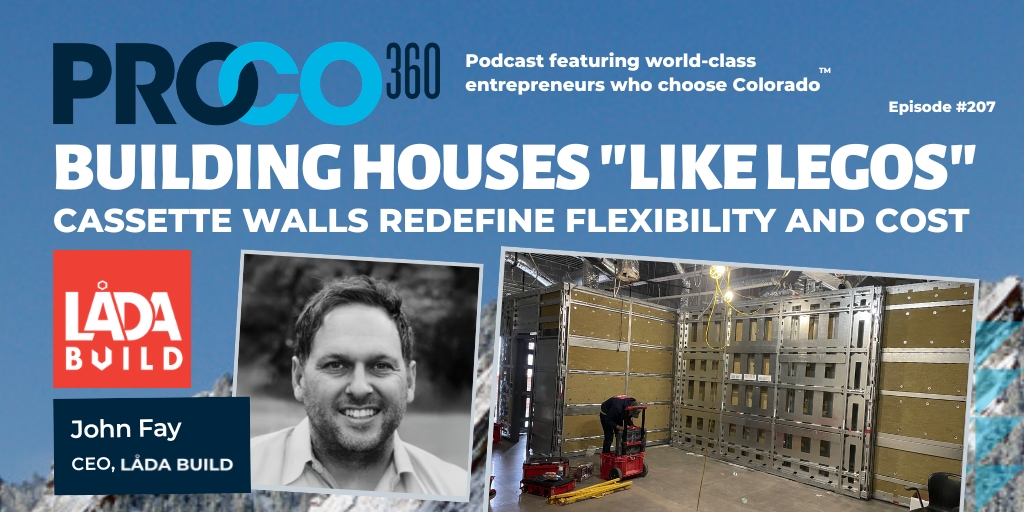
I heard God say “I want you to build a real wall that can come apart.”
John Fay, CEO, Låda Build
Building Houses "Like Legos"
- Låda Build’s biggest customer is Walmart. THAT was a surprise! I wanted to feature a Colorado western slope company and was excited to learn about Låda Build. The company has a very low key (sometimes none) web presence, so I was expecting a fledgling company doing more experimentation than delivery. I learned that, yes, they do regular business with Walmart – and found the company’s concept is extremely intriguing. It invented and builds structural walls that interlock using cams. I suggested to John Fay, company founder, that it sounds like Ikea furniture and he didn’t disagree – he did clarify that Låda Build’s cam locks are designed for the structural purposes they deploy. And this is impressive: Låda Build’s seven configurations of walls can interlock to accommodate more than 96% of structural designs. When you listen to this episode, you’ll know why I called John, “Noah.”
John Fay 0:05
With those seven sizes, the way the walls assemble is they have internal cam locks, and so you basically are locking the walls together. I literally heard a voice, and I believe it was God’s voice, and I heard Him say, “I want you to build a wall that looks like a real wall, but can come apart. I came home that night. I didn’t tell my wife, because I just was ruminating on it, and thinking, like, am I crazy? And I remember I woke up the next morning, and I walked into the room.
Dave Tabor 0:40
Well, that that phrase makes me a little nervous. For you,
John Fay 0:50
he said, has Walmart reached out to you, and I said no. And he said, I just feel very strongly that they need your products.
Dave Tabor 1:00
This is the
Dave Tabor 1:00
ProCO360 podcast for people who love Colorado and love hearing from Colorado’s most inventive and successful entrepreneurs. Today’s guest is John Fay, founder and CEO of Lotta Build, based in Grand Junction. Lot of Build has developed what John called the productization of construction, even different from modular home building, we’ve talked about that before on ProCO360 Lot of Build has created pre-engineered walls, it calls cassettes that have been described as coming together like Legos. We’ll talk about how that works. And I was eager to meet John, because it’s fun to feature companies and entrepreneurs from the Western Slope. And John and Lotta Build are based in Grand Junction. So, John, glad we’re connecting on ProCO360
John Fay 1:42
Yeah, Dave, pleased to be on your podcast. I really appreciate it, and excited to get to share more about what we’re doing over the Western Slope.
Dave Tabor 1:51
I was serious when I said I’m glad that we’re talking, because you are on the Western Slope, and you know, I get around Colorado, and so for me, though, featuring companies like Grand Junction, oh, it’s really fun. So, anyway, do a better job than I did of explaining, describing a lot of build and this whole concept.
John Fay 2:07
Yeah, thank you. Well, you did a great job, but yeah, I mean, I think you know our goal as a company is really to kind of invent the building blocks of the future, you know, understanding, you know, what those blocks need to look like, you know, to alleviate costs and sustainability for reusability, and then also just on labor constraints, and so really trying to one of our mottos is, you know, free the world to build, and really trying to create these platforms, so we affectionately call ourselves the two by four of the future, so really looking at the paradigms and the products in a way that that they’re user friendly and they really start to change, you know, the usability and the cost structure of how we build moving forward.
Dave Tabor 2:50
Is there, is there actually like, aside from being a better way, is there a painful problem that you’re solving?
John Fay 2:57
Yeah, so if you look at construction historically, especially in the 21st century, some of the things that we’re seeing are instructions lagging so far behind from a technological revolution standpoint. So, you look at other products like computers, electronics, you know, phones, these these other categories at fintech, you know, we’ve seen tremendous growth and efficiencies and reductions of costs, you know, primarily around, you know, how these products have come into the 21st century and created new solutions.
Dave Tabor 3:28
Yeah, construction hasn’t changed all that much.
John Fay 3:30
Yeah, it hasn’t. You know, it’s lagging behind. They say it’s one of McKinsey has tons of reports talking about how it’s one of the largest sectors, you know, it’s like a $13 trillion sector that really hasn’t had a lot of technological revolution and the efficiencies and the costs, and so what you see, especially since Covid, is the cost to construct has gone up 20% year over year, so it’s really an unsustainable model, and then adversely, when you look at the side of actually building things, you see projects that are continually going over costs, you know, through change orders or just time and delay. Yeah, and then you’re seeing, you know, we’re approaching almost a million person shortage of skilled laborers in the United States, and so it’s like this perfect storm where something’s got to give to kind of changed the model,
Dave Tabor 4:21
and yeah, so how is.. I mean, modular housing has been, and factory-built housing has been really sort of in the news a lot. It’s been growing. There are factories in Colorado now for building homes. What’s the difference between what you’re doing at Lotta Cube and what these factories are doing as they build houses?
John Fay 4:39
Yeah, so I would say, you know, you have different categories of modularity, probably one, one of the most common, and people are most familiar with is volumetric.
Dave Tabor 4:49
What’s that mean?
John Fay 4:50
So, yeah, volumetric is similar to basically building a block inside of a factory, so you, you had the Fading West crew on, I know, I. It was some, they’ve done such a great job, you know, create creating these efficiencies in their factories to then reduce the costs to bring products to the table that really allow, you know, the common homeowner to be able to afford housing,
Dave Tabor 5:14
and
Dave Tabor 5:14
basically just so everybody knows what Fading West did, and you can go back and listen to that episode, but they’re basically building a home inside of their factory and bringing it on a on a flatbed and setting it on a foundation, so the idea is gaining efficiency in it by building in a factory, predictability, cost containment, so forth, right. So, Lada,
Dave Tabor 5:34
yes, one
John Fay 5:34
of the things about, you know, the way that those units are built, some of the efficiencies that we see that are missing are building in a digital platform, and so if you, if you were to go to Home Depot today, right, and you were trying to pick out some two by fours to build some structure, you’d have an incredible hard time finding straight boards, consistent product, and so we really see construction from more of a productization standpoint, and and we see those volumetric guys, you know, eventually using our products to build out their volumetric modules, and the benefit in it is we call it productization, so you’re able to take a set product that’s standard and you’ll be able to take, so like for example with our product we have seven sizes of wall panel cassettes, but the irony in the in the product, is you can build virtually any floor plan using just those seven products, and so you’re not relying on heavy customization, highly skilled labor, because it’s a digital product.
Dave Tabor 6:32
So, hold on, let me interrupt you there, because, okay, so you got seven size, you’re calling them cassettes, but let’s paint the picture. If I’m going to make, are you guys, are you actually making houses out of Lotta build?
John Fay 6:43
Yeah, so we have part.. well,
Dave Tabor 6:45
hold on, hold on, hold.. wait, don’t jump in there yet. So you can actually build a house out of it, right? Is that what you’re saying? Yes,
John Fay 6:50
right.
Dave Tabor 6:51
Okay, so using your cassettes, I can decide by putting cassettes, pieces, walls, essentially. Can I decide how my house is structured and put walls basically where I want them using your technology.
John Fay 7:05
Yeah, so yeah, with those seven sizes, the way the walls assemble is they have internal cam locks, and so you basically are locking the walls together, and yes, you can build virtually any floor plan, and we’ve been able to pump in a lot of different floor plans into the system, and that were random floor plans, and we’re able to get on on average 93 to 97% compatibility with the original design intent.
Dave Tabor 7:30
Wow, so that’s kind of like, what’s that store where you go and everything you put together by yourself uses camera blocks?
John Fay 7:34
Ikea, yeah,
Dave Tabor 7:35
these are like IKEA houses,
John Fay 7:38
and, well, in some ways, I mean, you know, they’re
Dave Tabor 7:41
John, you don’t have to,
John Fay 7:44
or cassettes are three times stronger than a stick built structure. Yep, so, and the other thing is, these cams are like bomb proof, they’re not like your IKEA cams, and I love IKEA, and they serve a great market, and they have good products for that market, but, yeah, you know, similar concepts and crossovers to IKEA and a Lego, and
Dave Tabor 8:04
so, yeah, trying to get my head around this. So then, okay, so if I want a certain configuration, you guys can help me design it with software and so forth, and walls go here, here, here, blah blah blah, they get locked in place. What do you do then? run wires and you know, electrical and plumbing through whatever it is that you’ve now constructed,
John Fay 8:22
yeah, so the cassettes are designed in a way that you, you can still interface with traditional contractors, or you know, the traditional labor and materials. So we didn’t want to totally alienate ourselves from what the market really offers, and so we do have a plug and play electrical system, so you actually can do 90 plus percent of electrical without an electrician. Wow, and then, and then you can also bring in traditional electrical as well, you know, J boxes, you know, switches, whatever outlets, and wire, traditionally. So, the wall, the cassettes are designed in a way that the interface can happen either way.
Dave Tabor 8:59
That’s cool. All right, I want to back up something. Like, if I understand your background, you were like a real estate developer, real estate commercial real estate, and are you actually an ex high school counselor?
John Fay 9:11
Yeah, so I have no.. well, so I have zero experience in engineering, architecture, or real estate.
Dave Tabor 9:17
Yeah,
John Fay 9:18
I actually went to Colorado State University and got my undergrad in history, and then went to Adam State College in Alamosa, Colorado, and got my master’s in counseling psychology, and spent years as a, as a school counselor, as child welfare case worker, foster coordinator, you know, mental health counselor in a hospital. So that was most of my career throughout, you know, my early years.
Dave Tabor 9:40
As the story goes, because I read it, you know, you figured this out in your garage, and what simulated the idea that you should even create something?
John Fay 9:48
Yeah, so I, I had never looked at commercial real estate before. My wife, at the time, had a music school, and you know, we were kind of thinking about, you know, how could she get more exposure, you. And I thought, well, maybe, maybe we should go in a commercial real estate, you know, location, so that’s probably where that piece comes in, and you know, figure out if we should have a spot where we can get more exposure, and so my wife has this amazing degree from Manhattan School of Music and concert piano performance, and we’re like, how do we, what do you do with that degree, and so we learned
Dave Tabor 10:20
you do the history degree,
John Fay 10:22
I know, right, get creative, yes, especially if you have a history degree, yeah, so I, you know, unbeknownst to me, I, you know, I went out and looked at real estate, five properties here in Grand Junction, and walked away, honestly, like incredibly frustrated, like the process, and was just kind of crying out to God, and saying, “God, I’d like, what is.. what is this? This is so frustrating to me. And some of those frustrations were, you know, putting all this money into the space I didn’t own, you know, and feeling like I didn’t.. I didn’t have any leverage. And then also just the waste, you know, someone coming in after me and tearing everything apart and throwing it away, and I simply was frustrated and crying out, and I heard – I literally heard a voice, and I believe it was God’s voice – and I heard Him say, I want you to build a wall that looks like a real wall but can come apart, and I was honestly pretty freaked out by that, and it, and I was paralyzed by the idea for two years.
Dave Tabor 11:17
Wow, so two
Dave Tabor 11:18
years, two years were what it just sat in your head,
John Fay 11:22
it did, and I kept trying to hand it off to people. I said, oh, to my friends, oh, you build stuff, you should do this, you know. And no one ever took me up on that offer, and you know, so that that whole experience really happened in 2010 And then in 2012 you know, my wife was basically kind of proud of me and said, hey, like, you need to do what you feel like God showed you to deal, do, and so I did end up hiring someone. It didn’t go so great. And then I was praying again. I was like, what? I feel like I wasted a bunch of time and money, and so ultimately just felt like I heard the Lord say, you need to build it, and I started making stuff in my garage in 2014
Dave Tabor 12:03
so, and you were met, but you were fat, were you fabricating out of metal at the time?
John Fay 12:06
Well, kind of. I mean, it was mostly
Dave Tabor 12:09
cassettes are metal, right? They’re all steel gatling. Yeah,
John Fay 12:12
yep. So we’re working on a wood version as well, but, um, yeah, back then I was just using two by fours and and putting cam locks that I made into them, and you know, filling them with foam, kind of like a sip, like a structurally insulated panel, and that was those were some of my early prototypes, and then eventually, you know, kind of had this encounter in California, and met an engineer that really started taking these ideas in my head and kind of formulating them into actual products.
Dave Tabor 12:40
What was that encounter?
John Fay 12:43
Yeah, you know, I was in a business group, CEO, like business group in Redding, California. So we had moved there in 2018 and through that ended up having an encounter with a gentleman who said, you know, hey, I want to learn more about your company, and through the sharing of that, you know, he was a gifted engineer, mechanical engineer, and through that was able to take everything in my head and actually, you know, design it into an actual product.
Dave Tabor 13:11
Well, how’d you wait? What were you doing in a CEO group? Weren’t you a high school counselor, though?
John Fay 13:16
I wasn’t by then. So I ended up, I think my last year of school counseling was 2010 and I really dove into helping my wife with her business, and then learning about this, and then just had this passion for business, and then ended up starting Lotta Cube at the time, which is now a lot of Build.
Dave Tabor 13:35
Yeah, hey, by the way, listeners, when you check out Lotta Build, there’s what’s the little thingy over the a that little circle over the a,
John Fay 13:43
it’s an umla, so my, you know, my wife has Scandinavian roots, you know, our ancestry, I guess, and so you know I just loved, I still love modern Scandinavian architecture, and so when I was trying to think of what I would call
Dave Tabor 14:00
Kia then, right, I mean IKEA, right? Yeah, yes,
John Fay 14:05
yep. And so, yeah, so it’s actually Laura, is the correct pronunciation, but we call it Lada Q, but yeah, it means box or barn.
Dave Tabor 14:14
All right, so when you started making these things, it sounds like divine, a divine calling for you, seriously, to start building walls that could be interconnected, was it basically you’re just going to build it? I mean, it almost sounds like Noah’s Ark, but yeah, it’s like I’ll be kind of build this thing, but was there any vision for what you were going to do with
John Fay 14:35
it? Well, I didn’t know at first, so, so when I first had that promonition or vision voice. I remember I came home that night. I didn’t tell my wife, because I just was ruminating on it, and thinking, like, am I crazy? And I remember I woke up the next morning, and I walked into the room, and I told her, I said, ‘Hey, I feel like God showed me how to build walls, didn’t. Definitely, and I didn’t even know why I said this at the time, but I said I think I’m going to do projects for Tesla someday, and this was 2010 and she kind of looked at me sideways, and like I was crazy, and she goes, but you don’t build stuff, and I said
Dave Tabor 15:16
yes, it’s
John Fay 15:17
true, and and she kind of jokingly said, okay, Noah, you know,
Dave Tabor 15:22
like,
John Fay 15:24
and so there you go, right,
Dave Tabor 15:25
yeah,
John Fay 15:27
and so that was, you know, I don’t know if it was just like getting those words out of my mouth that really kind of set things in motion, you know, but I’ve, what I’ve learned is it comes down to belief, right, we kind of, we get whatever we declare and whatever, whatever we believe.
Dave Tabor 15:42
Well, unless you’re completely inept at building stuff, in which case you find somebody that can help you.
John Fay 15:49
Yeah, I think it’s a combination, right? Like, God always brings the right people that are smarter than me, and that’s been a huge piece of the puzzle, for sure.
Dave Tabor 15:58
Wow. All right, so you’ve gotten some track, I mean, now you’ve got 15 employees, something like that.
John Fay 16:04
Yeah, so we have facilities in Grand Junction, Colorado. We do manufacturing and assembly in Guadalajara, Mexico, Denver, Colorado, and Cape Town, South Africa. And so,
Dave Tabor 16:18
wow,
John Fay 16:18
a lot of that was strategy around, you know what has been our biggest client for the last six years, which is Walmart, and so doing projects for them.
Dave Tabor 16:30
Okay, no, you can’t skip past that. So, what’s the deal with Walmart? What are you doing for them, and how did that happen?
John Fay 16:36
Yeah, so you know, I had an I had an architect call me in 2020 which maybe 2019 and he said he’d seen my product, and he said, “You know, I really.. he said it’s the best volumetric modular building system I’ve ever seen. I was like taking notes, you know. Okay, what does that mean? You know, back then, and so from there he said, “Has Walmart reached out to you? And I said, “No. And he said, “I just feel very strongly that they need your products. And wow,
Dave Tabor 17:08
all right. Now I’m going to interrupt you right there. And when I come back to you, I’m going to – we’re going to wrap this story up to find out what Walmart is doing with Lada Build. But first, I want to let listeners know again, this is ProCO360 named Best Colorado Business Podcast since 2021 I’m your host, Dave Tabor. This is a podcast for people who love Colorado and the stories of Colorado businesses and entrepreneurs. My guest today is John Fay, founder and CEO of Lotta Build. Want to thank our sponsors, Via Technologies, and they host ProCO360 website. They also do a bunch of work to help me around that they have a great team that attracts really smart customers. The whole idea is if smart customers are your collaborators, you can deliver great service to them. So, thanks to Via Technologies. Also, want to thank my friends at Denver Ventures – you may know them as Denver Angels. They became Denver Ventures not too long ago, and they’ve partnered with ProCO360 to bring me some really interesting emerging companies, and so I thank my friends at Denver Ventures for their partnership. All right, back to John, the Walmart story. So he said, have you ever done anything for Walmart? They need you, and you said no.
John Fay 18:18
Said no, I’ve never. So he introduced me, which I fly out to Bentonville, and we start doing projects. So, we did – we did all their new projects for vision and optometry centers for a couple years. We’ve done pharmaceutical applications, now we’re doing distribution center applications.
Dave Tabor 18:36
So, you’re basically, are they using you to reconfigure big boxes into smaller boxes within their stores or within their warehouses,
John Fay 18:44
in some cases. Yeah, but the primary applications are what they call tenant improvements, so they have those spaces in the front of the store that usually have like a McDonald’s or a Build-A-Bear or Bank,
Dave Tabor 18:54
yeah,
Dave Tabor 18:55
on the
John Fay 18:55
Hoor Vision Center, and so we’re basically going into an empty space and building out entire sections that normally would take, you know, a month, we’ll do it in usually 10 days, so it’s, we’re typically around 75% faster than stick build construction, less labor.
Dave Tabor 19:14
Wow, that’s cool. And, and you’re, you’re not disposed, like, if they change their mind, they don’t throw it out, they don’t demo it, they move it to some other application or configuration. So, Walmart, like they’re big customer of yours,
John Fay 19:27
they’ve been our biggest historically. I mean, we’ve
Dave Tabor 19:30
done so,
John Fay 19:30
you know, other large companies.
Dave Tabor 19:32
Okay, so here’s a question for you, which you, I hope you’ll answer, which is, of course, Walmart has a reputation for beating down prices so much that companies can barely afford to do business with them. In your case, like you’re an emerging startup company, like you can’t afford to operate on the cheap like that. Did you have that conversation with them?
John Fay 19:51
They were super gracious, you know. They’ve been historically, they understand the value, I think they understand the speed and the benefits. You know, which there’s tremendous list of benefits, but they’ve actually been very gracious, you know, obviously cost is always, you know, a priority, and but they’ve been really a great partner in allowing for us to grow with them.
Dave Tabor 20:15
That’s cool. That’s a nice, nice thing to hear. And I mean, do they seem to treat you differently as a, I mean, do they seem to care that you’re a startup trying to, trying to grow?
John Fay 20:26
Yeah, you know, so we were originally with a department called Walmart Health Wellness, and they were trying to really change healthcare as we know it, and they had some really cool models, and they made a lot of traction, and then that division actually shut down in 2024 they still have health and wellness, but kind of the stuff that we were doing specific to those applications kind of shifted, and so they cut, we kind of moved on for a bit, and then they came back, and we now, we’ve been doing distribution center applications,
Dave Tabor 20:56
that’s that’s pretty exciting, really exciting. Yeah, now you’ve gotten lots of recognition. You’re listed as, like, a company to watch. Energize Colorado. Is that because, like, why is that? Is it because you’re kind of cute, that it, you know, it’s a novel kind of a thing, or is it something much more interesting?
John Fay 21:17
Well, you know, it’s definitely not because I’m cute, but really, I would say, you know, we’re in this segment that is like we talked about earlier in the podcast, where there’s just a void of, you know, a technology and standardization and construction that is causing tremendous problems and costs and delays and usability.
Dave Tabor 21:40
Is all this patented. I mean, can you patent this notion of using cam locks to create walls?
John Fay 21:46
Yeah, so, well, cam must create walls. I would say that’s not patentable, you know, relatively to what that is. But I would say the utilization, the category we’re in, and the design, so we do have utility patents. So, yeah, so, so those things are definitely patentable. I think I kind of take on the Elon Musk approach with patents, you know, they’re only as good as you’re able. It was your defense, and you know, so I just feel like for us it’s just, you know, I feel like we’re 10 years ahead of anybody in this category, and so when we were doing this 10 years ago, 10 plus years ago, people thought we were crazy, you know. I would look at me sideways, and now it’s becoming more of a standard.
Dave Tabor 22:28
Well, that that phrase makes me a little nervous for you when you say it’s becoming more of a standard. What that means to me is that, okay, now others can just do it. Are there competitors yet? You know, cam locking component
Dave Tabor 22:42
walls,
John Fay 22:42
they’re not not one to one competitors, but they’re coming, and I feel like the market is so massive, we need multiple players, no one entity is going to own the market, it’s nearly impossible. So, yeah,
Dave Tabor 22:57
but I mean, do you feel pressure to scale? Do you feel pressure to get investment, and you know, so that you can, you know, take off?
John Fay 23:05
I have off and on historically, and you know, I’ve bootstrapped this entire opportunity. I’ve had investment opportunities, probably well over 100 some were legit, some were probably less, you know, enticing, but you know I’m just trying to take it one day at a time, I don’t feel like a pressure to go in one particular direction, but I just feel the drive and the passion to continue building the products and building this out in a way that helps people and gives them really good products.
Dave Tabor 23:37
Well, that you know, you sound like an awfully nice guy, and I’m worried, I’m worried for you, John, because, like, it’s, you know, the companies that are successful just can’t stay small because these other guys want to come gobble them up, is that, I mean, maybe that’ll, that’s what’ll happen, some PE company with lots of money will buy, you know, lot of build or whatever, but I mean it’s hard to stay small and still compete.
John Fay 24:02
Yeah, I mean, you know, if it was easy, everyone would be doing it. You know, there’s so many,
Dave Tabor 24:05
well, fair enough, so
John Fay 24:06
many things that are very difficult, and understanding how these systems work, and how to make them work. So, you know, we’ve, we’ve had amazing partnerships. So, we had a partnership with Autodesk and a company called Copa, the UK, where we started to work on the computational design software side of how do you build with these products, got to do some great marketing with with Autodesk, and go speak at their Autodesk University.
Dave Tabor 24:33
Well, that’s cool.
John Fay 24:34
Yeah, so there’s there’s pieces that are happening, and I do feel like we’re kind of on this precipice of, you know, how do we scale? Because the opportunities are so tremendous, and the needs are so tremendous. So, I just think it’s a matter of time, but I, I’m enjoying the ride. I’m not
Dave Tabor 24:52
good. So, I do have a question. Like, okay, now you’ve got, well, you’ve got employees in three cities around the world, Grand Junction. And you said South Africa somewhere, and where’s the other
John Fay 25:04
big towns, South Africa, Mexico, and then Westminster, yeah, and
Dave Tabor 25:10
and in Mexico and in South Africa, are they contractors or are they actually employee teams?
John Fay 25:16
It’s both. So
Dave Tabor 25:18
really,
John Fay 25:18
we have people on the ground that are a lot of build affiliated directly have third party contractors that they oversee as manufacturing partners for the components.
Dave Tabor 25:29
Then you must be doing well enough. I’m glad to hear that. That you can have employees based in other parts of the world, that’s great. I think back on what you must be like this, a bad assumption, but with a counseling degree, like there aren’t a lot of CEOs that have a background in counseling, so like, are you nicer than most? Like, to just stop and listen, you know? How does that make you feel, that kind of stuff?
John Fay 25:58
Not necessarily. Yeah, you know, I want to get stuff done, you know. I think I’ve taken on more of an entrepreneur mindset, you know, but I still have that. I can still lean back, you know, on those those skill sets when I need to. Yeah, but I want to get stuff done. I go get her, like we’re trying to build something, something huge. We’re trying to change the way the world builds, so you know, we’re going after big things, yeah,
Dave Tabor 26:22
because it really, I, you know, at least the stereotypical, stereotypical, and you kind of said this, the stereotypical entrepreneur has a lot different methodology around getting stuff done than somebody who I would perceive as, you know, a counselor, like they just don’t seem the speed and the drive, and the energy you have to put into building stuff as an entrepreneur is way, way different, isn’t
Dave Tabor 26:45
it?
John Fay 26:46
Um, you know, I think, I think, you know, if you were to talk to my wife and ask her, like, what am I like, you know, she’s one of the things she said, I’m a whale hunter, right? I go after big opportunities, I do big things, I’ve historically been like that, you know, I ran track at the collegiate level, and the pro at the pro level, and Europe, you know, done a lot of, you know, pretty significant things, I think, you know, on my resume, and I’m not here to brag, but, but I’m built for big things, you know, and I think, you know, there’s stereotypes, right, of different occupations, but, like, I think I was built to be an entrepreneur, and I think you know I thrive on that, and in that environment, and yeah, I go after things,
Dave Tabor 27:28
that’s cool. You know what comes to mind when you say that, and I believe you, John. It’s just like, what took you so long? Like, is that the way it is for, because you did all these other things first? Why do you think it took you a while to find this path?
John Fay 27:40
You know, I don’t know, I think it’s, I think it’s God’s timing, right? Like, for me, I remember when I, even when I started this concept and these visions in 2010 you know, the I looked at the landscape and I thought, man, either I’m crazy or I’m on to something, you know. So, so I think it’s just timing, you know, you’ve probably heard of so many companies that had really great ideas, and, and if you looked at, if they would have done it 10 years later, they probably would have had been wildly successful, you know. So it’s just, it’s just the perfect storm, I think. And the time
Dave Tabor 28:12
does it
Dave Tabor 28:12
feel like the timing? Does it feel like the timing was right for you? I mean, it took, it had this gestation period of several years before you turned it into a business. Does it feel like you hit it right in stride, there’s your running metaphor.
John Fay 28:24
I feel like for what I needed, right, I had to prove a lot of things to myself first and gain that confidence that I could be in this category, you know. So, so the nice thing about that is, you know, I speak at Stanford occasionally, they have me speak in the classrooms, you know, civil engineers, mechanical engineers, you know, and you know I’m speaking in Washington DC next week at the National Institute of Building Sciences, you know, so, so it’s it’s taken me a while to catch up to this category, you know, academically and kind of have my voice and really understand like what product and how does it fit into this category, but I feel very confident, you know, that the last, you know, 1213 years have really prepared me for this.
Dave Tabor 29:09
That’s super cool. You know, you do have to mature into that way of thinking. Yeah, I mean, I remember when I first had my company, years ago, many years ago, and I was in this CEO peer group, and the first day I went in there, and my first thought was, like, God, all these guys, women too, men and women, know so much more, I’m just, I’m the only one who doesn’t know what I’m doing, right? And then you come out of there, within one meeting, I’m like, God, they’re as clueless as I am, you know, it’s just, yeah, yeah,
John Fay 29:39
yeah, I mean, I think you know, I was telling my kid the other, my son, the other day, you know, it’s like, you know, you get to create your own world, you know, relatively speaking. And I told it, because they, he was said, aren’t you nervous, Dad, when you go speak at these events? And I said, you know, I used to be. And then I prayed about it one day, and God told me, like, John, I gave you. Vision for this, you’re the inventor, like you know more than anybody, and so when you, you can be confident when you go and speak about what you’re building, and so that was a huge game changer for me a number of years ago.
Dave Tabor 30:10
Yeah, that’s a good way to put it. You don’t have to be the smartest guy in the room, you just have to know more about your subject than the rest of them.
Dave Tabor 30:16
Yes,
Dave Tabor 30:17
yeah. What other.. what’s next? Go ahead.
John Fay 30:20
Yeah, well, Dave, I was going to tell you about a really cool product that we’re doing. So,
Dave Tabor 30:23
please do.
John Fay 30:24
When you look at the two by four, the future, right, the number of things you can build is tremendous, and the scope of that. So, you know, one of the, one of the companies we’re working with is called On Med, and they’re based out of White Plains, New York, and they make what are called medical care stations, and so these medical care stations are basically units that deploy and they get built in a day.
Dave Tabor 30:47
Yeah, we met through on med, they’re the ones who
Dave Tabor 30:49
introduced us,
John Fay 30:50
kind of why I wanted to talk about that. Yeah,
Dave Tabor 30:52
yeah,
Dave Tabor 30:53
yeah.
Dave Tabor 30:53
And so this is a platform for you, you can build these standalone medical centers.
John Fay 31:00
So on med came to us in March of 2025 and said we need help, because they just came from CES and they won all these awards, and they were like, we need to scale this, and so
Dave Tabor 31:11
yeah,
John Fay 31:12
we wrap stuff up. So we’re their OEM manufacturer, and they are a great company doing really great things, and they’re going to really change the healthcare accessibility for people around the world,
Dave Tabor 31:22
that’s cool, and you’ll be right at the base of all that, putting the build, putting these building as a generous word, they’re they’re freestanding units, right, yeah, on the in thin buildings on the street, wherever, but that’s cool. What else is next for you?
John Fay 31:36
Well, you know, we’re we’re always looking at the building market, you know, housing – we’re doing, we’re bidding a lot of projects in the US Virgin Islands for rebuilding stuff after the hurricane. So, hospitals,
Dave Tabor 31:50
yeah, you know, it would be rapid deployment for construction. Yeah,
John Fay 31:54
we were working on some government opportunities that I can’t share a whole lot about, and then data center stuff, so we actually have a data center cabinet that’s made out of the same products, and so the nice thing is it’s a cabinet that you can change the sizes over time, and or take 50% of that cabinet and you can put it in any other project that I’ve discussed today.
Dave Tabor 32:16
Wow, that’s super cool. All right, well, I think that’s a good place to end on, I mean, there’s.. I think we.. you’re leaving me feeling like the sky’s the limit for you guys.
John Fay 32:27
Well, we’re having fun.
Dave Tabor 32:28
Yeah, good for you. Well, let’s wrap up. I’m Dave Tabor, host of ProCO360 You’ve been listening to my conversation with John Fay, founder and CEO of Lotta Build, and John.. but that’s.. and by the way, we didn’t talk that much about Grand Junction, so before I wrap up, yes, it’s great to have you on ProCO360 I’d like to feature Colorado-based companies, and I said at the beginning, here you are in Grand Junction. So give us a couple quick thoughts about your success based in Grand Junction.
John Fay 32:58
Yes, you know, Grand Junction, I grew up here, my wife grew up here. It’s just a wonderful community, you know, for raising kids, especially. And they say West Slope, best slope, no,
Dave Tabor 33:11
but I mean, you founding, you’re found, you’re finding employees, you’re finding support, the whole thing, right?
John Fay 33:17
Yeah, so the Grand Junction Economic Development team has been just really incredibly supportive for us over here on the Western Slope. They’re really proactive and you know, looking at opportunities, finding what companies need and helping them grow that over here on the Western Slope, and recruiting new companies too. So, trying to diversify our workforce over here, you know, love oil and gas, what’s necessary, but historically it’s ebbed and flowed a lot, and it’s been devastating for, I think, this side of the state, and so you know, creating more of a, you know, kind of a diversified workforce, diversified businesses and opportunities, I think has been really critical.
Dave Tabor 33:55
That’s cool. Well, I’m glad we got to cover that, and I almost forgot, I’m glad we did, and you know, when I think of when I think of Grand Junction, I think of Enstrom, and you know, nothing, not a bad thing to think about, right? But it’s cool that lot of that lot of build is there. Listeners, glad you’re on ProCO360 where we say live, work, love Colorado, because you and I and my guests can be successful anywhere, and choose Colorado. If you haven’t yet, it’s a huge help if you submit a review in your podcast app. Thanks again to show sponsors via Technologies and Denver Ventures. That’s the show, Live, Work, Love Colorado,
Unknown Speaker 34:30
you
Transcribed by https://otter.ai