

“We camped on the ice at -40 degrees, sleeping in tents with no heat… my fingers didn’t work.”
Guadalupe Laiz
Frozen, Fearless and Focused
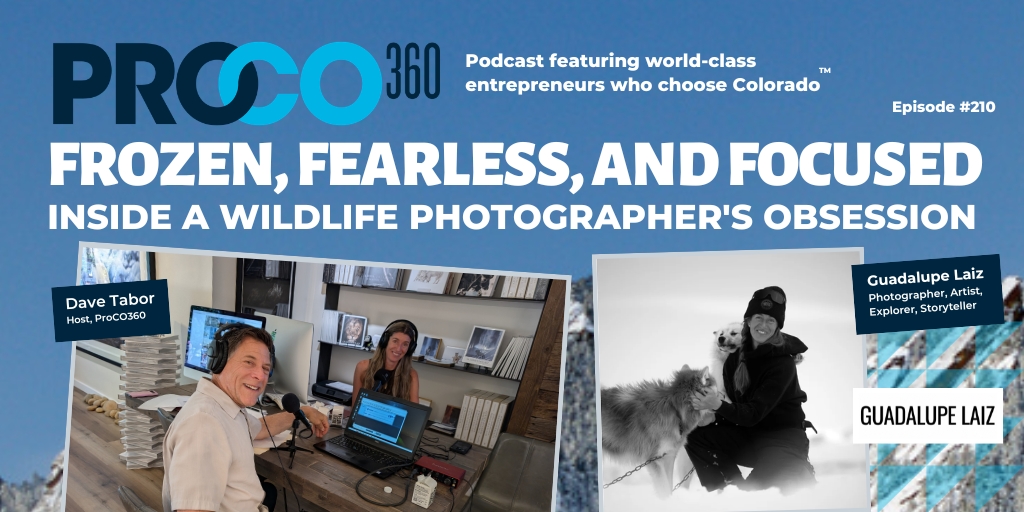
- I first found Guadalupe's work by accident, walking into her Aspen gallery and stopping dead in my tracks at photos of Icelandic horses. I did a podcast episode with her five years ago and I’ve been following her ever since. This time I recorded the conversation in her gallery, surrounded by the work we were talking about — polar bears, Arctic wolves, sled dogs, elephants from Africa, images that are far more visceral than what you and I might see in typical galleries. Guadalupe's path to this life wasn't a plan. She discovered a camera in her house as a kid, moved to the U.S. at 20 with nothing but that camera and a tripod, and stumbled into her signature subject almost by accident — a six-day trip to Iceland to visit a friend turned into five years of sleeping in barns and building trust with horse ranchers. In this episode, she talks about the challenges of her work including camping on Arctic ice at minus 40 degrees and an attack by Arctic sled dogs that threatened her life. She’s an amazing woman and this is a great story.
#DaveTabor#ProCO360#Taborbusiness podcastColoradoColorado businessColorado entrepreneurentrepreneursGuadalupe LaizPassionStartup SuccessThe WHYVision Driven
FULL TRANSCRIPT +
Keywords
Guadalupe Laiz, ProCO360 Podcast, nature photography, Icelandic horses, Arctic photography, polar bears, commercial photography, long-term projects, book series, extreme conditions, wildlife photography, emotional connection, gallery exhibits, entrepreneurial journey, film festivals.
Speakers
Guadalupe (72%), Dave (27%), Speaker 1 (<1%), Speaker 2 (<1%), Speaker 3 (<1%)
I back then I literally was just going from place to place, basically introducing myself and asking people, may I go to your, you know, to your, to your field, and just spend time with the horses, and they were like, absolutely, you can come here, stay here, sleep in the barn if you want. I moved too quickly, and they got my hand, and they got my thigh. We have camp on the ice at minus 40 plus in sleeping in tents with no heat. My fingers might not work in the three seconds of opportunity that I have. I don’t think it’s about the best picture in the world. I’m not aiming to. I never taken any of my photos to contests, like I don’t do any of that stuff. This is the
ProCO360 Podcast, for people who love Colorado and love hearing from Colorado’s most inventive and successful entrepreneurs. Today’s guest is Guadalupe Lays, a world-class nature and wildlife photographer. Several years ago, I walked into a gallery in Aspen and stopped dead in my tracks. The photos of Icelandic horses took my breath away. They were so visceral, a feeling that I didn’t get from other wildlife photographers I typically see. These seem so different that I ended up doing an episode with the photographer and Guadalupe Lays, since then has thrived. She’s grown her business, she’s created photographic series in the Arctic featuring polar bears, wolves, and sled dogs, and sometimes images just of the sheer awe of the region. She’s been deep in Africa, photographing elephants, apes, and giraffes, her work and her mindset have both evolved in ways that I wanted to explore, and so, and she’s still based in Aspen. In fact, we’re in her gallery today, I’m in Aspen, and we’re in her gallery recording here. So, Guadalupe, glad you’re back on ProCO360
Thank you, Dave. Thank you so much. I really appreciate you taking the time to come talk to me again, and yeah, I’m thrilled to be here. Well, you’re good
as fun. My wife, Cheryl’s here. You showed us around the studio and some amazing photos, so we’re going to talk about how you got those and such too. By the way, listeners, we’re going to cover some of Guadalupe’s back story, but if you really want to hear about how things evolve for Guadalupe, go to the ProCO360 podcast in your app, and search for ProCO360 and listen to our prior session. Okay, so following the introduction, Guadalupe, some of the listeners have not, probably most have not heard your prior episode, which we did several years ago. So let’s talk a bit about your background before we move forward, and you came to photography kind of sideways. I mean, photography wasn’t the original plan for you, you were going to do something more responsible, so talk about how you got here.
Yes, I mean it feels like it was literally 100 years ago, but I, and I think so differently now than maybe even when I spoke to you five years ago, but the idea was to definitely go into a more conservative career, I discover the camera in my house, and I really started practicing using it and spending time with it, and obviously I fell in love with it, and the journey was very long, but you know, I never stopped taking photos since I was very young, when I had the camera. Long story short, what happened that when I moved to the US, when I was super young, 20 years of age, I came with my camera, no money, but with the camera in a tripod, really build my, my identity, my character, my career. In a way, it was a long journey. I studied photography, and I, you know, I, I have an education in commercial photography, and I was taking photos before that for many, many years, but definitely was a long journey, and it led me here today.
Guadalupe, you said you know that this whole route through fashion, all that somehow ended up here, but really, when did you get your first idea to say I’m going outside, I’m taking my work outside, I’m going to turn my professional career into natural photography.
A little happy accident, I was in Europe working on a series of cityscapes for a gallery in Paris that was interested in that work that I was doing, and I decided to go to Iceland for six days after literally going from city to city all over Europe, very busy in Musician. That I’m very fond of was recording music in Iceland, and I was very curious to know why he was drawn to Iceland in the first place, and why he was repeatedly going back to record in Iceland. And sure enough, I went to Iceland, discovered the Icelandic horses, and that changed my life.
Were you taking pictures of the man and becoming inspired right on the spot?
100% I mean, the day that I got there, I remember like it was yesterday. This was almost two decades ago now. I got out of the airport, drove out without a plan. All I knew is that I had six days to explore the island, and I saw a little fault on the side of the road, and in that fold is the first picture of my first book from Iceland, and the rest is history.
Wow, you had to go and actually, though, when you went back, asked the farmer or the ranchers if you could photograph their horses, were they did they were they curious?
Yes, this was lucky for me before Iceland became so popular and hot for tourism, so everyone was very chill about things back then. Now they’re, you know, there’s maybe too much tourism, so they’re a little bit more guarded, I suppose. But back then I literally was just going from place to place, basically introducing myself and asking people, may I go to your, you know, to your, to your field, and to spend time with the horses, and they were like, absolutely, you can come here, stay here, sleep on in the barn if you want, and I did that for five years.
Wow, I slept in barns,
I literally stayed with them, I helped them feed their horses, and became a little bit part of the family for a tiny bit of time, and and help them out, and they will just let me do my thing, and it was beautiful. Yes.
Oh, how nice. Now, were you thinking about the commercial nature of your work at that time? You’re out there shooting horses, and
no, not at the beginning. I mean, I did say to myself, I think I want to make a book out of this. I had that vision very clearly, without.. I don’t know where it came from, but I was.. it was very clear to me that I wanted to put together a body of work about the I Sandy Horse. There was no grand plan, there was no.. I wasn’t thinking from a financial, financial standpoint, nothing like that. It was just a natural, I guess, thought that came to me, and I decided to take it very seriously.
Yeah. Now, why books? Because I’m in your gallery, and I’m looking over your shoulder, and there are several beautiful books, and I’ve seen them, and the photos are beautiful, but I think about, I think about photographic art, and I think about what’s on the wall. So, why books?
I am so lucky. Intuitively, I felt like for me to connect with whatever might be a place or an animal, it has to be a long-term project, a long-term thing, and the books really gave me that, because you had to revisit and revisit to build a body of work big enough to create a book, and when I take projects, I decide to do something I kind of like to deep, you know, go very deep into it, and in the books become a very personal journey. It’s not just about the picture anymore. It becomes something much deeper than that. And I always say, you know, if I go to the same place over and over again and I don’t come back changed, then it hasn’t – I haven’t been there long enough. And the books are really doing that for me, so it became the best way that I can sort of express myself with that goes beyond the picture, beyond a piece of art that you see on a wall. It’s kind of like if I compare it with a, with a musician, you know, for them probably completing an album that has a beginning, middle, and then maybe you might like a song, and you’re just listening to that song over and over again, but for the person that actually put that album together, it goes way deeper, right? So that’s kind of how I see it. Yeah,
did you ever want to quit? It’s so cold.
Yes, it is cool. It is cold, but
you’re laying there on the ground. What are you wearing? You’re wearing one of these. Yes, we have all the..
we have all the gear. I mean, very snow pants, under layers, hand warmers. I mean, sometimes you have all these restrictions with weight, and you have so many cameras that you bring with you, but they. I bring lots of weight on hand warmers. You’re prepared, you have the right gear. I have a big challenge now, just because I have a hand that is not working very well, and it doesn’t have circulation, so that’s my new challenge. So,
talk about that.
Yes, so I’m working on my feet. Book is going to be on polar bears. It’s I started at nine in 2018 so almost nine years ago. It’s gone, is called The Lonely Wanderer. I’ve been going to the Arctic back and for every year, some years more than others. Now I’m really pushing and doing a lot of trips. Last year we were finishing a short film that is called The Lonely Wanderer on Polarverse. It’s a 25 minute film that I, that I’m doing with my Icelandic partner, throwing cobbles on. In long story short, what happened? It is a long story, but what happened is that we were trying to come back home, we got stuck in the Arctic, we couldn’t get out, weather got bad, and I was on the site working on photographing the Canadian Eskimo dogs from Baffin Island. These are the original Canadian Eskimo dogs that are in danger of extinction today. These dogs are not like dogs that you will think of as anything that you can imagine as a dog. These dogs survive the same environment as polar bears. They eat the same food, the polar bear seed. They need the rubber seal, the fat seal, to survive out there. They’re extremely strong. They still use them to hunt polymers, and they keep them chained on the ice. These are
domesticated, but sounds like they’re semi wild,
100% semi wild. These dogs, to give you an idea, cannot be loose. They don’t trust these dogs to be loose today. They’re too dangerous to go to town, and it’s a big mess. So, is that there will be a very long conversation to have to talk about this project. It’s a book that comes out in the fall. It’s called Echoes of the Pack. I came back from the ice literally broken hearted. We had a very heavy experience that is going to come out in once the short film is out on the ice with the polar bears. And to ease my mind, I went to continue to photograph the dogs, and long story short, I was tired, I was exhausted. It was time to go home. We were drained, and I continued to photograph these, 120 chain dogs that I’ve been photographing for these past three, four years, and I moved too quickly, and they got my hand, and they got my thigh, and they destroyed my hand, and they let me go after that, and I have no circulation in my fingers, because obviously the damage of the nerves was quite deep. So now my hand doesn’t like the cold. That’s the.. I tried to make a very short version to try to explain. Yeah, so now the challenge is it’s not so much my body now. It’s kind of funny how you step to a whole different level. You think that the discomfort is the cold, but now the discomfort is that you have a hand, that the nerves are all destroyed. So now you had to deal with that. But well, I was going to
ask you if this ever feels dangerous as a job, and it sounds like, yeah,
yes. I mean, I never had an issue because we are very respectful to the animals and we don’t push our boundaries, we don’t move too fast, we don’t do anything that might trigger an animal to basically give you any kind of warnings that they’re not happy that they’re you’re in their space, so I’ve been very aware, and I learned that long time ago, and I’m very proud to say that we do things very respectfully. This was my mistake. I was tired. It was time to go, and I moved too quickly, and that was, and that was it.
Wow, yeah. So that must have been frightening,
very much.
Yeah,
I’m very lucky to be here, to be honest with,
really. Wow, yeah, those dogs could have..
there was no doctor to go to either. So, yeah, it was.. it could have been.. it could have been the end for me, for sure. I’m not making it up yet.
Wow, yeah. When I look at your photographs, there are 1000s of wildlife photographers, so do you try to differentiate, or is it? Does it just happen?
No, no, I’m very lucky. I suppose I do what I do. I try not to follow too many photographers. It’s hard when you get to meet so many in your travels, not to stay engaged, and I don’t want to compare. It’s very difficult, because there’s so many talented photographers out there, but I found a way to follow my heart and my intuition and do it in a way that this speaks to me and touches me. And then, if people like it, great, but I honestly took a very different approach. I feel like in the way that I’m presenting the work, if you will.
So, do you do you know photographers that you share ideas with, or even skills, or anything like that? Are you just.. is it better to go it alone?
No, I kind of like to keep it to myself, I. Yeah, there are a lot of other photographers that are way more technical than me, way better than me. I am okay with that. I don’t, I want to keep it. I want a white canvas as much as I can. Yes, I don’t want the comparison. I don’t want to see too much what other photographers are doing, and it’s been working well for me, it keeps it pure, it keeps it honest, it keeps it is a reflection of myself in a way, and sometimes it’s hard to see it with photographs, because you’re just taking a picture of something, it’s not like a song that comes from within, but if you go deep into it, there’s always different ways of doing it, so
yeah, I would think that if you and I saw the exact same image, that not only would your skills be better, but even the way I frame it, even the way anything, I just, you know, that’s that’s the talent that you bring, right?
Yes, I mean, sometimes I think I’m an awful photographer, honestly, I doubt myself a lot, I really do, I really do, I really do. I don’t think, like I said, somehow my journey has taken me in a journey that is not just about the photo, and I’ve been writing a lot lately, so my new book has a lot of poetry in it, and it goes way beyond the picture.
Yeah, it’s funny that you say that, because I was looking at your Facebook posts recently. Oh
boy,
and well, but I was like, my, my thought was it sounds like she’s becoming more poetic, that you’re working, you know, and and I had a couple that I took, I did some screenshots. Here’s one. It says, perhaps I don’t go into the wild because I feel connected to animals. Perhaps I go because in their presence I finally feel connected to myself. And then there’s one that sounded even more poetic, which was you wanted to be trusty and true, but feathers felt from our wings, so talk about this. It sounds like you’re moving in that direction,
I guess. I, it’s always been there, I just never put it out there, because my, my muse has always been music, and music deep lyrics, that’s been my thing since I’m very young. That’s kind of what I’ve been attracted to, and inspire me so much in my life. Music, I play music, but just for fun, for myself. And I guess now I’m just getting a little bit out of my shell and putting some thoughts out. It’s very dangerous for me, because I was like, I wonder what he’s gonna pull out, because sometimes I’m going to bed and something comes out, and I just write it off.
Well, but you always accompany it with your photos.
Yes,
so that’s good. So, is this when you think about who you were as a photographer five years ago? First of all, you say you don’t really follow a photographer, so are you? Are you improving your skills? Do you work on improving your skills, or have you shifted your mind to, you know, the subjects, and you don’t worry about the skills?
I don’t worry so much about the skills. It’s a great question. I do need to keep up, and some working in the Arctic is very different than let’s say working in Africa, so I need to learn how to, you know, put a camera upside down and put a monopod down on the ice in the best way I can, so I can photograph a polymer from low angle things like that, but it all comes from things that I already know. I’m a very graphic photographer, so for me it’s not, it’s not even about lighting, sometimes it’s just the moment that I’m, you know, there’s always room for a lot of, you know, you know, learning and just doing things better, but for me goes again, it goes way deeper than that. I don’t think it’s about the best picture in the world. I’m not, I’m not aiming to. I never take any of my photos to contests, like I don’t do any of that stuff. Most photographers really want to win all those competitions, the big competitions, and get the, you know, the front page of Nag Geo. I have no interest in that, and that’s okay, I think there’s true for everybody. Well,
I’m going to take a quick break, and then I want to talk about Africa a little bit. I’m going to remind listeners, this is ProCO360 voted best Colorado business podcast since 2021 I’m your host, Dave Tabor. This is a podcast for people who love Colorado and the stories of Colorado businesses and entrepreneurs, my guest today is photographer Guadalupe Lace. Hey, I want to thank our sponsors, Via Technologies host, ProCO360 Really appreciate the help your team gives me. And by the way, Via has built a very nice business. They, they kind of recruit really smart clients who can then partner with them to achieve some great things around client. Growth using web-based technology, digital marketing, and so forth. Also, my friends at Denver Ventures, we partner on some episodes to feature great Colorado companies. So, all right, you mentioned that Guadalupe, that the Arctic, which seems so interesting, is a lot different from Africa. So, talk about that a little bit.
Very different. You couldn’t be more out of your comfort zone than being in the Arctic. I mean, I just.. I think it’s the hardest thing I ever done, like.. like I don’t.. I don’t know if I could ever do anything harder than the Arctic. If you’re camping on the ice, we have camp on the ice at minus 40 plus in a sleeping in tents with no heat, being out all day, no showers, obviously trying to keep yourself warm enough for when the right moment arrives, which you never know if it’s going to be 10 hours, being out in the field, and you’re already shutting down, like literally shutting down your body, shutting down yourself, it’s very difficult sometimes. You’re so nervous, sometimes I don’t sleep for weeks before a trip because you’re thinking about these things that you cannot control, which is obviously not very smart, right? My fingers might not work in the three seconds of opportunity that I have to get it. Does
that happen?
Of course it has. Yeah, really. Yeah,
as soon as the shot comes, all of a sudden your fingers can’t work,
yeah, because your fingers get numb, and you can feel them, and you cannot press the trigger. Wow, it sounds insane, but it’s so true. Yeah, just
do you ever feel heroic being out there? Sometimes I watch, like, news people or weather people, and they’re standing in the middle of a storm, and clearly they just, they think a lot of themselves in this heroic scenarios, you know, you’re not at all, no,
not at all, no. If you spend a lot of time with animals, you, it’s very humbling, you realize how safe we play it. We really do. I truly do think that. In no, not at all.
What about when you’re in Africa? Do you ever feel in danger. Do you ever feel that these shots are putting you in harm’s way?
No,
no,
no. And we also do things in a way that is safe, and more so thinking about the animal first, so you never want to get in a situation they are pushing too much. That’s important.
Yeah,
of course, I like proximity. I like to get as close as I can, but we always do it with respect. I have been as close as we are right now, which I don’t know what that is. I don’t know to the head of a lion in front of me, and, but you know, you had to read the situation in and know when is too much. When can you do it? If the animal is relaxed, if the animal.. it depends on the situation, right? It’s not the same, an animal has their calves, or is mating, or is actually hurt. If an animal is.. it depends on the situation. But yeah,
well, so, as we kind of wrap, I wanted to.. I wanted to ask you about the experiences here in the gallery, you’ve been quoted saying sometimes your customers will cry when they see photos and things. I mean, what is your job in curating the gallery and helping customers find photographic art that that’s right for them?
I’m not very, I’m not a very good sales person. I just tell the stories, and I’m very honest. I try to.. I don’t know if it’s a practice. You will tell me you’re.. you’re the smart guy.
Yeah,
I think it’s a practice, practicing to being as honest as you humanly can be. I like that. I don’t want to.. yes, of course, I need to sell art. This is how I make my living. This is how I do my trips, and, but, but I like to listen, and then, and then guide them through it. I only share my experiences, and that’s really, truly all I do. People sometimes ask me, I feel so afraid of these animals, but then I feel so drawn to them, and so move, and I always go back to the conversation of the lack of connection that we have with the natural world, and that’s where all I think it comes from, this fear, all these feelings that people have, and I don’t know, I try to go deep into that conversation sometimes when, when I have the time,
but people, people like that. I mean, that’s what draws them to art, isn’t it? Is to hear from the artists.
Yes, and it’s lovely to hear all the stories, because for everybody it hits a different spot in them, like it’s different for everyone. And
by the way, listeners, we were talking before we even started about what it takes to even display your art. I mean, you can spend several $1,000 simply to produce frame and so forth. I mean, you’ve got well into the six figures of inventory in your gallery. You also have to invest, I don’t know, what does it cost to go on a.. how long are your trips to Africa or to the Arctic?
Oh boy,
they’re weeks, right?
You can easily spend.. I don’t know, I don’t.. I don’t know if talking about numbers is a good idea, but like, you can easily spend $40,000 on a trip,
yeah,
or more,
yeah, yeah. And so, so you know, and I think about.. and because this is an entrepreneurial show, at some.. at some point, you know, I think about what’s involved in investment on your behalf to even bring these, these pieces of art to consumers. The
honest truth, I think, is God in the universe has gifted me with this opportunity, because I gave it all. I risk everything from the very beginning, everything that I will make, I will put it back into it, and it just worked, because I invest so much into making the books, and one more trip, and we’re missing this, and I think it all comes back to me. I don’t know, I, yeah, I don’t know, there’s some magic there that I don’t understand. Yeah, but
you’re one one person. Do you have others? Do you have staff? Do you have others on your team?
I have employees, they, they come and go, and it’s not easy. It’s not easy in Aspen to have consistency with, with, with employees, and so on. I have people that help me, but I’m literally the core of everything behind this. Yes,
and there seems like you like it that way.
Not necessarily. I would like to be able to have a little bit more balance, but I’m not a.. I’m not scared of cleaning the floor when I had to clean the floor. If no one is coming to open next day, it’s just.. it has required a lot of me to make it this far, and I’m okay with that. I think I think being humble is very important. It doesn’t matter if it’s a tricky thing. We have celebrities coming here and buying the work, and so many names that I can throw out there, and it’s very impressive, right? Like, it’s just incredible that people love it and take it home, and, and it’s quite expensive, but I think it’s a, it’s a beautiful thing to come from, so humble, because you’re not afraid to do the dirty work as well, you know, so, yeah,
yeah, so I was curious, before I wrap up, to after you go to a shoot, you might have, after you’re out for weeks, you might have 10,000 photographs. You may have, you personally go through all of those, of course, and choose the ones you like. Is there post production done on them?
No, no, no. I keep it. If I had to spend more than three minutes editing a picture, it means that it’s a bad picture. No, no, no, no, no. I, my work is very simple. The commercial work really helped me to frame whatever I want the picture to be, try to frame it, you know, as it is. The composition just to be what it is. The only thing that I tend to do is desaturate my tones on on digital photography. I don’t like loud, but no, it’s it’s a simple process. Yeah, so
interesting. You desaturate because so many wildlife photographers or nature photographers seem to over saturate, and then they print them on metal. I mean, they want it to scream in my, yeah. And you’re cringing a little.
Yes, yes. And the natural world is very.. I don’t know, it’s very harmonic. I don’t, I don’t, I don’t like very loud, but I don’t like loud music either. So, I think I just goes well with kind of how I see things and what I like.
So, what’s in front of you now?
In front of me,
yeah. Projects, next developments,
there’s a lot going on right now, so I don’t know how I’m going to honestly juggle everything. I’m trying to find good people to be part of my team and help me with the business side of things right now, because I have a little short film coming out. We’re going to bring it to film festivals, where we’re very proud of what we created, and it’s very, it’s brutal, it’s honest, it’s very exciting. So it’s very exciting. I think it might be a turning point in my, in my journey. This short film that we have
in the topic,
the lonely one that are we filming the Arctic, is about the polymer, but it became about me, and it became about a reflection of everything, really. It’s is deep. deep, it’s very honest, it’s nothing like you will see, it’s not a documentary about polar bears, it’s nothing like that.
And
then, yeah, I have a book coming out in the fall, because of the pack, the Canadian Eskimo dogs from the Arctic, and we’re trying to figure out how to open another gallery in Houston, which someone is helping me with that right now, so hopefully we can make that happen. There’s so much that we’re working on, so yeah.
Do you have a the next photo shoot that you’re looking forward to the very most?
Yes, I go back to.. I came back from the Arctic 20 days ago. I go back to. Greenland in a month, in a month, and change the 18 of algos. I go back to Greenland. I’m trying to photograph those gigantic icebergs for transition photos that I need for my book, The Lonely Wonder. And there’s a couple of years that we’re going to go to that we know that some polymers are roaming around that area, so we’re going to try to do that, and then I go back to Zavala in September, north of Norway, so more polar bears.
Wow, that’s
what I’m working on. Great.
Well, I think we’ll end on that note. And what a great conversation. I’m your host, Dave Tabor. And today on ProCO360 you’ve been listening to my conversation with photographer and entrepreneur Guadalupe Lace, great getting back together and getting updated on everything you’re doing.
You’re so kind. Thank you, thank you, thank you. You’re
welcome, listeners. Glad you’re here on ProCO360 where we say live, work, love Colorado, because you and I and my guests can be successful anywhere and choose Colorado. You make the show successful by subscribing to the ProCO360 podcast, and if you haven’t yet, it’s a huge help if you submit a review in your app. Thanks again to show sponsors via Technologies and Denver Ventures. That’s the show Live, Work, Love Colorado,