

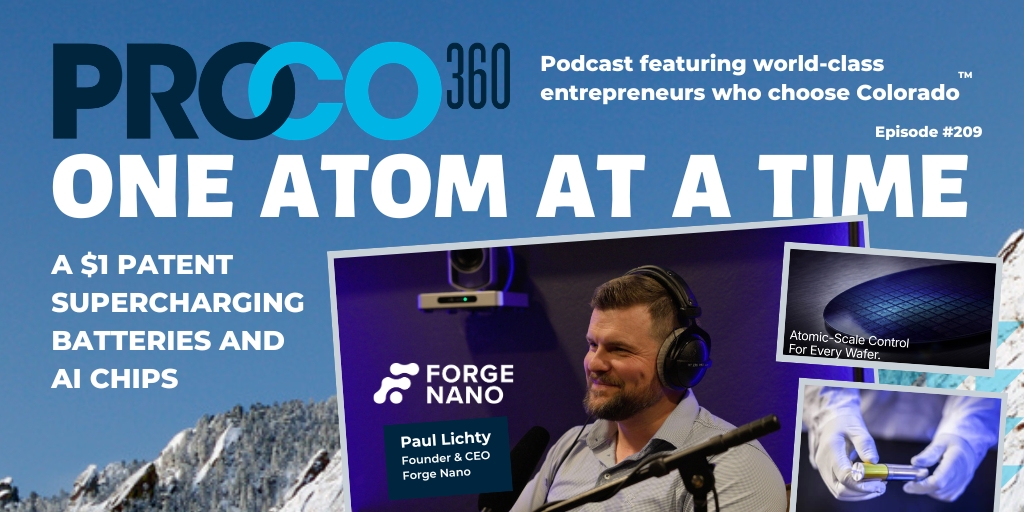
Whatever gets exposed gets one atom on it and then the process shuts itself off…”
Paul Lichty, Founder & CEO, Forge Nano
One Atom at a Time
- A $1 patent. A $1.6 billion company. That gap is what happens when a brilliant team takes an overlooked technology and figures out how to run it at industrial scale. Paul Lichty, CEO of Forge Nano, joined me to explain how his company deposits a single atom of coating on a surface – and why that one atom matters enormously to battery manufacturers and AI chip makers. I tried. I really tried to understand the science. Paul was generous in walking me through it, and I nodded a lot. What I walked away knowing is this: the applications are enormous, the momentum is real, and the story of a $1 patent becoming the foundation of a unicorn company is one of the best I've heard. You'll finish this episode smarter than I am about atomic layer deposition – which isn't hard – and genuinely impressed by what's being built right here in Colorado.
Paul Lichty 0:05
But yeah, ultimately it’s whatever gets exposed gets one atom on it, and then the process shuts itself off after a single monolith, and that tactical advantage of my battery lasts longer or it’s safer, I can have more power, all of that is absolutely critical in those markets, and those are those are your first adopters.
Dave Tabor 0:27
I didn’t realize that what you do enables batteries to be that much better than chips to be that much more powerful.
Paul Lichty 0:38
No, early on there would be, you know, seven days a week, 12 hours a day. I remember going straight at that for about four months, and then I said, I gotta take a day off. This is the
Dave Tabor 0:51
ProCO360 podcast for people who love Colorado and love hearing from Colorado’s most inventive and successful entrepreneurs. Today’s guest is Paul Lichty of Forge Nano? Paul started with an idea that the University of Colorado’s own tech transfer office said we’re not so sure we want that, so he bought the rights for $1 and started building in his Westminster garage. What he’s built is now one of the world’s leading atomic layer deposition companies. And what is that? We’ll talk about that, and here’s the idea, though. Imagine coating a material one single atom at a time, maybe not one at a time, but one thick. Anyway, we’ll get into that. He’s creating a layer so thin it’s invisible and so precise it transforms how materials perform. Forged nano does this at an industrial scale, making batteries last longer, semiconductors perform better, and all kinds of advanced materials stronger and more durable. They’ve raised over $100 million from investors like GM, Volkswagen, and LG, and they’re doing it right here in Colorado. So, Paul, welcome to ProCO360
Paul Lichty 1:58
Thanks so much for having me.
Dave Tabor 1:59
Yeah, and I, you know, I say this is, and I told listeners, I told Paul, coming into this interview, like, these are really challenging for me when I don’t understand nano physics, particle, whatever, like, these are tough, so I prep and I prep, and I walk in ignorance, so I gave an intro, help us understand better what Forge Nano does,
Paul Lichty 2:19
yeah, yeah, I mean, it’s a, it’s a, without going too far into the physics and the chemistry, it’s a process that allows us to do perfect coatings and kind of perfect manipulation of matter, and that’s part of what was attractive to me, learning about this going through school, is it’s, it’s the best way that we have the science and physics available to us to build things and I always love building things, and so you can’t pass up the perfect process for building materials.
Dave Tabor 2:50
Well, building them one atom at a time. Okay, so for a lay person, why do we have to be able to coat things so, so precisely as to like an atom thick,
Paul Lichty 3:01
well, it really gets into having the maximum capability. So, for instance, when we coat materials that go on lithium ion batteries, we’re putting a protective coating on, and that’s important. But if you get too thick, you can’t have the lithium ion transport, so you lose the conductivity. So, there’s always this trade off with with thickness and performance, and that’s where a perfect coating process or an atomic level process unlocks more capabilities than you would have otherwise available.
Dave Tabor 3:33
And is this really a single atom thick?
Paul Lichty 3:35
Yeah,
Dave Tabor 3:36
so I’m picturing that there was this video made a few years ago where IBM had somehow man managed to manipulate atoms into the IBM’s, like you can do that
Paul Lichty 3:47
more or less. The function is of the chemistry is to do one atom thick on everything, so it starts with a really reactive what we call a precursor, and that just bonds with every single available surface. Now there are ways to pattern, there are ways to mask, so that you can start doing that with a lot more control. But yeah, ultimately it’s whatever gets exposed gets one atom on it, and then the process shuts itself off after a single.. wow.
Dave Tabor 4:17
But again, I don’t know anything about this stuff, but atoms can’t actually sit next to each other, bam, bah, bah, bah, can they? They have some natural spacing, right?
Paul Lichty 4:26
So it depends on what we do with it. Single atoms deposition, their positioning is controlled by what we call the ligands that stay attached to it. So it’ll come, and I’m for the audience, I’m using my hands here, but if you imagine you know atoms attached to this umbrella of other molecules that allow them to be in the gas phase, land on the surface, and then that umbrella keeps them from getting too close together or bonding. It really is what shuts off the whole rest of the surface from doing more than a mono layer.
Dave Tabor 5:05
All right, so is there any way for someone like me to understand how this process works?
Paul Lichty 5:12
It, you know, I like to use the analogy with Lego. You know, everybody has – I’ve got kids, they love Lego, but, but the really fun part about that toy is after you’ve built the things and then take it apart, what they can do with just discrete building blocks, putting it together to build something really amazing. Both my kids have built things that I don’t think I can reverse engineer, just coming, coming right out of their imagination, and that’s what gets unlocked with how we’re able to do this atom by atom for making materials. There’s a lot of applications that we haven’t even discovered or that people are working on in universities across the world using this technique, which unlocks that ability to be creative and use your imagination to build whatever surface you want.
Dave Tabor 5:59
So, when you were back at CU in the lab, what year were you when you started working on this stuff?
Paul Lichty 6:05
I started working in my undergrad, maybe my junior year, so I was about 20 years old, and that would have been 2024 2025 Okay, sorry, 22,004 2005 Okay.
Dave Tabor 6:19
Oh, okay, got it all right, so because the company started in 2011
Paul Lichty 6:23
yeah,
Dave Tabor 6:23
right. Okay, so one more dumb lay person question. Then I’m just listeners, I’m just going to give up. But how, when you’re in a lab and somebody says, “Hey, wouldn’t it be cool if we could make single layer atoms line something right? And then the question says, well, yeah, it’d be cool, but how do we do it? So, what at a macro level is happening when guys like you say, ‘Hey, how do we make that happen?
Paul Lichty 6:49
Well, I mean, we lucked out and really stood on the shoulders of giants, if you will. This process was developed probably 60 years ago, and so when I entered into the lab and started learning about something that we were using mostly from an R and D standpoint, if we wanted to make a new catalyst rather than getting your chemistry set out and trying to figure out how to synthesize it and get it on the substrate and purify it, there were all these molecules that have been known that create this mono layer that we could just buy and put them in our specialized reactor to make the product that we were looking to make. It’s kind of like 3D printing with atoms,
Dave Tabor 7:33
got it? So now I’m starting to put it together, because the real secret, the secret sauce for Forge Nano, is not that you know how to do this, but that you can do it quickly, that you can do it as part of a production process that makes it practical now going forward, right? Talk about that.
Paul Lichty 7:50
Yeah, as you can imagine, if you’re going to build something atom by atom, it can take a really long time. Yeah, and that’s where it’s been kind of a process of last resort for industries like the semiconductor, where transistors have shrunk down, now they’re seven atoms thick, the dielectric gaps, so you have no other option than controlling things down atom by atom, and the main issue by taking this and applying it to every other product you can imagine it has been scale the speed and the pricing and the magnitude that you can achieve by doing this, and that’s really what we developed, was just processes, equipment, sometimes special, specialized different components that allowed us to take this to the next level, where the costs of doing this become oftentimes cheaper than what they’re currently doing.
Dave Tabor 8:45
Okay, and in a minute we’re going to go into the two main product lines you’re focused on, batteries and chips. But first, I’m intrigued by this brand name that you have, called Atomic Armor. That’s a cool name, and in any other world it wouldn’t really mean a ton of armor, it would mean some kind of a fitness drink or clothing or something. So, how’d you come up with this? It’s pretty cool.
Paul Lichty 9:08
Yeah, we were several drinks in with some investors of mine, actually on Pearl Street, and just trying to think of how to take what is, as you’ve identified, a complex technical product, and even you know, saying atomic layer deposition is a mouthful, that’s usually when I see investors’ eyes roll back into their, you know, to the back of their head, because there’s just a lot going on there. How do we summarize this into something that that conveys what it is we do very succinctly, and we came up with most of where, where we apply our coatings is protection, and you know it’s atomic armor.
Dave Tabor 9:45
Cool. All right, I want to go back a little bit, because is it true that, that I mean, so many good ideas come out of University of Colorado engineering, and so forth, they can’t take them all, but this is one that they passed on, and. You bought for, is it true? You bought it for $1 and now you’ve raised, you know, you’ve got an over much, well over a billion dollar valuation. Is that all true?
Paul Lichty 10:08
Yeah, yeah, I mean, there’s some, there’s some caveats there. We do still have CU on our cap table, based on some in licensing of IP and other transactions that happened. Well, that’s since we started, but so yeah, the buffs are going to benefit from what we’re doing. We’re happy to see that, but yeah, originally the original IP around a scaled up process, they passed, and we had kind of hit a deadline with when you have to submit to the patent office and you have to provide action, and so it was going to cost money, and we said, all right, we’ll get the money out of our pockets, we’ll hire the lawyer, and we’ll move the thing forward.
Dave Tabor 10:47
So, this is where some of these things just die if they don’t have enough momentum, and someone doesn’t, isn’t willing to invest in the patent, they just either, they don’t necessarily die, but someone could take
Paul Lichty 10:56
it. Yeah, yeah, once you disclose to the patent office, you have a provisional period, yeah,
Dave Tabor 11:02
like a year or something, right? Okay, and then
Paul Lichty 11:04
you kind of have to, you get feedback, but you have to continue to pay the legal and the filing fees, etc. to get a real patent finally issued,
Dave Tabor 11:13
okay? But now, when you started this back, I mentioned in 2011 you were designing what was going to be a technology to unlock production for products that hadn’t actually become invented particularly well at the at that time. I mean, for lithium ion batteries, they weren’t a thing then, or they weren’t much of a thing. Same with the kind of neat, I mean, chips, of course, were there, but not these multi-dimensional, teeny-tiny chips. Like, so, did you know this was coming, or did you just like the technology?
Paul Lichty 11:43
It’s kind of a little bit of both. We see it as an inevitable step if we’re going to continue to make better and better products. Anything you can think of eventually will get to a point where you’re unlocking additional performance or reduced costs or new capabilities by having the capabilities of, you know, building it atom by atom. It’s that’s just kind of 2011
Dave Tabor 12:07
It became obvious that at some point it was going to get so small it was going to be atomic layer production.
Paul Lichty 12:14
I mean, that’s the natural course of things. If you look at Moore’s Law, everything is shrinking in order to keep up with the number of transistors and more, you hit this fundamental limit, which is a single atom. We don’t have the ability to put down half atoms,
Dave Tabor 12:29
not yet. That’s 50 years. Are they going to look back and think we’re prehistoric? And
Paul Lichty 12:35
I mean, like I said, that goes beyond my physics know-how. There may be some things that come up, but I think there’s so much white space still in what we do, unlocking new capabilities, new technologies. Anything that that is really outside of a semiconductor product is is that uses atomic layer deposition is enabled via our equipment and capabilities, and that’s a, that’s a pretty neat place to be. Yeah.
Dave Tabor 13:03
Okay, so I want to talk about both of your main project or product focuses. By battery, is that accurate? Batteries on one hand, chips on the other hand. Okay, so complete this sentence before Forge Nano lithium batteries could only be made such and such. Now this is the outcome,
Paul Lichty 13:21
sure. Before Forge Nano, lithium-ion batteries suffered from all these side reactions that cause your phone to die after two years, and your electric vehicle to lose range. When you protect the materials, what we’re really doing is just shutting down all the unwanted reactions, or slowing down the unwanted reactions, and enabling the ones you want, which is just lithium going back and forth. If there were no side reactions, your batteries could last forever.
Dave Tabor 13:50
So manufacturers must hate you. You’re making, you’re making batteries last longer, you’re making phones last longer, you’re making car like
Paul Lichty 14:00
there are markets that do not appreciate a longer lasting battery, that’s for sure, but that’s also why you know our go-to market strategy has been around the marketplaces like defense, aerospace, satellites, where longer lifetime adds a significant amount of value,
Dave Tabor 14:16
that makes sense, and I could think, though, that there’d be some markets like, yeah, we don’t need to pay more for this, that actually hurts us. Although that didn’t work so well for Kodak, it didn’t work for others, right? That, but because you can, I mean, sheltering yourself, your customers from a better product probably isn’t a good long end game.
Paul Lichty 14:35
That’s how we think, you know, we want everybody to make products that can last forever and maintain value, but yeah, we have, we have a certain consumer culture. Yes, yeah, it doesn’t always line up with it.
Dave Tabor 14:47
Okay, so finishing the battery piece, if a battery would have lasted two years with normal use, with if they’ve been built using your technology, how long could they last?
Paul Lichty 14:58
So we, we’ve done the head to head. It with things like cell phone batteries, it’s at least four to five years. We have a product that was on one of our satellite missions that actually, after three years, there was no degradation, and so we don’t know how long that was going to keep going, or if something else was going to was going to cause that degradation, but our ability to protect the product, and you can either exchange that for longer lifetime or more rigorous abuse, fast charging, or you can unlock more of the lithium that’s in it and get more energy density.
Dave Tabor 15:33
That’s pretty amazing. You also then would have a profound impact ultimately on landfill usage, disposal of all these kinds of things that people like, what are we doing with these? Wow,
Paul Lichty 15:44
and even in recyclability, we’ve worked with companies that do recycling, and we’ve shown that we protect the underlying material. Now, the lithium comes out of, let’s say, your cathode, and it goes back and forth, and it can get lost in the battery a lot of different ways, but the underlying cathode material, when we coat it, is protected, so you can just relithiate it, and it goes right back up to 100% which, for conventional recycling, right now you have to take it all the way back down to the base metals, you have to rebuild the cathode material, and then you know make it again,
Dave Tabor 16:19
I’ve never heard the term relithiate, but here, here we go. All right, so I want to ask you about the chip technology, because that’s even more profound. But first, I want to take a quick break and remind listeners, this is ProCO360 named Best Colorado Business Podcast since 2021 I’m your host, Dave Tabor. This is the podcast for people who love Colorado and the stories of Colorado businesses and entrepreneurs. My guest today is Paul Lichty of Forge Nano. Want to thank our sponsors, these guys are great, I appreciate them. Via Technologies, they host ProCO360 and their great help at keeping the website up and running. They are building a growing business by working closely with really smart clients to partner on achieving client growth using web-based technology and digital marketing. Also, my friends at Denver Ventures, we stay in touch and we partner to feature some great Colorado growth stories as well. All right, so I want to switch now to two chips, because to me that’s, I mean, you’re enabling AI to do some things, AI chip makers to do some things that they never could do before. So, talk about that.
Paul Lichty 17:29
Yeah, the semiconductor industry is really the first commercial industry to start using atomic layer deposition, and that only started about 15 years ago in earnest for high production, because again it’s kind of a process of last resort, and then when you have to get seven atoms, you need to use very precise processes, but what we did with our experience coding things like particles or high surface area objects, we were able to take that high throughput innovation, apply it back to semiconductors, so now we can do the same ald as everybody else, but we do it much faster, and we can do it at that speed with very high what I’ll call aspect ratio features. So, if you think of really tiny straws, in order to get your atoms all the way to the end of that straw to react and coat can take a very long time via conventional ALD. We’ve innovated ways to drive that much faster. So, what we highlight in some of our press releases, we talk about aspect ratio, and the current state of the art is probably a 10 to one aspect ratio. So, a straw with a diameter that’s 1/10 of its length, we’ve been able to show 1000 to one aspect ratio at high speed, and so what this means is the ALD step is no longer the bottleneck in your total fab process, and you can make much smaller features, and so for things like AI, it’s not so much how many transistors you can put on there, it gets down to the advanced packaging and your ability to conduct in an overall chiplet between the processing, the memory, the sensors, rather than conducting electrons. The analogy we use is driving to your friend’s house across the neighborhood, there’s tiny little wires that have to conduct there, and you get losses and inefficiency and heat stacking packaging, which is kind of this holy grail of semiconductor packaging. It says, okay, instead you’re all in an apartment building and you just take the elevator up, it’s a much shorter distance, there’s less heat, less loss, less resistance, but that’s only enabled if you can make these tiny little straws and fill them with with conductive metal,
Dave Tabor 19:44
it’s hard to even conceptualize.
Paul Lichty 19:46
Yeah, it’s too small. Okay,
Dave Tabor 19:49
so how do you, you charge by the atom, or what? How do you, how do you charge? You can’t, I mean, you can charge by the chip, I mean, essentially you’re installing. Sort of process that they use, so do you charge to licenses? Do you charge to it? So, how do you make money at this?
Paul Lichty 20:06
So, in the semi industry, everything’s done in a fab, which is in a clean room. It’s very controlled, so we sell our equipment that allows them to do this process and do higher aspect ratio or do higher throughput. We sell them our equipment, similar to a competitor’s piece of equipment that won’t be able to do all those things, and that gets installed in the clean room on their clusters and has to meet up with their control systems. It’s a whole production.
Dave Tabor 20:30
Well, yeah, but clearly then if you’re selling the equipment, you got to build it first, hence the going public. But I mean, you got to raise a ton of money. What’s it? I mean, you can’t tell me exactly, but piece of equipment must cost millions of dollars.
Paul Lichty 20:45
Yeah,
Dave Tabor 20:45
and you know, are can you have, I guess, on something like this, even if you’re selling the equipment, I’m sure there’s service, there’s all kinds of other things that go with it. They keep some perpetual cash flowing, but, but on something this proprietary and this exciting, the margins must be okay. I mean, yeah, I mean, it
Paul Lichty 21:05
does depend. A lot of manufacturing is has been driving towards cost reduction. I know that’s what
Dave Tabor 21:13
I’m asking. Yeah,
Paul Lichty 21:14
yeah, and that’s like our equipment, we sell for the same price of some competitors piece of ald equipment, even though we could process 10 times the waivers, and the reason we do that is because when you say, hey, buy, buy, they’re looking for a car that’s going to take them to a to b, and when you’re in a bb process, it doesn’t necessarily matter if that car goes much faster than the other one that gets them to the same spot, so there’s a lot more product development and customer development that we have to do to not only convey the value but then prove it and show it, and then that value comes over time as we get more market share.
Dave Tabor 21:51
I would think as this becomes proven as the way to go, that you’ll have a much better chance of much better opportunity to sell for what its full value is, rather than just knocking off your competitor, you know, with a better product.
Paul Lichty 22:05
Yeah, we, so we hope so too. Yeah, I’m sure your investors
Dave Tabor 22:08
do. All right, I want to, I want to switch entirely from the subject of the technology. I knew I was going to get just sucked into this, but and when we’re done, I got one more question. When we’re very done, but we’re not, so talk about, I mean, you went from being a PhD student to having a PhD, but you’re working in a lab, now you become CEO of a company with just a few employees, and now you got to see, now you got 100 and some employees, right? So talk about that transition from being the scientist guy tinkerer, which you start out as, to being what you are now,
Paul Lichty 22:41
yeah, and they, you know, if you read a lot of the books, it’s often a difficult transition to go from kind of engineer founder or innovative founder to running a company, and we were just saying it’s shifting from having a team of firefighters that know how to solve problems and innovate to more of a team that knows how to do the same thing over and over again, finding those small efficiencies, and it’s a slightly different mindset. I think what has helped me to stay where I’m at and still enjoy it is just finding the innovation in every step of the process. You know, it’s not always going back to my engineering roots and designing, you know, new valves or something, but it does when we get a process built out, an assembly line, and being able to innovate ways to do it better and better, you know, that’s still very exciting for me.
Dave Tabor 23:34
Yeah, but as far as the leadership piece, I mean, to go from, I mean, let’s face it, you probably, well, maybe you don’t, but I would assume you know as much about this product and how it works and how it’s built as anybody on the team, that’s not your job anymore, right? Is it?
Paul Lichty 23:49
No, unfortunately. Yeah, so talk about if I go on the back there, there’s somebody watching to make sure I don’t touch a wrench.
Dave Tabor 23:56
Yeah, so how does that, but mentally, like it’s a mind shift,
Paul Lichty 23:59
yeah, yeah, 100% The things I do are more focused on what’s, what’s, what are the important things that have to get done with within the company to keep it going, so I can enable my team of people that are even smarter than I am to keep doing the innovating. And that is, that true?
Dave Tabor 24:16
If they were smarter, wouldn’t they have been in that lab?
Paul Lichty 24:19
I know, I think a lot of it is right time, right place.
Speaker 1 24:22
Yeah,
Paul Lichty 24:22
and really, in a lot of ways, probably being too stupid to know how hard it would be to start a company and go it on my own, you know.
Dave Tabor 24:31
Yeah, but you’re not on your own now, and I have investors, and you know it seems when investors get involved, and even good investors, their pace and their focus is often different from what might be comfortable for a technology-driven founder, right? So, how do you talk about that? How do you deal with that? And so, yeah,
Paul Lichty 24:52
we’ve most of our early investors were actually strategics, and that I think was more beneficial than maybe. Typical venture investor, because we were working with them on learning how to apply this to products, learning about the product product cycle for them, and how they think about going to market, so we were able to think a lot more about how this gets out into the market versus just I’ve got a cool tech and I better, I better make $100 million in revenue next year. Otherwise, you know, our funding is going
Dave Tabor 25:26
well. I was just talking to somebody not dissimilar from you, a guy who formed a new technology at CU, and who had strategic investors, but the investment wasn’t enough money from them. You’re laughing. What am I going to say?
Paul Lichty 25:43
I mean, it’s never enough money. No, that’s okay.
Dave Tabor 25:45
No, what I was gonna say wasn’t enough money from them to make them necessarily lean into deploying what they had invested in. They didn’t have enough vested, like, and it was disappointing for him because he was hoping that these strategic investors, right, we’re gonna be leaning in with them. You haven’t had that problem.
Paul Lichty 26:09
Well, yes and no. I think it was, it was very good at highlighting, for instance, we have a number of car companies or companies that supply in that auto supply chain, it was, I think, valuable for us to learn early on how long it takes for a new technology to actually get into the supply chain for those companies,
Dave Tabor 26:33
but they also, oh yeah, so even though you’re ready, they might not be, even though they’ve invested to be alongside you. They might not be ready to just say, “Come on, we’re ready too.
Paul Lichty 26:44
100%
Dave Tabor 26:45
wow, that must suck.
Paul Lichty 26:47
I mean, it allows you to learn and also readdress your thoughts on the market. Like I said, we target things like aerospace and defense, where higher performance is an absolute must have, and that tactical advantage of my battery lasts longer, or it’s safer, I can have more power. All of that is absolutely critical in those markets, and those are those are your first adopters. The any big companies rarely going to be a first adoptor of new tech,
Dave Tabor 27:23
but you mentioned, but these are government buyers and defense, aren’t they traditionally reputationally super slow?
Paul Lichty 27:32
They’re trying not to be, unless they need it, unless
Dave Tabor 27:34
they need to solve a distinct problem right now.
Paul Lichty 27:37
Exactly.
Dave Tabor 27:38
Yeah, yeah, got it. All right, I want to go back to some of the founding stuff, because there’s this notion of a valley of death that you’ve heard of, right? You’ve developed something that works in the lab, and you know it works as confident, but just like, well, maybe not just like, but I’m gonna use this analogy anyway. A batch of cookies, you can make one or small batch, and it’s delicious, it’s wonderful. You make 1000 times, and they suck, so scaling is hard. So, how did you guys manage that? Did you do stages?
Paul Lichty 28:08
Yeah, I mean, a lot of it was building the company. We bootstrapped the company for the first six years, so when we started it, and we put some of our own money in whatever small amount we scraped together as grad students, just to pay for patents and things, and then we built everything, basically dumpster diving and eBay, you know, pressure controllers, and doing it as cheap as we could. Then we started doing consulting services, some demo and R and D development, and slowly we got to the point where we said, okay, if we need money to go to the next step. Let’s actually go look at raising capital, but I think part of what helped us across the valley of death was just finding ways. We’ve always made money, you know, maybe not profitably until we took on investment, we were profitable, and then that extra burn to build the next size. Yeah, that’s what reduced profitability. So, I think our approach was different than, like, the typical, you know, venture model of you’re going to work on this thing. It was survival from day one, and then how can we move this to the next stage with the resources at hand?
Dave Tabor 29:14
Well, so what I’m wondering, when you say survival from day one, and stuff, it was like, can you like software? Is easy, you have a minimal viable, minimum viable product, right? I mean, when you’re attracting investors before you actually can go to go to market, are these people so.. I mean, you said that they’re strategic partners, so they’re pretty technically savvy, but did they really understand what you were doing,
Paul Lichty 29:42
I think, from a technology standpoint, they did. From a market standpoint, they have their own agenda in terms of how can this be applied to our products, and weren’t as concerned about how does Forge Nano turn their technology into products and sell to the whole market, so we had to do that part on our. Own, which was work with these companies, work on their products, and then keep an eye towards how can we advance this to other customers or other markets by, by incrementally, you know, growing our scale. Was that
Dave Tabor 30:15
hard? Was it hard to serve your customer investors and also look at the broader, longer range picture, or did they? How well did those? Well,
Paul Lichty 30:22
yeah, it’s typically an exercise in doing more with less, yeah, for years.
Dave Tabor 30:29
And you’re married with kids,
Paul Lichty 30:30
yeah.
Dave Tabor 30:31
How did that all work out?
Paul Lichty 30:32
My wife met, we met after I had started the company, so she kind of knew what she was getting into, and she, she’s wonderful, and we have a really good balance on that, that allows me to do this.
Dave Tabor 30:46
Yeah,
Paul Lichty 30:46
and you know, have a family.
Dave Tabor 30:48
I had a terrible balance when I had my company. I mean, 100 hour work week, sleeping at the office, like it was a terrible balance. And you know, I’ve talked to my kids about it, they’re now grown, and like they don’t remember it, but my wife does, yeah.
Paul Lichty 31:02
You got that dad guilt that builds up at the
Dave Tabor 31:05
time. No, I didn’t have any guilt at the time. I was desperate to not go broke. Yeah, so there’s no guilt. There’s not room for guilt. There you go. You probably felt the same thing at hunger, like I can’t. No,
Paul Lichty 31:20
yeah, yeah, no. Early on, there would be, you know, seven days a week, 12 hours a day. I remember going straight at that for about four months, and then I said, I got to take a day off. So I took, I took a Sunday off, and my, my wife, who was, we were dating at the time, I was like, what do you want to do? And she’s like, oh, you’re free, okay? I’ll cancel my plans. We’ll find something to do. Wow, wow.
Dave Tabor 31:45
All right. Before we wrap up, I want to mention, of course, ProCO360 focuses on world-class entrepreneurs who choose Colorado. You’re based in Colorado, your roots are CU Boulder. So, how has Colorado played a role, and what you’ve gotten accomplished so far.
Paul Lichty 32:01
Yeah, I think you know there’s a unique environment here. If you look at the top funded states, it’s the coasts, and then Colorado, and so you know it’s a combination of, I think, our aerospace history, a combination of the national labs, the university systems. We just have a really high degree of technical competency out here, as well as maybe some more of that work-life balance that you, you’ve been describing well. Yeah, not, not in my case, but you know, a lot of our employees might come from other states where there isn’t the same opportunity to do something really impactful, but also go skiing on the weekend, yeah,
Dave Tabor 32:41
for sure. So now I, as you think about that, you’re really changing the future of batteries and semiconductors, both allowing batteries to last longer, be more reliable, be safer, and all that. Chips, you’re allowing more to be stacked more powerfully than ever before with your technology meaning, when you think about where the world’s going, is is for is nano nano forge really like are you releasing all these technologies to like quantum leap?
Paul Lichty 33:14
I mean that’s how we feel eventually not every market needs the absolute highest performance out of their product, and so atom by atom manufacturing maybe isn’t a requirement, but more and more as they get to that point, they come up against the inevitable barrier, which is single atom precision. So, if you want the perfect performance and the perfect coating, you’re going to have to eventually use ALD to get there, and we position ourselves to be the leader in scaling that and bringing new products to market. Wow,
Dave Tabor 33:44
I didn’t realize that what you do enables batteries to be that much better. Where’s the better market for you, or is it both simultaneously?
Paul Lichty 33:55
You know what we really found is it’s always a function of how we approach the market, so batteries for electric vehicles, it takes so long, it’s killed so many companies, but batteries for defense and aerospace is great for us, and we’re getting on more and more satellite programs, more and more defense initiatives in semi, in a lot of ways, because there are other vendors and there are people know the technology, it’s a little bit easier for us to go in and say, you know, Ald try ours, versus you have no idea what we’re talking about, but this is a better end product, and you got to be a little bit better at knowing the full vertical stack of that product, because you know they’re buying a full solution, so I’ll say the industries that know what you do and buy what you sell are always a little easier than ones you have to evangelize.
Dave Tabor 34:48
Yes, that makes perfect sense. It makes perfect sense, and there’s still the long sales cycle for the ones that need it, but yeah, it’s hard to build a business based on that.
Paul Lichty 34:56
Oh, we, I mean, we have, we’ve sold commercial tools to. The companies that make like the first new solid state rocket fuel of last 60 years, that company is using ALD to coat their product. It’s not a huge market, but it’s one where we had to build a relationship, develop the product, and then we just sold them a tool and a license to do it, and that we’re happy to do that, especially in some of these markets that aren’t going to necessarily ever be huge,
Dave Tabor 35:25
yeah,
Paul Lichty 35:25
but they need better products,
Dave Tabor 35:27
yes, and they’re the adoption curve is quick,
Paul Lichty 35:30
which much faster, which is great big ones, yeah,
Dave Tabor 35:33
yeah, yeah. All right, last question, as you last conversation point, as you look back on all this experience, what story comes to mind that best captures sort of what makes you feel how you feel about it today?
Paul Lichty 35:49
That’s an interesting question. You know, early on we were taking on development projects, and that’s where the engineering side of my brain. I just love that everything from magnets to rocket fuel to vaccines, you name it. We have taken taken programs on, we’ve upgraded, we made better products, and these are all things that, while they’re not, you know, on the on the front burner, they’re on the back burner, and we still get to innovate new things over and over again, that’s what I think always got me excited, was making new things, and it’s even though we have a lot of focus now on the markets that we are, you know, our battery factory is coming online in North Carolina, we have to be very focused, very disciplined, but at the end of the day, all of that still enables us to just make new, better products across all these great markets, and that I can’t imagine anything more fun or exciting than that.
Dave Tabor 36:47
That’s cool. Well, let’s wrap up with that. I’m your host, Dave Tabor, and today on ProCO360 you’ve been listening to my conversation with Paul Lichty of Forge Nano. Paul, it’s great to have you on ProCO360 Thanks for explaining things the best you could, I was great. I will never fully understand what you do, but I’m so impressed with it. So, it’s, it’s gonna be cool to watch batteries get more efficient, chips more powerful. So, yeah, that’s amazing. Listeners, glad you’re here on ProCO360 where we say live, work, love Colorado, because you and I and my guests can be successful anywhere and choose Colorado, you make the show successful by subscribing to the ProCO360 podcast. If you haven’t yet, it’s a huge help if you submit a review in your app. Thanks again to show sponsors via Technologies and Denver Ventures. That’s the show. Live, work, love Colorado,
Unknown Speaker 37:39
you
Transcribed by https://otter.ai