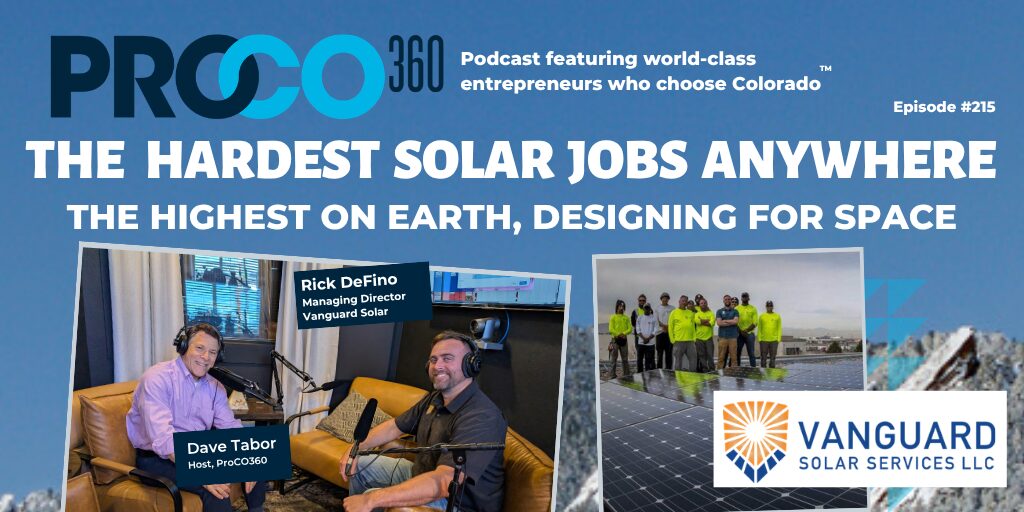
“We won the design, engineering and commissioning of the highest microgrid on the planet.”
Rick DeFino, Managing Director, Vanguard Solar
The Hardest Solar Jobs Anywhere
- Most solar companies want the standard jobs. Vanguard Solar keeps taking the hard ones. They built a solar project in Chile so high the crew has to work on oxygen. Now they're designing solar power for a farm NASA hopes to send to the International Space Station. Managing director Rick DeFino tells me how a Colorado solar company ends up on those projects, and why a chance conversation on a street in Malaysia got him into solar in the first place. He also explains why some of his steadiest work is fixing systems that other companies walked away from. It's a fun one. Give it a listen.
Rick DeFino 00:06
We won the design and engineering and commissioning of the highest microgrid on the planet. Intention has been the name of the game with this building a company that we’ve always wanted to work at. They are talking to us, stating that they’re hoping to put this second of a kind that we’re slated to build next year, sending it to the ISS. We value our ability to do things self-funded, right? But we also get excited when we find out our competition is flirting with private equity.
Dave Tabor 00:38
Welcome to the ProCO 360 Podcast for people who love Colorado and love hearing from Colorado’s most inventive and successful entrepreneurs, I’m Dave Tabor, and I’ve gotten to know a Colorado solar company that stands far out from the others. Vanguard Solar builds some of the largest, most extreme solar projects in the world, including a solar farm powering telescope at the highest elevation solar site on Earth, and that’s in Chile. Also, they’re doing a project for NASA where they’ve been contracted to design solar power for a self-contained farm that will be on the Moon. So when I heard that, I thought, How does a solar company end up working with NASA? How does the solar company end up in Chile? So there’s some great stories. I want to talk about that, and I’m sure listeners, you’re going to enjoy this episode as much as I will. So managing director Rick Defino is in the studio with me. Rick, welcome to ProCO 360. Hey,
Rick DeFino 01:35
thanks again for having me there.
Dave Tabor 01:36
Yeah, and we were just talking, listeners, about how Rick’s from the East Coast and I am too, and so we may be interrupting one another, right? So yeah. So all right, but Rick, first, how did you get into the business of solar?
Rick DeFino 01:46
You know, I I honestly think that it really comes down to chance sometimes with where you’re going to be, but also kind of you know in your 20s, they call me your trying 20s for a reason. It’s not as simple as walking into a job at you know a Goldman Sachs or Morgan Stanley. So, I was working in live broadcast television in New York. You know, I was working for CNBC just for a year and a half. First job out of college, didn’t have too much debt. I used to row Division One in college, right? So I didn’t really have too much debt coming out, thankfully, right? But live broadcast television is as brutal as it gets. You know, I think the existential moment that I had is when I had a an executive vice president, right, who was in one control room, had two heart attacks over a five year period, right, in the same control room because it was high stressful. I was working with the likes of Larry Kudlow every single night. I was working with Jim Cramer, the whole nine yards. So
Dave Tabor 02:44
Ruth, Jim Cramer, the stock guy, yeah, shrieks all the buttons, all the buttons. We were the
Rick DeFino 02:49
only Philly fans in the building, filled with angry New York fans. So it was kind of one of those things. But I just did not really like the job. I knew that I I wanted to do more. You know, I’ve always been about communal impact, you know. Really, just what benefits the community? What can I do that’s, you know, basically uplifting other, you know, other communities, things of that nature. So what it came down to is, I had the opportunity to stay on in television. I got out of that. I actually ended up traveling Asia for about nine months. Right, happened to have a random conversation with a stranger on the streets of Kuala Lumpur, Malaysia, and I happened to become very good friends with this person. They introduced me to a job opportunity in Sydney, Australia. So I cut my teeth in the solar industry in Sydney, Australia, for about a year. I launched a branch for a different company in New Zealand for a year, and then eventually went from a hyper mature market to a non existing market to coming back to the U.S. after almost three years abroad, and yeah, just got into solar in Colorado.
Dave Tabor 03:58
Wow, well that’s that’s kind of an interesting story. This random notion that you got into solar by bumping into somebody-that’s cool. Now, now though, at Vanguard, which is your company, what’s what’s the project size? What kinds of just to help listeners understand what your what your business is about? Like you do some big projects,
Rick DeFino 04:21
without a doubt. Yeah, we’re we’ve been very fortunate to build this reputation that we have there, Dave. I mean, really, it comes down to we’ll do the smallest of residential systems to systems as big as you know 1.5 megawatts to two megawatts.
Dave Tabor 04:35
You know, people. Okay, we’re gonna. I’m just set the term here. People don’t know what most of us don’t know what a 1.5 megawatt is. What is that?
Rick DeFino 04:42
Think of just a minor field of solar, right? Not not something that’s spanning hundreds of acres. I mean, you have 50 gigawatt systems being built, you know, by major utility players. This is something that could actually support a smaller community. It could. Support and industry things of that nature. So your home would be maybe a a five kilowatt to a 10 kilowatt system. You know things of that nature.
Dave Tabor 05:09
So yeah, but so the the projects you’re doing though, you’re doing whole neighborhoods. You’re doing the tops of big industrial complexes and things like that, right?
Rick DeFino 05:17
Yeah, we’ve we’ve been very fortunate to build the reputation that we have, Dave. Just because it’s it is really about going above and beyond. You know, it is construction first and foremost, but our team has an obsessive aspect when it comes to customer service, making sure that we’re thinking of the clients building their home just as our own, right? But we’re also thinking about just taking a bespoke, a custom solution per project. You know, so if it if it comes down to a a unique way, right, to approach a project such as the the projects we’re doing, you know, in internationally, right, or with different scientific research organizations, you know, we we have the experience to do so. I’ve been in solar for 13 years. My business partner has been in solar for 32 years. I’ve done work now in four separate countries on three separate continents. So we’ve we’ve just been able to you know garner the right type of reputation just by saying yes.
Dave Tabor 06:18
Well, at this point, at this point, it seems like solar is fairly mature. How much engineering is still involved versus you know you just plug it into the program and it tells you what you need. You you know stick stuff together and it works.
Rick DeFino 06:35
I wish things were that simple. I’ll say that much. Really, what it comes down to, solar is you have an understanding with the utility, so it’s called net metering. That’s with under the Public Utilities Commission, the PUC as we call it. They they are indicating that the utility has to achieve X amount of renewable, you know, renewable streams of energy. Yeah. So you’ll enter into a interconnection agreement with the utility, and really, what it comes down to is just making sure that you’re pulling your permit through the building department. You’re filing the interconnection agreement. So we have to follow the regulatory as well as compliance market. And this is for
Dave Tabor 07:19
an individual house as much as it is for a a massive say data center with solar on top to really anything a field that’s going to serve a neighborhood exactly all of these things have to be negotiated well but they don’t have to be negotiated really do they I mean all of this is set by statute as to what net metering is going to be that is is a solar going to be able to sell power back to the utility at what price? I mean, that’s all that’s all decided by government, isn’t
Rick DeFino 07:48
it? Yes and no. It really depends on the the clients. In some cases, the client can actually connect up to 200% of what their current consumption is.
Dave Tabor 07:58
But that’s a government that says like, yes, we allow we. This is just going to be what the utility has to deal with. To clarify,
Rick DeFino 08:05
that’s more the utility. The utility will give the green light for that.
Dave Tabor 08:08
Doesn’t that have to be like state or community law somehow? They because that requires a utility to allow a customer to sell power back.
Rick DeFino 08:17
Yeah, under the Public Utilities Commission. Yeah, yeah. So I was working, you know, in other states back in 2015, you know, when I came back, and you know, you had a whole diaspora of different solar professionals leave the state of Nevada because they canceled metering. So, and it’s on the docket for certain, you know, utilities within Colorado, but that could that could take away 1000s of jobs. Yeah, and
Dave Tabor 08:41
oh, I want to. I want to talk, but just to define net metering, just actually, please do define. I have my own, my own mind. Know what it means, but define that.
Rick DeFino 08:50
So net metering is the process by which that any amount of electricity that you overproduce, the utility can compensate you, right, in terms of actual dollars or in terms of utility credits, so and it’s not to the tune of you’re paying at your home 13 to 1415, cents a kilowatt hour. The utility will only compensate you to the tune of 123, cents per kilowatt hour. So it’s a raw rate.
Dave Tabor 09:16
Yeah. So net metering, though, is the mechanism that allows a solar generator,
Rick DeFino 09:23
yeah,
Dave Tabor 09:24
meaning the person who owns that solar plant, whether it’s a house or a big thing,
Rick DeFino 09:29
in a distributed generation room that
Dave Tabor 09:30
allows them to push to to be paid back for precisely. Okay, got it. Precisely. Now, okay, so back to my original question, which was, don’t these things just plug in now and work?
Rick DeFino 09:43
It’s not as simple as that. You know, the the whole way that solar works is that your your panels on your roof, on a field, on a carport they’re collecting ultraviolet radiation. It’s got to go somewhere, so it’s direct current. So it’s got to flow to an inverter. So panels can be very uniform across the board. You’ll have tier one solar panels. You’ll actually have fiat compliant. That’s foreign entities of concern compliance. But when it comes down to inverters, inverters are the key to the puzzle. So that’ll translate the electricity from direct current to alternating current, so your building can use it. So with that said, the inverters they you have to, you know, you have to install the inverters the correct way. You actually have to have the right type of utility buy-in. The building department’s going to be involved to making sure that, you know, you’re installing things correctly, etc. But is
Dave Tabor 10:36
that isn’t all that figured out now? I guess not. I mean, each installation can be different.
Rick DeFino 10:42
Each installation, you have to approach it just as a bespoke custom solution every time. So,
Dave Tabor 10:47
okay, so talk about what you’re doing in Chile because one of your one of your colleagues, Jordan House, was like flying to Chile. He was telling me, yeah, and overseeing the engineering of of a site. Talk about that’s kind of cool.
Rick DeFino 10:59
We we’ve been really fortunate to be a part of very unique projects, right? This is definitely one of the capital ones. So we’re working with a general contractor based out of here in in Colorado, and we we won the design and engineering and commissioning of the highest microgrid on the planet. So this is at 17,000 feet in in and the Atacama Desert of northern Chile. So my first time, my only time going out there so far was about two years ago, and it’s so high you need to have oxygen while you’re walking on all. Yeah. So this project’s called the Advanced Simons Observatory, right? You actually have the you know the likes of the University of Pennsylvania funding National Science Foundation funding, etc. and what they were finding is there was a disparity between you know providing clean science, right, as well as the amount that they’re paying for their diesel generators. So really, to power these telescopes, things of that nature. So what what they were out to do was cut how much they were paying on diesel while providing cleaner science for their research. So this is going to be estimating to save them, you know, to the tune of almost a million dollars per year. So
Dave Tabor 12:15
wow, which is pretty incredible. Even after this is after the how how many years are going to take them to pay back what this installation is going to cost.
Rick DeFino 12:22
I don’t have the metrics on that really, but it is about. I mean, you know, again, there’s been a series of different grants that have allowed for this, so they’re looking less for the ROI and more just styming the, you know, the the hemorrhaging, you know. So yeah, yeah, yeah.
Dave Tabor 12:37
Wow. So is it does being high altitude have any impact on electricity, on movement of electricity from solar panels to the usage and so forth?
Rick DeFino 12:48
A tremendous amount. I don’t even
Dave Tabor 12:49
know how to ask that question. Yes,
Rick DeFino 12:51
you did a good job. What it comes down to is also storage. That’s the biggest aspect to it. So again, we could definitely have our engineering team describe what it does, but many storage companies stepped away from assisting us with this because their batteries are only rated for 10,000 feet. So,
Dave Tabor 13:11
what difference does altitude have on battery storage?
Rick DeFino 13:14
A significant amount. Why? So, again, that’s more of a technical question. You know, but I
Dave Tabor 13:20
wouldn’t have understood your answer, Rick. It’s okay,
Rick DeFino 13:23
but we were we actually had to we had to devise this system, this plan. We had to engineer something that was frankly impossible, and it was it was pretty important that we we worked directly with the client, you know, who was overseeing the construction, the funding, different governments involved. To the client, the the project is still ongoing, right? So there’s only so much that we can say at this point, but it’s in the process of being commissioned, and it’s it’s pretty exciting. So
Dave Tabor 13:56
does solar act differently at that altitude? Does the actual collection of solar energy?
Rick DeFino 14:01
You have that much more generation. Plus, when you’re south in the southern hemisphere, too, your panels are facing north as opposed to facing south. You’re collecting more energy. That I would have missed that. Yeah, I would have missed that. Exactly. I’m not on your team for that. So,
Dave Tabor 14:15
what else is what else is tough about being up? So you have to have oxygen to do any of the work. What else is tough about building a solar system? Logistics, right? You know,
Rick DeFino 14:25
you got to think about getting up on top of a mountain every single day. So, and again, you know, this is a lot of which Jordan can speak to. My business partner, director of operations, chief of engineering, he just got back from being there for almost two months. So,
Dave Tabor 14:38
two months for the
Rick DeFino 14:39
commissioning process. You know, so
Dave Tabor 14:41
and is it working?
Rick DeFino 14:42
Yeah, they’re they’re getting it there. There’s a lot of communications issues. Well, well, communications problems you have to work through, right? The the biggest thing about microgrids, and that’s something our company is. We are what’s called an EPC, so engineer, procour, and construct projects. We do an extraordinary amount of. Service. That’s why we’re Vanguard Solar Services. So that’s operations and maintenance on utility scale systems, commercial industrial scale systems. There’s also 1000s of abandoned systems. You know, all across the nation from solar companies that have gone out of business. So you know. Oh,
Dave Tabor 15:16
meaning that they’ve been purchased. Correct. The company that installed them is gone. So now somebody has to take care of it.
Rick DeFino 15:22
Precisely. So that that’s that’s what we’re known for. It is unsexy. It is not something that is that is the the very quick and clean. Get out there, install, and then depart. Move on to the next one. So where our company finds itself is in this niche of being a community representative for all these abandoned systems by the 1000s, so stepping in when Sun Power is out of business, Titan Solar is out of business, Empire Solar is out of business. So
Dave Tabor 15:51
who pays you? I guess whoever needs the service done, whoever needs the system, yeah, yeah.
Rick DeFino 15:55
And you have to also follow, you know, where the systems are in receivership, you know. So it’s very much detective work on our part, finding out as you know you have 1000s of these clients that are not having their systems maintained, and you know the best thing about solar is there’s no moving parts. Right. You know it is once you’re installing it, it should be fine, but you’d be surprised sometimes you’ll have critters bury underneath solar panels because it’s a warm space. If it’s if it’s utility scale systems and there’s a hailstorm and suddenly you have hundreds of modules being knocked out by baseball sized hail, so it’s getting a company out there that can either repower the system, do corrective maintenance. It’s all the unglamorous aspect, you know,
Dave Tabor 16:43
sounds like you have to figure out that in some of those cases, it’s a puzzle as to who’s going to actually be responsible for a hiring you, b paying you,
Rick DeFino 16:52
exactly.
Dave Tabor 16:53
And whose job is it to figure that out?
Rick DeFino 16:55
It’s it’s our teams, you know, our project management team. You know, we navigate a lot, you know, and then sometimes it could be we’re working with major companies. If it’s CBRE, if it’s Wells Fargo corporate, things of that nature, just because they they need assistance, you know.
Dave Tabor 17:10
Do they pay you to figure
Rick DeFino 17:12
it out? It really depends on what the scope is. Yeah, is it? But it’s
Dave Tabor 17:15
possible, huh?
Rick DeFino 17:15
Without a doubt. You know, is it non performing? Is it does it need a once over? Does it need just a service provider that can give it the thumbs up on an annual basis? But if it’s
Dave Tabor 17:25
an abandoned system, I would think that you add tremendous value by them saying, “Hey, something’s not working, and you say, “Okay, well, we’re going to put you on the clock now
Rick DeFino 17:35
to
Dave Tabor 17:35
figure this out, and then you can hire us to fix it if if you want. Precisely. Yeah, that’s cool. It’s
Rick DeFino 17:40
attributed to our collect knowledge. That’s something that we’re we’re very proud of, right? It’s the fact that again, there’s really not a system that we haven’t seen. If it’s five years old, 10 years old, 1520, years old, we’ve we’ve seen a lot of different systems and a lot of different conditions. There’s a lot of the times where a client will have a $200,000 system up on their roof if it’s a commercial installation and it hasn’t been working for the past two years, and they’re none the wiser, so it’s it’s it’s a lot worse paying
Dave Tabor 18:07
their utility. They’re just
Rick DeFino 18:08
paying their utility bill. So it’s it’s it’s unfortunate, but at the same time, it’s we also look at it as a representation of our industry, right? So anything we can do to clean up the reputation to help these building owners, homeowners, asset owners, right? Yeah, you know how to assist them with gaining that revenue back. Yeah.
Dave Tabor 18:32
All right. I want to continue to pursue that in just a minute. I want to first take a quick break. You are listening to ProCO 360, named Best Colorado Business podcast since 2021. I’m your host Dave Tabor. This is a podcast for people who love Colorado and the stories of Colorado businesses and entrepreneurs. My guest today is Rick Defino of Vanguard Solar. I want to take a quick moment to thank Via Technologies. They host ProCO 360, and they their great team helps me keep that website up and running, Via Technologies is building a great growing business by working closely with really smart clients to partner on achieving client growth using web-based technology and digital marketing. They’ve also been doing a ton lately, helping clients develop specialized AI-powered business tools. So if you need help with that. Call my friends at Via Technology; they’ll give you some great guidance. All right, I wanted to ask you, Rick, about this notion of of sort of managing the reputation of your industry because so much has changed over the last several years. A, you mentioned big companies that went away. One that was funded by massive government, federal government dollars, and that went away. So you’ve got these abandoned systems, and you’ve got this political tug of war going on in your world. So what is happening?
Rick DeFino 19:53
I think I speak for 1000s of solar companies when we say we were watching with bated breath to see. The tax credits go away. You know that’s also bad for business. It doesn’t really matter where you fall politically, but when you kill 10s of 1000s of jobs, or it has the potential to kill 10s of 1000s of jobs, it’s you know you’re not doing right by you know your state, your country, etc. Although
Dave Tabor 20:18
some people would say an industry in a capitalistic country, an industry should be able to stand on its own without having those incentives. So, yeah, what you’re thinking? I
Rick DeFino 20:28
think that you have to be self-aware too, understanding that you can’t be expecting to receive any type of rebate or tax credit or something along those lines. The the metrics, the the value add the financials have to speak for themselves. That’s exactly what solar still represents, even without the tax credits. I think we’re also at the the dawn of of the tax credits dissolving, disappearing. If you didn’t actually get your tax credit safe harbor, right?
Dave Tabor 20:58
Well, then I’m confused because I think you agreed with me, and what you’re saying is different. So, should we be having tax credits to support an industry in general?
Rick DeFino 21:10
I I think it’s also what I will say in response to that, Dave, is that we need to have we’ve built mechanisms and systems in an industry off of these tax credits. A lot of corporations, companies have built their their processes, their entire identity, their their business verticals on tax credits to some degree. You have those other companies that are helping out with managing and assigning these tax credits, these rebates, so it’s it’s less of of a of a you know agreeing with you. More we should have done it more formulaic. We we should have done it in a measured approach.
Dave Tabor 21:55
Yeah, yeah. You know that makes sense. I mean, and look, I’m not. I’m a free enterprise guy. Of course, I still think that sometimes it’s in a nation’s best interest to simulate certain industries, and I and I think in in in our case, I think simulating the solar industry really did work. And to your point, then it sounds like Rick, you’re you agree with that, except rather than just sort of having an on-off switch, that there ought to be a tapering mechanism to allow adjustment.
Rick DeFino 22:23
You don’t want to rip the rug right under an entire industry. That’s precisely what happened. So, but again, you have to survive. You have to have the the right type of vertical strategy going into it. That’s what our our company was able to do. And so
Dave Tabor 22:38
it sounds like Now, solar without any tax manipulation in many applications, solar still makes pure economic sense.
Rick DeFino 22:52
Without a doubt, you have to sit with the numbers. It’s going to have a different payback period, but there’s also market reactions. You know, you have price drops for raw materials for solar panels, but now with new federal regulations, the the price of modules is going to skyrocket in December of this year. Well,
Dave Tabor 23:10
these are tariffs as opposed to regulations. Yeah, precisely. Okay. Right. Yeah.
Rick DeFino 23:13
But even still, it’s something that you know. Again, it’s it’s our industry is trying to get back up. You know, when it’s being taken down a couple more times, yeah. But it’s being it’s being smart about what your approach is. You know, with our our approach is really just microgrids, microgrid remediation, those types of installations, service being a core component, as well as commercial, industrial, and small utility scale installations. Things
Dave Tabor 23:38
that make sense financially, regardless of government intervention, exactly. Got it. Well, that makes. I mean, to me, that’s we’re talking about sustainability with solar, but this is all economic sustainability is doing it where the math works. Precisely. So, yeah. Okay, I want to talk about another cool project that you’re doing, and I know it’s not a huge one for you guys yet, but it still is fun. This project that that you’re doing with NASA with your partner company called FarmBox. Talk about that.
Rick DeFino 24:03
Yep, our sister company FarmBox Foods. And again, I got to make sure I can say all these things. But they they develop vertical hydroponic farms in shipping containers. Right. So one thing that we’re doing in a partnership with NASA is building a a microgrid within a smaller shipping container 20 foot farm. So again, it’s traveled all over you know now the world you know from Jefferson Air Force Base. I believe it’s in Guam now, and you know they are talking to us stating that they’re they’re hoping to put this the second of a kind that we’re slated to build next year, sending it to the ISS. So we’ll see exactly if that happens. So not the moon, right? Not as oh, not the moon. Okay,
Dave Tabor 24:51
but they want to put a self-contained growing module
Rick DeFino 24:56
precisely
Dave Tabor 24:56
in the International Space Station powered by solar that you guys design.
Rick DeFino 25:00
That’s what we’re being told, but that’s super cool, though. I
Dave Tabor 25:03
mean, you know, you think about it. How else are you going to get fresh fruit up there? Precisely, and and wouldn’t that be interesting to be able to grow fresh fruit?
Rick DeFino 25:10
Yeah,
Dave Tabor 25:10
food inventory. I know they’re doing
Rick DeFino 25:12
something, some semblance of it right now with hydroponics, but again, I can’t speak to that. Yeah,
Dave Tabor 25:17
okay, but that’s that sounds super cool. Do you see yourselves putting hydroponic solar powered hydroponics on the moon?
Rick DeFino 25:25
If we got if we got the contract, I know that we would find a way to do it. I’ll say that much. But that would be so
Dave Tabor 25:31
that would be so cool, and it makes a lot of sense because we’re talking about within within you know maybe a half a generation actually having people living and working on the moon. So where does the food come from?
Rick DeFino 25:41
Exactly. And
Dave Tabor 25:42
what a great-I mean, the seas are easy to get up there.
Rick DeFino 25:46
Oh yeah. And
Dave Tabor 25:47
there’s water on the moon. Yes, at least I think there is. So and you don’t need much water when you farm hydroponically. And no. So what a brilliant. Okay. Yeah. So how hard would that be for you? I mean, it seems like it would be something you guys could figure it out.
Rick DeFino 26:03
I mean, again, who knows? You know where where we’re going to be in those? You know, the next couple of years, let’s say, just share like, how you going to do? No, it’ll be cool. Yeah, it would be. All right, now
Dave Tabor 26:13
you run a business with two other partners. Yep, and I’m always curious about that because when I had my own company and yeah, I didn’t have any partners, but I did have people who had Phantom Stock, and and the idea of sort of negotiating decisions with other stakeholders can be complex. Yeah, how do you guys manage that in you know a fairly fast changing world?
Rick DeFino 26:33
Without a doubt, I think you actually have to have skills and abilities that complement one another, but you also have to have the right level of communication. You also have to find out how how others communicate too. It’s just a style of leadership, you know. When it comes down to how we function together, we were trying to talk be talked out of it by other people too. Just you know, not having more than just yourself running the company. But it’s it’s always great to have built in sounding boards, right? Making decisions together, you know. Again,
Dave Tabor 27:03
always. That’s kind of a general term. It’s not always good to have three people making decisions. No,
Rick DeFino 27:08
not not always. But I think it’s everyone stays in their own lane for the most part. Right. So if it’s operationally, if it’s if it’s management, if it’s larger decisions, contracts, etc. I have to be the one to to uptake that mantle. If it’s engineering, you know, it’s Jordan. If it’s sales, it’s Jake. You know, so it’s you know, again, we do very well complementing each other. Yeah, that’s cool. Yeah,
Dave Tabor 27:33
can you guys still have a decent margin in this world with all of the stuff we’ve already talked about? I mean, is this something you can self fund to grow and keep thriving.
Rick DeFino 27:42
We started this company being bootstrapped. You know, one thing too that I found fascinating is just for years and years we’ve been propositioned by private equity, right? And it’s always a dance with the devil. That’s the way that we look at it, right? So we we value our ability to to do things self funded, right? But we also get excited when we find out our competition is flirting with private equity because we’ve seen it time and time again of service, custom, you know, customer service, your ability to make decisions just be completely handicapped. So that’s
Dave Tabor 28:15
not the world you want to sign up for.
Rick DeFino 28:17
No, no, I I don’t think it’s it’s in our future, right? I think it’s we’re always trying to do right by our employees. Something that we’re very proud of is we’ve we’ve built a culture, we’ve built a team that we’d be proud to work at ourselves. It’s always it’s always been intention is been the name of the game with this building a company that we’ve always wanted to work at. Right, empowering your employees, being able to, you know, hear their decisions. We’re not a B Corp company, but I think we we can also move quicker than a B Corp sometimes. So you know, again, it’s it’s something that if you empower your team enough, if you’re we will pay more than the market average, so we retain the right type of talent. We never have turnover, so
Dave Tabor 29:02
that’s cool. And you know, it’s to be fair. I picture you know at least for your installers,
Rick DeFino 29:07
yeah,
Dave Tabor 29:07
they are standing on top of solar panels, radiating heat in hot weather. In many cases,
Rick DeFino 29:14
yeah,
Dave Tabor 29:14
that has to be brutal.
Rick DeFino 29:16
Oh, it can get up to 110, 120 degrees on that roof, right? And again, you know, they’re not standing on the panels as much as they are just being around it. But it is, it is punishing. But I mean, our our crews are the best in the business in Colorado. I’ll bet any amount of money to that. So, but it it really it’s it’s something that we we’ve been painstaking in our approach to pursue the right type of talent, you know, and to maintain that talent. So
Dave Tabor 29:40
how? What else has changed? We talked about the lack of incentives and tax breaks and stuff. What else has changed in your world in the last 10 years? I know the cost of materials has gone down, but now it may not now may reverse. But so what else has changed?
Rick DeFino 29:55
I think it’s the technology has increased tenfold when it comes down to pan. That were installed seven eight years ago. You’re getting about four times the output, right? When it comes to battery storage technology, you know I know you had Peak Energy on it. They’re they’re a fantastic company, by the way. But you know lithium, you know ion technology, lithium iron phosphate, that LFP technology. I mean, it is the market standard because it is-it’s a commodities game. You know, the the price is extremely low for it. Your companies are able to manufacture more of these batteries. Yeah. So the dawn of storage has been a a new conversation to have with clients. We always like to phase it out, not necessarily lead with solar married with storage, because that is quite a bit out of pocket for our clients. So I think it’s really just making sure they understand what what do they need for. Are they trying to bypass certain utility structures that are in place? If it’s time of use, things of that nature, right? Or are they trying to power a microgrid system? Yeah, yeah.
Dave Tabor 31:00
I I’m fascinated by sort of watching the trajectory of storage. Yeah, because I would think the greater the storage technology improve improvements, the more powerful your offering becomes economically, the the less friction and transition. I mean, is that is that fair?
Rick DeFino 31:22
I’ll I’ll say this just with everybody’s rates skyrocketing right now, the amount of calls that we get about storage has probably increased tenfold. Every single request for residential new installs, commercial new installs is 90% of the time followed up with a storage conversation. So it’s you know again it is definitely a no brainer if you’re spending double what you were spending last year on electricity, you know just to you know hedge against your future your future costs. But we’re
Dave Tabor 31:56
still not at a place where where batteries are enough, are we? It.
Rick DeFino 32:03
I’ll. I’ll put it this way: you. You can absolutely. It depends on what we’re talking about. If we’re talking about residentially, you can absolutely, you know, offset your electricity depending on what you’re doing in
Dave Tabor 32:15
Colorado. Are you likely to be able to put a cost-effective battery in your home, such that you could charge it most of the time, like on a sunny day, unless it’s raining or whatever, to where you could run off the grid essentially while you’re on the grid.
Rick DeFino 32:31
There’s a lot of inputs you have to put in place. So the questions we’ll ask clients all the time is, how long do you want to be purely on storage for? Right? Is it you know seven hours, eight hours? Is it 24 hours? That changes the nature of the conversation. You know, so
Dave Tabor 32:47
so but okay. So answering the question though, if somebody wants to be off the grid while they’re technically on the grid, so you know is that battery cost effective, or is that just not there yet? It
Rick DeFino 32:58
can absolutely be cost effective. It just again, it depends on inputs. How big of a family do you have? Multiple EVs, a hot tub, a sauna, a pool running at the same time. Well, a sauna
Dave Tabor 33:08
and pool probably change the equation a lot. But okay, I get it. Yeah. All right. So, what else do people get? Like, I’ve never been in your business. Most listeners have. What do most people not understand about the intricacies of like your world, the solar world.
Rick DeFino 33:25
I think when it comes when it comes down to to solar, you just have to be honest with yourself about the bill that you’re realizing. So if it’s if you own a commercial property in Denver, you’ve probably heard of our name before. When it comes down to if it’s Energize Denver compliance, green building ordinance compliance, navigating these these measures taken by the state, by the city, things of that nature. When it comes to residential, it’s being realistic. Can I afford to be paying this type of bill for the rest of time, for as long as I’m at this house? So it’s always going to add value. A lot of the time, realtors don’t necessarily like solar because it’ll complicate the the purchase and the sale of a home.
Dave Tabor 34:07
Because a lot of times, the solar isn’t actually part of the sale. It’s it’s owned by someone else.
Rick DeFino 34:12
Precisely that, right? So we get calls like that all of the time to help navigate through, and we’re we’re thankful to be certified by so many different companies, such as Tesla, etc. But it’s really we we try to be that company that Coloradans can actually contact if they’re in a pickle, if they’re in a bind, they need someone else to help them. You know, when there’s when there’s no one else. So
Dave Tabor 34:35
as we wrap up,
Rick DeFino 34:37
yeah,
Dave Tabor 34:37
any like if if you were to think back on something that you’ve accomplished, a project or a business, building your business, kind of a thing, what are you most proud of relative to this?
Rick DeFino 34:47
I mean, I’m most proud of being a father first and foremost. I would say, right? But I’m proud of the the team, the culture that we’ve built, right? I’m proud of the being a part of a company that does right. By the community, I’m a proud member of the Denver Children’s Foundation, right? You know, I’m I’m proud to have completed certain projects. I mean, in in the Southern Hemisphere, in Oceania, with Australia, New Zealand. You know, I think it’s not necessarily about the legacy you leave behind as much as it is about the lives that you impact. That’s the way that I look at things.
Dave Tabor 35:22
Well, I’m going to ask you, and you’re kind of going down that path. But ProCO360 has a new sponsor, Philosophy Communication, and sort of it’s a well established PR and marketing firm. And with their name in mind, I want to ask, like, what’s your philosophy about running your company going forward around growth and that kind of thing. How do you how do you think about that?
Rick DeFino 35:45
That is that’s a tough question, there, Dave. I I think that you you always want to think about your team and and your your community, your clients first and foremost, right? I don’t think you know the quickest path to growth is taking outside capital, outside money, right? But I think we’ve we’ve tried to do it in a very holistic manner, very intentional about our our approach. So I think growth can only be done with you know our team in a in a formulaic way. It can’t be done in an expedited way if you throw money at it. So I don’t know if that answers your question.
Dave Tabor 36:18
Yeah, I mean it sounds like that’s your philosophy of of how you want to manage growth, anyway, right?
Rick DeFino 36:22
Yeah, without a doubt.
Dave Tabor 36:23
Yeah, because a lot of around that line. I mean, do you have goals around around growth? You have a philosophy that says we’re going to grow to X by a certain period of time, or is it different? How do you think about
Rick DeFino 36:41
it. I I think that in the the changing regulatory environment that we find ourselves in, we have to redefine different scopes. One thing that a lot of you know our your listeners, our clients, etc. don’t always know is we’re an electrical contracting company first and foremost. We imply master electricians, journeymen, residential wiremen. So you know, it’s being able to do the electrical work outside of just solar specific. You know, it is evaluating new opportunities too. I mean, we’re we offer heat pumps because it’s a perfect marriage to what we do with renewable energy. So it’s it’s about being you know about resourceful first and foremost, you know, understanding where the market is going, and yeah, just we’re a relationship company first and foremost. I’ll say that much. So yeah,
Dave Tabor 37:31
well, I think that’s a good note to end on. Yeah,
Dave Tabor 37:33
I’m your host Dave Tabor today on ProCO 360. You’ve been listening to my conversation with Rick Defino, managing director of Vanguard Solar and Rick, great to have you on. Great to talk with you. And by the way, listeners, I got to give the team at Vanguard kudos. Probably their smallest project they’ve ever done was installing solar in my on my RV, which is sitting out on some camping property in the middle of nowhere. You guys, thank you again. You guys were so kind to take care of that and and make it so it’s up and running and and use the inverter and it worked. It’s awesome. So listeners, that’s an aside. But glad you’re here on ProCO 360, where we say live, work, love Colorado, because you and I and my guests can be successful anywhere and choose Colorado. You make the show successful by subscribing to the ProCO 360 podcast, and please submit a review in your app that helps a ton. That’s the show Live Work Love Colorado.