

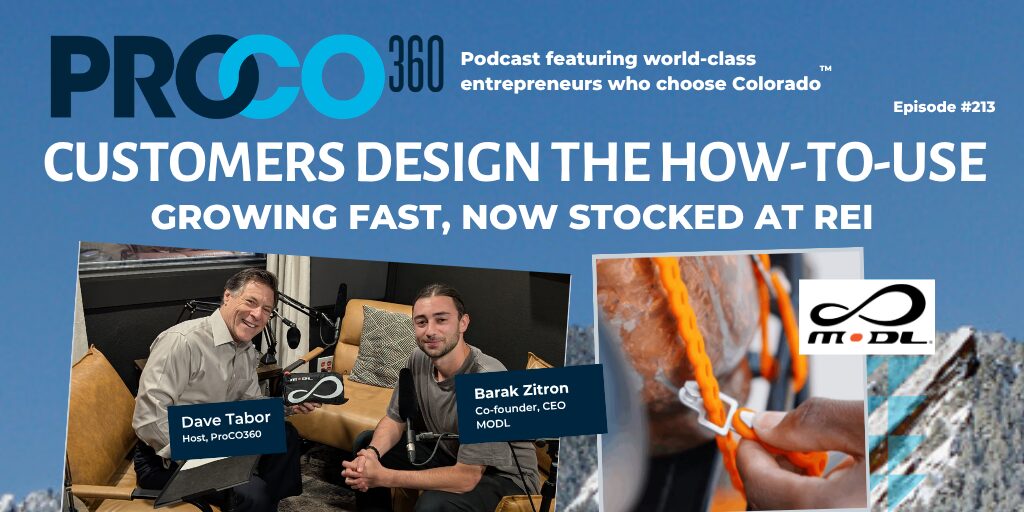
“We create a product that’s made to be interpreted by your mind and you create a solution with it.”
Barak Zitron, Co-founder and CEO, MODL
Customers Design the How-To-Use
- I've always loved seeing outdoor gear companies that seem to come out of nowhere with one simple product and take off – and that’s MODL. I’m a bit embarrassed that I learned about MODL via Facebook ads, but whatever. I investigated and saw that MODL is a Colorado company, so I wanted to meet Barak Zitron, co-founder and CEO. The company started with an idea to secure a water bottle from swinging on a backpack — and turned into the Infinity Tool, a strap system now sold in REI stores across the country. What stood out to me most was the design philosophy behind it. Barak doesn't try to anticipate every way people will use the product — he builds something simple enough that customers invent their own solutions with it, from securing a snowboard binding mid-mountain to mounting gear inside an aerobatic plane. We also got into how a three-person founding team keeps R&D costs low, how they landed REI after two tries, and why their growth has run about 2.5x a year for three straight years. It's a look at how a product built to be "finished" by the customer became one of the fastest-growing outdoor product brands.
Barak Zitron 00:05
I create a product that is made to be interpreted by your mind, and you you create the solution with it. Technology, you know, people talk about AI, but technology in general has just it’s allowed a core team of three to do like some genuinely incredible things. Yeah, we want to create something simple that you can riff on. You know, we can focus on selling one product that services all these people. So there’s a lot of leverage in the product itself. I don’t know if I recall the exact moment we got the order, but I can tell you, I can tell you, we were we were very excited. Welcome to the ProCO360.
Dave Tabor 00:41
ProCO360 Podcast for people who love Colorado and love hearing stories of Colorado’s most inventive and successful entrepreneurs. I’m Dave Tabor. Today’s episode features Barox Citron, co-founder and CEO of Model Outdoors, a company started with a single product, the Infinity Tool, a modular strap that secures just about anything you want, anything you’d use in daily life, with a particular focus on outdoor uses. In 2017, Barack and two friends, Jack Leitz and Justin Gould, started Model and hoped it would become a business that allowed them to dodge conventional careers. I look forward to this conversation about product innovation, product invention, about turning a product into a business, about expanding that business, about protecting unique product attributes, even patents. So lots to talk about. Barack, welcome to ProCO 360.
Barak Zitron 01:34
Pleased to be here. Thank you.
Dave Tabor 01:35
Yeah. Okay. So you got to talk about like the very beginning because this is this is a company built on an invention, a single invention. So talk about how it started and where you guys were coming from.
Barak Zitron 01:46
Yeah, it it actually started with a whole different product. It started with a with the idea for a modular water bottle, and so the very the very genesis of the idea was I was on a hike and I had an Nalgene clip to the outside of my bag, and it was swinging around, and I was thinking about the Nalgene swinging as opposed to thinking about my hike. And the original thought was, you know, if I had one more loop on the bottom of this bottle, it wouldn’t swing, and I could be focused on the hike. It was it was that simple. But then I realized, you know, what if it had different caps that did different things? You know, a multi tool for water, and it was a couple months. Didn’t really do anything with it. And we were getting to the end of college. And I was talking to two of my friends. I was actually on a camping trip, and I was going to go into finance. Zach was going to go into consulting. Justin was going to go into the medical world. And so we thought, you know, what if we what if we did something different? And I had this idea for a bottle, it seemed you know pretty simple at the time, but yeah, we set off on that adventure and launched the bottle on Kickstarter, and we’re able to kind of go straight out of college into into running model, which was a great experience. And the bottle actually kind of showed us the way to our current set of products, the Infinity Tool, and so for a long time, one of our customers’ favorite aspects of the bottle were the loops that we put on both ends of it, right? So, like the true genesis of the idea was, you know, to stop analgesic from swinging. We created an entire bottle to do that, and really, people are saying, “Wow, this strap is really useful. And I thought, hmm, maybe this isn’t a strap on a bottle, but or a loop on a bottle, but a bottle on a loop. And I was like, this thing could be so useful and such an interesting multi tool if you could wear it right on your wrist and you could clip it and cinch it and really bring just a lot of functionality to something that you can always have with you, and so we launched the product on Kickstarter. Really didn’t know how it would do. We just thought, you know, this is really simple and super useful. Let’s see how it does. And it did it did better than the bottle ever did right out of the gate. Wow! And so we were like, huh, there’s really something here. And then that’s when we started to realize, wow, this is actually like functional Legos, and we’re going to keep building this ecosystem with hooks, OmniLinks, magnets, and more. And this is going to be a buildable solution.
Dave Tabor 04:09
That’s kind of so. All right, let’s back up even because you guys were in college, so you have this idea for a water bottle with essentially securing attachment kinds of parts, right? So, but you had to build it. Like, where did you get started? How did you did you mock up your own? And then, yeah,
Barak Zitron 04:26
it was very it was very scrappy. I’d never I’d never designed a product before. I’d never used CAD before. I had the idea for it in my head. I’m you know I’d used Photoshop before, so the first the first vision of the bottle was actually taking a picture of analgee and chopping it in half, and then mirroring it, and writing “model on the side, so you saw a two-ended bottle, and that was the first that was the first thought. And then I went on to a free program online called Tinker Cab. At least that’s that’s what it was called at the time. Yeah, yeah,
Dave Tabor 04:56
yeah.
Barak Zitron 04:57
And yeah, started started. Kind of modeling what the bottle would look like. Obviously, I couldn’t create the right size cavity on the inside. Was just a representation of what this thing could possibly be. And then I sent that. What hired somebody on Fiverr, I believe it was. Yeah, yeah, Fiverr back then.
Dave Tabor 05:16
It’s still around, I think. Yeah, no, yeah, totally is.
Barak Zitron 05:18
We we still sometimes will hire people on Fiverr for odd jobs. Yeah, but hired a guy named Dima, and I was like, he was like, can you make this real? And he he did some he did some he did some of that work. He brought my ideas into a workable CAD model, but then once you actually start making it, you realize there’s a whole bunch of other engineering challenges that would obviously inform the design. So we we worked with him. We 3d printed a bottle, and this is this is something that’s actually pretty interesting. Which is, in order to get investment, what we decided to do was a really really simple MVP, like simple as in doesn’t even really work or exist, and we 3d printed a bottle, the the design that this guy created for us, and it was totally porous. So if you poured water into it, yeah, yeah, it would just seep right through.
Dave Tabor 06:10
Yeah,
Barak Zitron 06:10
but we basically made a website showing all the ways you could use it, and we mocked up the different caps, and we set up a place where you could buy it on the website, and you could choose your color, you could choose your caps that change the functionality, and we got to see we got to send people there with Google and Facebook ads. And if they tried to buy, they would get hit with a message that “Sorry, you caught us before we’re ready. Into your email, if you’d like to stay in the loop, wow! And so basically, we were able to see how much are we going to pay for advertising, how much are we going to pay for advertising, what’s the average sale going to be what caps are people interested in, and basically for a couple $1,000 we were able to kind of validate you know validate the premise of the business, and that’s what allowed we took that data to an investor and he actually allowed us to you know he he made the investment to allow us to bring it to market.
Dave Tabor 07:01
So, how many did you make?
Barak Zitron 07:04
The first one. Well, I mean, it was about a year and a half after that, or maybe about a year from getting the investment to the product actually going on Kickstarter, and it wasn’t even fully finished at that point. But our first order was based on our Kickstarter volumes plus some. And what’s nice about Kickstarter is you put an idea out there, and you’re basically getting pre-orders.
Dave Tabor 07:24
Yeah, and then people know it’s going to take six, three months, maybe not six, but they they they know it’s going to take some time before they ever get it, and they’ve signed up to not bitch. Exactly, basically, right? Yeah, they signed
Barak Zitron 07:34
up for. They understand that their early purchase of this product is actually what’s going to allow the purchase of the first purchase of these products be made, and so we were able to take that. We had a pretty successful Kickstarter campaign. What does that
Dave Tabor 07:48
mean to you?
Barak Zitron 07:49
It was it sold. You know, it was our first property. Did you
Dave Tabor 07:52
sell?
Barak Zitron 07:53
I think we sold around three to 4000. Really, that’s pretty. That’s pretty nice. And so you could
Dave Tabor 07:58
make a decent. So what did you order? Like 5000 of these bottles,
Barak Zitron 08:00
yeah, something like that. We ordered enough to kind of get us get us moving. You know, selling on our website after we delivered those first orders. So I
Dave Tabor 08:08
don’t want to talk about the bottles much more because the model is yeah, it’s not even that anymore. But it’s but did you make money in those first sales?
Barak Zitron 08:17
We no, we basically made it out break even on Kickstarter, which is pretty common. Which is very common. Things cost more than you expect. Things take longer than you expect.
Dave Tabor 08:27
Yeah, yeah, everything.
Barak Zitron 08:27
But luckily, we delivered a product that worked, and people were really happy with. So, did they
Dave Tabor 08:32
seed the market for model then for the rest of the products?
Barak Zitron 08:34
Say again.
Dave Tabor 08:35
Did they seed the market? Would they become pre-qualified customers you could reach out to in the future, to to launch model, yes, what has become,
Barak Zitron 08:43
yes. So I mean, we get all of their contact information. So it was just a great way to build. First of all, build the audience prior to the Kickstarter. Yep. Build the audience during the Kickstarter. You know, get to tell the story of actually manufacturing the product the first time, which is really just an amazing story. And you know, walk walk the walk. Don’t don’t talk about it. Yeah, and just do it in the open. And so that was really cool. And then you know we launched in basically December 2019 on our website after we delivered. And I mean it was a wild ride from there. Was it? Were people
Dave Tabor 09:14
buying the bottles, or did they? Did you see the demand for the for the strap the cinching system take off?
Barak Zitron 09:19
So that so the Infinity tool didn’t come on the market as a separate product until 2022, and wasn’t actually on our website until 2023. Wow! Yeah,
Dave Tabor 09:28
but did you sell the straps with the bottle?
Barak Zitron 09:30
Yes. So they came as a part of the bottle. Yeah, yeah, yeah. And so they came as a piece that you could take off. You know, you know, at one point you could connect them together, and so you could strap the bottle to anything, and then we just realized, hmm,
Dave Tabor 09:43
what the hell?
Barak Zitron 09:43
This maybe it’s not a a loop on a bottle; it’s a bottle in a loop. Yeah. Okay.
Dave Tabor 09:47
Now I’m going to change. I’m going to change, and really, because your your company, do you even sell bottles anymore?
Barak Zitron 09:51
No.
Dave Tabor 09:51
That’s what I thought. Okay. Yeah. So now it’s all about the infinity tool and the endless ways you can secure things. And I, you’ve got a fun. Video on on your website, listeners. I encourage you to go. And what is it? What’s the website?
Barak Zitron 10:03
M O D l.com.
Dave Tabor 10:05
Got it. So M
Barak Zitron 10:06
O D l.com. Yeah.
Dave Tabor 10:07
All right. So there’s a great video of you and your partners doing a a raft slash bike trip, and I love the section where you each are loading up your bikes, and you’ve all chosen your own weird configurations to load stuff, and you’ve all used the Infinity Tool and weird strapping systems and all kinds of stuff. And you’re like bragging about how you’re. I and I gotta believe. I gotta believe that as you drove away, as you rode your bikes away, this stuff started falling off, and you had to redesign, right? I mean, but it’s a great story. Oh
Barak Zitron 10:39
yeah, it totally is. I think, I think when you’re being authentic, when you’re creating the conditions for something real to happen, then you’re just gonna have a much better story than if you’re just trying to script everything out to begin with. And actually, when you see people who don’t get it right on the first try, I think it’s you know people people resonate with that, and then it’s about okay. Well, how do we change this? How do we work together? I’ll take that off your hands, and you know, make make a make fun of it a little bit. You know, it’s it’s it’s fun. It’s funny.
Dave Tabor 11:13
Oh, the way these bikes were loaded up with yeah, it’s ridiculous stuffs everywhere. But you’ve got you’ve got your product like in full view everywhere, holding everything down, yeah, just and it was the max, yeah, yeah. All right, so since we’re going to move on and we’re going to be talking about the the Infinity Tool and the the securing systems that you built, talk explain to listeners who haven’t maybe haven’t been to your website yet what the product is and what it does.
Barak Zitron 11:36
Yeah, so the Infinity Tool is a modular strapping system, so you can think about it like functional Legos. Build what you need to strap down what you need. You know, you can have straps that are just in line, and you could link them end to end to make them as long as you needed. Or you can cinch them down so you can pull them through each other to really get a tight grip on things. Then we have hooks, which basically turn them into adjustable bungee cords. Bungee cords are great, but they’re never the length you need. And so, having an adjustable bungee cord that maybe you could have go in multiple directions, you know, instead of just a line, there’s you know it’s coming out of a center point where there’s four coming out. So it’s really taking kind of that buildable nature of something like Legos to something that’s going to be actually functional, and pairing that with you know really high quality materials creates a product that you can you can trust and is really open to accepting your ideas.
Dave Tabor 12:29
Yeah. Now I’m holding I’m holding a a bracelet that just you know, but I that you gave me and well some other stuff which is super cool. Yeah. And I’m really curious about this material, yeah, because it’s stretchy and it’s strong. So really curious about what you went through as an engineering team or in hiring an engineering team to figure out this perfect product that stretches but strong that won’t break. So how did you figure all that out?
Barak Zitron 12:59
It was a lot of trial and error, and really, our our design team. I work with I work with a lot of suppliers. We do work with some designers occasionally, but honestly, it’s I’ve found great success working with these suppliers over in Asia. A lot of suppliers you can find through Alibaba or other sites that already specialize in the sorts in the sorts of materials or sorts of items that you want to create, and so they are the experts, and they are you know they’re the people who are going to be making the product at the end of the day. So when you’re working with them to design something, the the manufacturability is almost built into the reasoning more so than it would be.
Dave Tabor 13:40
That would make sense. They won’t design something they can’t make,
Barak Zitron 13:42
right? Then someone they’re going to push back a lot sooner than a designer in the U.S. would.
Dave Tabor 13:47
That’s that makes a lot of sense. Now, the thing is, like, okay, so this is kind of a feels like rubbery for the most part. I mean, what’s it made of?
Barak Zitron 13:55
Yeah, so it’s made of silicone and it’s really high quality silicone, and we’ve, you know, there’s there’s a ton of different processes that you can do to make silicone feel this this type of way, and it basically took a lot of trial and error. You know, different hardnesses, different compounds, different different finishes, and really just dialing in what is going to give us the best mix of the qualities we want.
Dave Tabor 14:19
So, is this combination a is this like a unique material that you would only this combination of materials is only found on model products or is this going to be also on a rubber rubber feeling clog or a necklace you know
Barak Zitron 14:36
yeah it’s a I guess so the entire formulation I guess, is is unique, but that isn’t that isn’t so unique in and of itself. That that it is unique, if that makes sense. Basically, you know, the way that we process the material turns it into something that is different than what the raw material going in. It has the potential to be a lot of different things, and so. The way that we process it turns it into something that is very specific to what we want.
Dave Tabor 15:04
And and what is patented about this?
Barak Zitron 15:06
Yeah. So the pat the patent is I’ve learned a lot about patents over the over the course of years. And what is very interesting is that the things that you actually get to patent are often very narrow versions of what you’ve created, and so basically we have design patents and we have a utility patent on the overall system that actually was inherited from the bottle. But we’re actually-I don’t know if I want to say this-but we’re actually still working on the patent for the the utility patent for the tool itself,
Dave Tabor 15:41
got it. Because that would be well. I want to come back to in just a minute, but I want to stop for a minute and remind listeners: this is ProCO 360, named Best Colorado Business Podcast since 2021. I’m your host Dave Tabor. This is a podcast from people who love Colorado and the stories of Colorado businesses and entrepreneurs. My guest today is Brock Citron of Model. And hey, I want to thank before I move on. I want to thank my friends at Via Technologies. They host ProCO 360, and this is a great company. They partner with really smart clients to grow their businesses using digital marketing, online tools, and so forth. So, contact Via Technologies if you want some help from some great guys over there, all right. Switching back, I want to talk about this patent protection thing because as I look at this product,
Barak Zitron 16:29
it it
Dave Tabor 16:30
reminds me of a million things that companies that sell on Amazon copy. Now, I was really pleased that when I did a search for model on Amazon, that your products came up and not a bunch of other ones, but that has got to be freaking you out, is it?
Barak Zitron 16:48
I think to some extent, yes. We do have some copycat products, but I think I think that there’s multiple ways to think about the copycat products. There are ways. There are ways that you can, you know, fight against them, especially on a platform like Amazon. If you have credible claims to either the trademarks or the patents, it’s Amazon does does have some paths to kind of take those down.
Dave Tabor 17:18
Are they responsive? Have they been responsive to you? They’ve been
Barak Zitron 17:20
somewhat responsive, but it is sort of a whack-a-mole situation because sometimes it’s the easiest thing you can get them on is if they’ve taken your exact photo or something and they’re using it on theirs. So then you say, “Hey, Amazon, they’re using our exact stuff, and then they take them down. But then if they change it around, they can get reapproved, and so it’s a whack-a-mole situation, and it’s not going to be perfect, but I also I have somewhat of a a viewpoint that you know maybe maybe it’s not such a such a terrible thing. You know there there could be there could be opportunities for you know a real competitor to to come up and to to compete with us on what we’re really doing, but our Amazon products are very are very limited, and the companies that are generally copying them are just trying to make a quick buck. They’re not trying to do the work to market this product and to really build that brand. And so, you know, when you see all these companies doing all this stuff, it’s like, how much do you actually want to spend your focus on something that you’re you might not be able to kind of put out entirely, and maybe they’re just stealing demand from themselves, and they’re making they’re making your business the the OG one. Yeah, yeah. So well,
Dave Tabor 18:37
and I I look at this product, and it’s got to be super strong in order, otherwise, otherwise you would lose customers. And like I’m stretching this really hard, and you don’t seem concerned.
Barak Zitron 18:50
It’s it’s really it’s quite strong. It’s stronger than it than it kind of expresses or or feels even. Like it might feel strong to you, but one of the one of the good things about the design of this is it’s totally invisible in that it doesn’t feel as strong as it is, which makes it makes it a better product in a sense because people naturally don’t want to test the limits of it, even though it has a higher ceiling. That makes sense. Yeah,
Dave Tabor 19:16
but what you know, what I’m thinking about though is that copycats are probably going to use a cheaper material. They will, yeah. And and so you know they’ll fail, and people will want the real stuff because like it’s expensive, but it’s not that expensive, and it’s cool and it’s fun to use. In fact, I looked at the reviews of your product, and the only non five star reviews were four star, and it’s because they’re expensive.
Barak Zitron 19:42
Yeah,
Dave Tabor 19:43
and people are like, “Yes, I wish it cost less, four stars. I’m like, “What the hell? Like, you know, you bought it. Yeah. So, but that has to make you feel good that that the only complaint is that it costs for something great.
Barak Zitron 19:56
Yeah, I mean, I I think it’s it’s amazing. Hear just the feedback across the board, but yeah, the fact that we’ve made a product that is useful and brings out people’s creativity and people actually surprise us with the ways that they use it. I mean, I think that’s like that’s everything we’re going for, and we want to make sure that we’re delivering the highest quality product possible. Yeah, and for a long time, we you know we we we didn’t make money as a business, and so we know how much we need to charge to actually make money. And so you know, it’s we we want people we want to get these in people’s hands for as cheap as we can make them. But we also want to give people the highest quality product possible, and that is always how we design from. We create. We create the best product we can, and then and then figure out how we can make that more effective, as opposed to saying, okay, our budget is this. This is our target. This our target price. Let’s build the best product we can to that price. I think you’re always going to create somewhat compromised product, at least on some axes, if you’re thinking about it in that way,
Dave Tabor 21:01
you know it makes sense too because, like you know, companies in the outdoor space, which is really where you, you know, you you sort of seem to shine. You know, people don’t want crappy cheap stuff. They’re willing to pay. They’re willing for you to have a decent margin, a sustainable margin, to have a product they can count on.
Barak Zitron 21:19
Yep.
Dave Tabor 21:20
At least that’s how it strikes me.
Barak Zitron 21:22
Yeah, I think so. I think when you’re out in out adventuring or whatever it is you’re doing, you want you want gear that you’re going to be able to depend on, and I think that that’s that’s as valuable as just about anything else.
Dave Tabor 21:39
Yeah, yeah,
Barak Zitron 21:40
and you know, also we put a lot of effort into the communication of of this thing, which is not not cheap. In some ways, it can cost as much as the product in order to in order to convey what what’s possible here. Because if you just show somebody this thing on a wrist,
Dave Tabor 21:58
yeah,
Barak Zitron 21:59
until nobody’s going to assume that you can do anything with it. Well,
Dave Tabor 22:02
that’s why I liked your video so much. If you guys try, so you mentioned a bunch of use cases that surprised you. I did not see those on your website. Yeah. So, but you must have seen people must send you photos and stuff like that. So, what are some really goofy, fascinating, fun use cases?
Barak Zitron 22:17
Yeah. Well, we get them from across the board, which is awesome, and yes, the outdoor industry is is a place where our products are super useful. But a lot of times we see them coming from totally different areas, and so one that just sticks out, which is crazy, is there’s a guy who is an aerobatic airplane pilot, and he uses Infinity Tools, the Infinity Tool system, to attach all the different things to the walls of his plane, so they aren’t all, you know, falling apart when he’s, you know, doing a flip in the sky. Like that’s pretty sweet. Yeah. We have we have people who are using them. We had one guy who crafted like this Walker situation. I don’t even know how to describe what it what it was, but he broke it. He broke his leg, and he was able to make something that was going to be much more comfortable for him. Or another one is when parents use them to childproof cabinets, for example. So many, so many different things. I mean, let me let me actually just pull pull this up real quick. Or do you have your phone on you?
Dave Tabor 23:20
Yeah.
Barak Zitron 23:21
Do you have our website up?
Dave Tabor 23:23
I’ll pull it up. Hold on. Let’s see. All right.
Barak Zitron 23:33
So you go infinity tools, infinity tools, and we have a section.
Dave Tabor 23:42
I missed it. I guess
Barak Zitron 23:44
that says uses the long list.
Dave Tabor 23:46
Oh no, I didn’t see that one.
Barak Zitron 23:48
Yeah, I mean everything from. Let’s see. See if there’s. I mean, I can just I can just read them. But mounting a Bluetooth speaker, grocery bag, handle tie, firewood collector. People use them for a yeah. Sorry, you know people love using them for a belt in a in a pinch. Oh yeah, and a GoPro mount. I we’ve had somebody who their snowboard binding broke on the mountain, and they were able to basically strap their foot back onto their board and get down the mountain. Carpentry glue clamps, so like in you know if you’re connecting weirdly shaped things to want to put pressure on them, using them to hold up your plants that are that are growing. How
Dave Tabor 24:38
funny! People just for everything.
Barak Zitron 24:39
So for everything, yeah. That’s what I really wanted to illustrate there, which is just that you can really use them for just about anything. But the outdoor space is really-it’s very clear use cases, and of course, attaching things to your bike, to your bag, fixing items. You know, if you’re paddling down the river.
Dave Tabor 24:57
Well, I think about you know using a carabiner and and. When those when you do that, it’s great, but they’re all swinging. So you know, think of it like that. Only you can secure it. So okay, cool. So think about when you. I did have another question about in the production thing. Like you guys thought, okay, this would be so cool. Let’s make these. But like, what did it cost you to get through the process to where, and how long did it take to get to where you can actually have this product and bring it to market?
Barak Zitron 25:28
Well, you know what’s really cool about our products is that they kind of build on the products that came before them, and so the loop was from was from the bottle, and so you know to create this new product, you know I’m designing the piece, the the metal piece, and that was interesting. But I mean, you can you can prototype things for fair for fairly cheap. You could probably
Dave Tabor 25:49
3d print this thing, make sure it works. You can 3d
Barak Zitron 25:51
print just to get the just to get the form right, and then you can have it CNC made, so you don’t have to buy a tooling for it. And then you have a metal functional piece and another thing that allows a small team to run a business like this is having a product that has like a lot of leverage built into it. You know, I design a product that other people are made to finish the design of. What does that mean? It means that I create I create a product that is made to be interpreted by your mind, and you you create the solution with it, and so now we’re in a sense offloading design, but in a good way because it enables people to solve the problems at hand, as opposed to us trying to think, well, what are all the problems? Use it this
Dave Tabor 26:34
way. Use it that way.
Barak Zitron 26:35
Yeah, we want to create something simple that you can riff on, and that creates something where we sell at the end of the day a very small set of SKUs that can do that can work with people who are flying planes to tying up cabinets to keep to keep their children out, or you know backpacking, biking, whatever it is. So it’s like you know we can focus on selling one product that services all these people. So there’s a lot of leverage in the product itself.
Dave Tabor 26:59
I
Barak Zitron 27:00
see. So I think one of the things that we’ve done really well is actually keep our keep our R and D costs super low, and then of course once we had that, then we were able to add to the ecosystem with the different with the different studs. But what’s really cool is that when you are adding to a modular ecosystem, you’re not adding one thing. You’re multiplying everything, and so not only it’s it’s not just a loop with a stud. Now it’s a it’s a loop that cinches that is also a bungee cord that you can pair with the OmniLink. So now all these things multiply together, and so you create multiplicative abilities. That’s cool. Without having to
Dave Tabor 27:43
start, yeah. Each time is an it’s an additive product line, and right, and that’s super cool. Like I know you went from the single. Oh shoot, what’d you call this? Stud link. Yeah, yeah, stud link went to one that now you know is one that has four. So now you can have like a spider web effect. Exactly. You know, so that’s super cool. All right, so how big is your company now? I mean, you’re selling you’re selling in REI, you’re selling in other places. Like, how big have you gotten?
Barak Zitron 28:08
So I don’t think when we want to talk publicly about just you know our revenues or whatever, but basically, I’d say we’ve grown about two and a half x year over year for I mean the past three years, and that’s been really the kind of lifeline of the model infinity tool business, and so it’s it’s been growing quickly. But the thing is, is we’ve actually found that we’re able to stay super lean as a team. We’ve we have our three founders, we have our customer service team right now. It’s two people, and we have our videographer who is who really allows us to make all the content that we that we produce. And between that, we we do a pretty solid job. I mean, we work with a lot of different teams that you know maybe there’s contractors doing something, there’s suppliers who are you know we’re serious partners with that we’re talking to every single production
Dave Tabor 29:03
companies, packaging companies, logistics, shipping around, and all that kind of stuff. Yes, so the core team
Barak Zitron 29:09
is small, but I mean, we have a network of people that can really get stuff done. That
Dave Tabor 29:13
is so cool. I mean, when I had a company many years ago, and I decided I wanted to scale it so that I could sell it at some point and man, I it was more hassle to have all those employees. Contractors are so much more responsive; they don’t ask a lot of questions other than how what you want rather than why. Yeah, and so it like I applaud that because you can you don’t need to add employees in order to get stuff done now,
Barak Zitron 29:40
right? And yeah, we found it’s it’s all about getting the right sort of partnership down. If the if the incentives are in the right places, it can work really really well. At the same time, technology. You know, people talk about AI, but technology in general has just it’s allowed a core team of three to do like. Some genuinely incredible things. I mean, just Shopify, for example. The fact that you can, a person in a weekend can build a website that can sell product that can, you know, has all of the outputs to be able to flow into an automatic accounting system. You know, automatic is a strong word, but you know, and then have that flow into a three PL where orders are just sent to the three PL and they’re shipped out to the customers automatically. You know, I’m I’m focused on the design side of things. My co-founder Zach, he’s operations, and Justin is our is our people person. He’s our marketing guy, and so between those three, it’s it’s genuinely incredible how much we’re we’re able to get done and still not feel underwater and not feel like we’re the bottlenecks of the business. So that’s been surprising. I know,
Dave Tabor 30:51
and it’s it’s pretty cool in that. Yeah, I think it’s a great example though of how you don’t need to have huge infrastructure to to expand and grow and thrive, and so now I assume you guys are paying yourselves.
Barak Zitron 31:05
Yeah,
Dave Tabor 31:05
that’s good. Now the other assumption I have is that three guys working together this long-I mean, I’m sure you’re still buddies, but gosh, three friends for this long-you know, your lives mature, you change. I mean, that’s a lot on three guys all the time together. Like, how does that work?
Barak Zitron 31:22
Yeah, I’m I’m super lucky. My my co-founders are my dream team. You know, when I was in when I was in college, I really I was going to go into finance, and I was I was just thinking if I could work with anybody, it would be it would be Zach and Justin. I mean, they are genuinely amazing amazing individuals. Zach, an incredible builder. He can just, you know, where we what we would say is, I might have the idea that’s way out here in the distance. Zach is saying, “Well, what about steps one, two, and three? And Justin’s always asking, “Are we even pointed in the right direction? And there’s a ton of respect and a lot of trust between us, and we find that if we just if we bring up the the issues soon, it’s us versus the problem, as opposed to creating dissonance between you know what I what I know and what I think and what Zach knows and what Zach thinks, and I think through that we’ve been able to just retain an amazing working relationship, and we’re still. I mean, they’re they’re my best friends.
Dave Tabor 32:25
Wow, how fun is that?
Barak Zitron 32:27
It’s it’s amazing. It’s I mean, it’s a total blessing. I actually I was just working. I met up with Justin at Odell’s Bagels today. I don’t know if you’ve interviewed Odell’s Bagels. No, great sushi bagels, and we did. Wait, what sushi
Dave Tabor 32:40
bagels?
Barak Zitron 32:40
Sushi bagels. Yeah, like you got to get the the hamachi on furrakaki toast. I’ll
Dave Tabor 32:46
talk to you some more about that. Yeah, no, no, it’s it’s
Barak Zitron 32:48
it’s amazing. And they’re on 32nd over in West Highland. I am shouting them out. But yeah, we just met up there this morning and did a little product product drop, product release, and so we ate some good bagels and did a did a product drop and you know I mean that’s organizing a supply chain and setting it up on the website sending sending emails and everything and you know two people were able to do it in a in an
Dave Tabor 33:15
hour wow
Barak Zitron 33:16
it’s it’s that’s unbelievable
Dave Tabor 33:18
I want to back up because I I am curious how you get into retail? You know, a lot of people with you know an invention, you know, don’t you know? They’re like, oh, I’ll sell it in through REI, for example, where you are, right? So how did that happen? How do? How did you get in there?
Barak Zitron 33:32
It’s a it’s a long road. I mean, you gotta you got to you got to be on their radar for a little while, I believe, and you have to have a product that you believe in, and and they believe in, and that has some some track record.
Dave Tabor 33:48
Did they make you test it? Did they make did they make you show them like strength and reliability stuff?
Barak Zitron 33:54
Um, you know, I they did have us fill out some pretty pretty insane forms. I’m not sure if I’m not sure if we had to prove those things, but that being said, we had to send their team a bunch, and they all tested them out for you know what it’s like to really use the product.
Dave Tabor 34:11
Yeah,
Barak Zitron 34:11
and at the same time, you know, we I think at the time we probably had over 1000 views on the website. It’s like you know, it’s on some level it’s starting to speak for itself a bit, and I think that goes a long way for especially a company like REI.
Dave Tabor 34:27
Yeah, did they want to know things about your supply chain, about your customer experience, all that? Like they wanted all that stuff.
Barak Zitron 34:33
They they want a lot of information. They also want to know, yeah, your your impact on on the environment and you know some more some more social sides of things as well. Do they buy
Dave Tabor 34:49
do they buy on contingency? Like, do you still own the product until they sell it? When you when you sell it to them, they actually buy it.
Barak Zitron 34:55
Yes, they actually buy the product.
Dave Tabor 34:57
Wow. Okay, that’s good for you. Yeah.
Barak Zitron 35:00
That’s great. Yeah, yeah, yeah. That
Dave Tabor 35:01
would be horrible. They said we need 100,000, and by the way, you own it till we sell it.
Barak Zitron 35:04
Yeah, I mean that wouldn’t be such a good deal. Yeah, yeah.
Dave Tabor 35:07
Have you sold out through RAI? I mean, are they continuing to gain traction for you?
Barak Zitron 35:12
Yeah, we’ve gotten a reorder. We’re teeing up for our next year. That’s fabulous. We’re growing the product line, and yeah, it’s super exciting. I, you know, it’s it’s the it’s the main retailer. You know, you have the vision of being you being in when you create a product like this. And we applied to REI Greenlight twice, once with the bottle back in 2020, and that was a we never heard a response. And then we applied again, and at the beginning of like the end of two years ago, so almost two years ago now, and you know they say on the application, you know you can just shoot the video on your iPhone in your application, and we’re sitting there like we could do that, or we could just do the best job that we could possibly do, and so we shot the best video we could, you know, in the freezing cold, we’re like narrating and doing take after take after take, and we submit it. We’re like, all right, you know, we we take a lot of solace in the fact that you know if we put our best foot forward on something, even if it doesn’t work out, it’s just like, all right, well, we at least we gave it our best shot, and it’s not we’re not the reason it didn’t happen.
Dave Tabor 36:16
That’s right. Yeah,
Barak Zitron 36:18
and you know, with anything, I think it’s about doing it right the first time. So
Dave Tabor 36:21
what happened when they called you?
Barak Zitron 36:23
It was it was super exciting. It’s not a it’s not a yes right out the gate. It’s a we’re it’s we’re interested. You know, let’s talk. Let’s let’s have a conversation. You can send us some product. We’ll talk about it. We’ll see where you guys might fit. And yeah, it it worked out. I mean, we’re in a we’re in a bunch of their stores. You know, some places were better located in the stores than others. Have to say, but you know, as we as we develop our own brand and product line, I think it’s going to become clear that you know it’s it’s different than the other things sitting on the shelves.
Dave Tabor 36:57
So what what was the moment when you actually found out they placed an order.
Barak Zitron 37:02
God, I don’t remember. There’s so many like. There’s so many like. I don’t call them false summits because they’re all because they’re all super exciting. You know, it’s like oh, it’s almost certainly going to happen, and it’s like oh, now it’s almost almost certainly going to happen, and then you get it. It’s like you’ve been you’ve been feeling that emotion that it’s already had. Like you’re not you’re not believing it, but so I don’t, I don’t know if I recall the exact moment we got the order, but I can obviously I can tell you we were we were very excited. I’m sure you
Dave Tabor 37:31
were. I’m sure the families got phone calls and all that. Yeah, yeah, the families
Barak Zitron 37:35
got phone calls exactly. Yeah.
Dave Tabor 37:36
All right. Well, now as we wrap up, you know this. Your Colorado-based company, ProCO 360, focuses on Colorado companies. What role has being in Colorado played for you?
Barak Zitron 37:47
Yeah. So the reason we came out here is because we were starting a business with products for the outdoors, and we actually sent Justin to outdoor retailer way back in the day to kind of scope out the land. Oh my God,
Dave Tabor 38:01
that’s like amazing. I
Barak Zitron 38:03
know, and that was that must have been like 2020 no 2019 probably 2018 even. And when he was out here, he was he said, you know, Denver’s a pretty cool place. And I I said like, what what if we move there? And then we’re from Atlanta originally. I’m from Atlanta, and it just never became a bad idea. And so, at the very midpoint of 2019, Justin and his now wife Taylor moved out to Colorado and said, “All right, guys, we’ll meet you out there. Basically, and so yeah, they they they dished us for Colorado, and then Zach and I were out there five months later. And so, is
Dave Tabor 38:41
Taylor jealous of you guys of the bromance that goes on?
Barak Zitron 38:44
I don’t think so. She’s got she’s got her she’s got her own relationship with Justin. No, they’re actually about to have a kid. Exciting, exciting! Oh, that’s cool. All
Dave Tabor 38:51
right, let’s wrap up there, listeners. Glad you’re here on ProCO360, where we say live, work, love Colorado because you and I and my guests can be successful anywhere and choose Colorado, just like you guys just did with model. So, congrats, and I’m so happy you are here on the program, Brock, with me.
Barak Zitron 39:08
Thank you. Great
Dave Tabor 39:08
conversation, listeners. You make the show successful by subscribing to the ProCO360 podcast. If you haven’t yet, it’s a huge help if you submit a review in your app. Thanks again to my friends and show sponsors via technologies. Really appreciate their support. That’s the show. Live, work, love, Colorado.
Transcribed by https://otter.ai