

“You can start to create employee avatar profiles to identify neighborhoods that attract talent.”
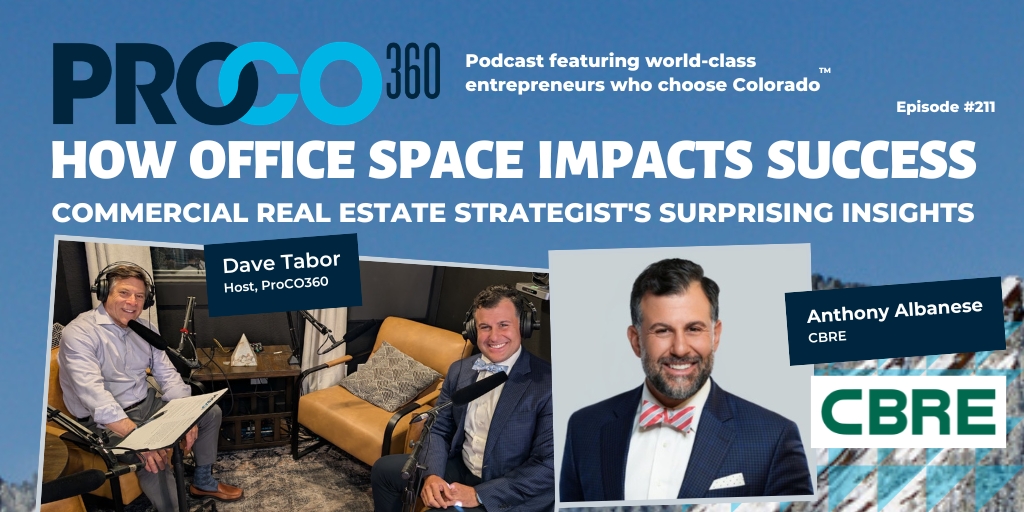
Anthony Albanese, CBRE
How Office Space Impacts Success
- good, the whole thing please I brought Anthony Albanese on to help you see something you didn't know you were missing. Twenty years at CBRE, and it turns out commercial real estate is nowhere near as simple as "find the space, sign the lease." Anthony shares insights most people never get access to: how commute times predict employee turnover, how you build a profile of the talent a company needs and figure out where those people actually live, how a company's financials tell you more than any floor plan. He's talked clients out of leaving Colorado. He's also told Colorado-loyal clients to grow somewhere else. We get into what he can tell about a company's health just from how they handle the real estate process, why he's walked away from clients over trust issues, and why he calls this a relational business, not a transactional one, after 20 years at the same firm. He also gives his honest read on downtown Denver's recovery and where the aerospace and defense boom along C-470 is pulling talent. If you've ever wondered what a real estate deal actually says about the business behind it, this one's worth your time.
Anthony Albanese 0:06
You know, when I go into the meeting, I have some idea of what they do, and then they describe it to me, and I think I’m in a sci-fi movie. You can start to create employee kind of avatar profiles to really identify neighborhoods and areas that attract that type of talent. What could and should happen for downtown Denver is that it becomes a much larger scale, wonderful mixed-use neighborhood. All I have is my time. We’re compensated when real estate transactions get completed, and so I have to decide which companies are likely to succeed.
Dave Tabor 0:44
This is the ProCO 360 podcast for people who love Colorado and love hearing from Colorado’s most inventive and successful entrepreneurs. Today’s guest is Anthony Albanese, a leading commercial real estate executive with CBRE. Anthony is different from most of my guests, while he does run his own business within the CBRE brand, I’ve asked Anthony to join me today to talk about commercial real estate. Why? Because I’m beyond curious about what the Denver and Colorado markets can teach us about Colorado’s entrepreneurial trajectory. I’m also fascinated about what’s going on? What’s going to happen, really, to downtown Denver, and how the business ecosystem is adapting to changes? And I don’t know, maybe not even adapting, but actually driving changes in Colorado’s business future. So, Anthony, welcome to ProCO 360.
Anthony Albanese 1:34
Thanks, Dave.
Dave Tabor 1:35
All right. So this is really interesting for me because listeners, I I was talking to Anthony, I had a preconceived notion. I thought I knew what he did because I thought he was a commercial real estate agent, and I know what that is. But as we talked, right, Anthony, you like you’re not that. So explain sort of what is different about how you approach doing what you do in Colorado.
Anthony Albanese 1:56
So yeah, it’s a lot more consultative than people imagine. The brokerage business really, you know, started call it about 3040, years ago on the tenant representation side, and a lot of the value was just understanding where space was, which floor in a building is available, and which tenant may be moving. And while there’s still certainly value in that, it’s a smaller piece of what we’re doing today. Today’s tenant representation, when you’re doing it at the highest level, has to do with understanding a company’s financing. Are they built to go public? Are they built to sell? Are they built to acquire along the way and then sell or go public? All of these things are going to change the operational need of the company, the footprint, the demographics of the different types of employees and labor pools, and where those labor pools are best found at the right wages. So, real estate kind of comes as a byproduct after you make all those operational decisions.
Dave Tabor 2:58
Yeah. So I would think though that most people, when they contract with you, they’re they think they’re getting somebody. They’re asking somebody to help them find space. They are much more simplistic than right than you just described. What are they missing?
Anthony Albanese 3:16
I usually start by saying, if you give me the ticket, you’ve lost 50% of the value. If I can help you define the ticket, the envelope that you’re actually operating in, that’s where I can drive a lot of value in terms of efficiencies, the layouts, the right area again in terms of wages, commute commute propensity is something that we take a strong look at. So we’ll map current employees and figure out how far is their drive to the current location, and if you’re planning on expanding, is that within a labor pool that’s also going to be within a maximum of a kind of 40-minute drive from the location? Because we see turnover above 20 minutes of a commute tends to be a lot higher. Wow! And above 40 minutes, it gets over 80% turnover in many areas, unless you’re a true employer of choice. So you’re then having to pay much higher wages.
Dave Tabor 4:10
Okay, so this is going to be a tricky question, but think about an example of somebody who came to you saying they wanted X, and after you talked to them, Y was like profoundly different from what they thought they wanted?
Anthony Albanese 4:25
I’ve worked with companies that said, “Hey, I’m a Colorado company. I’m dead set on growing in Colorado, and we evaluate other states and cities and for the right labor pools. And I’ve had clients make decisions to hire elsewhere. I’ve also, on the other side of that, had clients say to me, “I don’t think I can expand in Colorado. I don’t think there’s a deep enough labor pool here. I don’t think there’s going to be economic incentives available if we do grow in Colorado. And I’ve shown them that that’s not the case.
Dave Tabor 4:58
Wow. So, like, how much? You have to know about their business to be able to give them that kind of insight. I actually, this is why this is why I’m so curious because, like, I really thought you guys just look for space.
Anthony Albanese 5:10
I look for space that helps support a business, so I have to work with their HR. I have to work with different division heads depending upon the type of company. You know, there are certainly companies that are just kind of leader driven, and they make a decision based off of where the CEO lives. That still occurs. Yeah, yeah, I know. But there are certainly companies that, especially the the ones that are trying to scale significantly, where and have to go through multiple rounds of funding, where they’re getting asked questions from their venture capital, right? What is your growth plan? Is this market deep enough to grow? What is the facility’s plan? What does the facility actually cost? They’re going to get those questions as they go for fundraising. So I’m working with HR, finance, leadership to answer those questions ahead of time, and a lot of my clients use our material in their fundraising days. Yeah,
Dave Tabor 6:07
why would they use your material?
Anthony Albanese 6:09
Because we’re we’re showing the plan. We’re showing that it’s a legitimate plan, and when you apply the capital to this business, here’s how quickly it can be deployed. We’ve thought about the cost, so you’re as an investor, not going to get diluted a few years down, you know, six months down the road. Oops, project’s a lot more expensive than we thought.
Dave Tabor 6:30
So I would think, like, okay, just because I’ve been at this the the client end in the past, I’m like, I just want you to find me some space. Why are you asking me all these questions? Does that happen?
Anthony Albanese 6:39
And our oh, absolutely, in our specific experience together, working together, we needed to be around the capital. There was only so far we wanted to go from the capital, and certainly proximity to clients, proximity to specific vendors, those can be the driving factor. And then it comes down to a you know traditional kind of real estate leverage negotiation, and you know, like I said, there’s a lot of value in that. But where we kind of got on our path of well, you do a lot more than I was expecting when I described the clients that need help beyond that, need help really figuring out what is the location that helps them the most, and
Dave Tabor 7:22
now are you finding because you know back in the gogo.com days everybody was spending a fortune on finishings or furnishes and all that kind of stuff and then it sort of maybe slowed down a little bit now like what are you seeing around trends for just extravagance in finishing you know these kinds of things.
Anthony Albanese 7:42
The trend in the office is certainly around hospitality. So there’s a you know employee experience where people are trying to make the office nicer than someone’s house, right? So what is one of the benefits of coming into the office? You’re going to have access to might be a gym in the building. It might be lounge space within the space. It’s better coffee, etc. You’re trying to elevate the experience so that the employee says, “You know what? I live in a 800 square foot apartment. Going over to the office actually excites me. So do
Dave Tabor 8:18
they? Yeah. Do when it comes right down to it, and maybe it’s this mix of the two. But would do do employers tend to want to put more money into the finishing, you know, of the of a space or into the actual like location and things like that? What what tends to drive, and I suppose that changes. It’s
Anthony Albanese 8:37
kind of a combination of both, right? You can build the best space in the middle of nowhere, and no one’s gonna show up. So you got to make it easy for folks, and that’s again where that kind of location analysis on labor pools and propensity drive times, you know, comes into play to start, and then building the right type of environment from there.
Dave Tabor 8:58
Yeah. So what are you seeing in Denver now? I mean, there’s a lot of noise around companies leaving Denver. This is a Colorado podcast, and so much of Colorado is Denver. We have to go there, and there’s a sense of pessimism. I think sometimes around downtown, and then look at Cherry Creek, and there’s cranes everywhere. So, like, what is going on in the market? What are you seeing?
Anthony Albanese 9:18
Yeah, I’ll say I moved to Colorado and to Denver 20 years ago, and I absolutely love this city and this state. And you won’t find a bigger champion of the city and state than me. I think we’re coming off of a time period in 20 1819 where downtown Denver was idealistic. You know, there it was hard to beat. The size of the city was still very approachable. The retail was primarily local, not change driven. It was safe. It was inviting. I’d bring my four kids down to play in the Union Station fountains. It was a place my wife would. Like I said, just bring the kids downtown for a day and walk around and experience it. So we’re coming out of this, you know, just amazing environment. 2018, 2019, that hit a screeching halt in 2020, and you know, Denver did recover a bit slower than some other cities in the in the country. We just extended policies, etc. and being able to get together again and that type of stuff. So that had a negative effect, and so as a result of kind of coming back slower, as people would interact with downtown 2223, that might have been the last time they’ve been downtown because it wasn’t a very happy, healthy, safe environment during that time period, and I’ve been coming back. I started coming back downtown in 2020, had to, and so I’ve seen the growth back. I’ve seen the safety enhancements. I’ve seen the additional people on the street, the you know the signs of vibrancy continuing to grow, but you know there’s a perception that again some people may have that perception from three years ago, and that’s something we need to continue to work on.
Dave Tabor 11:18
How do you do that? I mean, as an as a broker, your job is to help companies get what’s best for them. How do you deal with if the if the perception is different from reality? How do you deal with that?
Anthony Albanese 11:35
Well, labor tends to drive the day, and there isn’t a better place in our metro area for a headquarters or access to most types of talent. So you know it’s the most publicly or it’s the most connected mass transit area in the city that gives you access to significantly larger talent pools for large employers downtown is hard to beat as you get into our suburbs, there tends to be more specific types of talent, and if you’re kind of a large headquarters with a G&A presence, decent G&A employment, it’s tough to beat downtown. So that ultimately, and you know, Colorado is the second most educated workforce in the country behind Boston, right per capita, and so we have so much to offer companies and the reasons why they should be here. You and I have talked some about the business environment and the policies that have kind of stacked one on top of the other, that have made that more difficult, none in and of themselves that were particularly the reason. But when you look in totality, it’s just become very complicated and costly to do business in Colorado. Those are self-inflicted wounds, as we’ve discussed, and we can decide to change.
Dave Tabor 12:58
Well, I hope we will. And now I want to shift gears a little bit because part of the way you approach doing what you do is being part of like groups of people that aren’t necessarily going to be your customers. They’re part of the business community. Talk about like what kinds of things you do. You’ve talked about traveling with groups of business people. Talk about how you’ve injected yourself or become part of these kind of activities and how that’s changed your ability to operate in the market.
Anthony Albanese 13:26
Yeah, you know, working in the built environment-that’s where we spend 80% of our life, whether it’s in our house or an office or place of work-and so it’s community driven, right? Everything to me about what I do is about the community, and so knowing other people who are pro-business in the community, knowing our political officials and their viewpoints on and policies towards business and safety, those are all extremely important to not only my career but it’s where I raise my family. Right. Yeah. So yes, I went on the trip to Japan with Mayor Hancock and have done some exploratory trips and you know see other cities. But I do a lot of that in my job, anyways, when I’m helping companies evaluate which city to be in. So I kind of get a lot of those exploration experiences. We go to another city, meet with other major employers, talk about the pros and cons. So I see, really, how Denver stacks up. You know, just on my day-to-day business. Yeah. So
Dave Tabor 14:30
in those conversations, and you’re talking about like how to, like, what do you do with that information?
Anthony Albanese 14:34
It’s again kind of leading my clients to understand the why, right? Why would you grow in Colorado? Why would you pick Texas? Why would you pick Atlanta? It’s understanding your alternatives and being comfortable with the decision that you’re making. So even if it’s not something you have any interest in doing, it’s good to know an alternative. Yeah,
Dave Tabor 14:58
I suppose it helps you. Help your clients think more, more carefully, more deeply about considerations that are important to them. Yeah. All right. So, shifting gears a little bit, one of the things I’m intrigued with is what we can all, as business leaders, learn from the way the real estate market behaves, and it it like there has to be you mentioned 20 years in the business. There has to be some kind of pattern recognition, maybe that when you you see things that are happening in the market that sort of help you unfold or understand what’s happening in a broader economy. So what are you seeing today along those lines?
Anthony Albanese 15:37
Yeah, I’m constantly asked to be an economist and do predictions on real estate markets, and again, it comes down to employment. So you know, I’m looking at what industries are being invested in, which industries are in specific markets. So I would say, you know, a major driver in Colorado right now is we have excellent engineering talent. Some of the political changes that were made towards funding of startup startups in the aerospace and defense have had major benefits to Colorado and a number of groups that are working on technology. That you know, when I go into the meeting, I have some idea of what they do, and then they describe it to me, and I think I’m in a sci-fi movie. It’s there’s some really incredible stuff happening right now in aerospace and defense, and you know with that, you know that’s just one example of like a growth engine right now, and they’re going to look for specific types of spaces in a specific portion of the metro area more often than not. Again, there’s some challenging of of that that you can’t just have a herd mentality because if everyone sets up shop in the same place, that talent pool can all of a sudden that looked fairly deep become fairly shallow. So there has to be a what are other alternatives conversation to make sure that we’re not putting ourselves at risk as one industry square. Well,
Dave Tabor 17:04
I’ve seen some aerospace companies along my c4 70 corridor where I I don’t know this to be the case, but I heard they set up shop there just specifically to attract talent from bigger, more established players. Is that kind of stuff happening?
Anthony Albanese 17:20
Yeah, it’s there’s the vast majority of our engineering talent is around kind of the northwest market through the southwest market. So if you’re around the c4 70 loop on the west side, you’re going to access that talent. If you go up again, this is how specific it gets. If you go up to I 25 and 225, you start getting out of that drive time propensity for that type of talent. So that’s how, within a 10-mile difference, it can completely change your access.
Dave Tabor 17:52
So, to the let’s talk about aerospace engineering talent, for example, are they living in those areas because their employers are there, or are they living in those areas? Because there’s something about those areas that they that they just like.
Anthony Albanese 18:05
It’s generally because there’s
Dave Tabor 18:07
nothing down there except a few restaurants. Hardly like there’s nothing. Yeah,
Anthony Albanese 18:11
you can start to create employee kind of avatar profiles of you know if you’re paid a certain wages and you’re interested in a certain level of schools for children, or and you’re at a certain age, you can you’re interested in certain types of restaurants. You can start to really identify neighborhoods and areas that attract that type of talent for their residential living.
Dave Tabor 18:41
Ah, so you know, I that’s so yeah they so they want to buy a house that’s in this price range that’s near this or near that and this is where they’re going to near this good school because this is where they are in life.
Anthony Albanese 18:51
Yep, exactly.
Dave Tabor 18:52
Wow. So it’s probably not these people along that corridor not in their first job. Typically, they’re maybe a little further along in life. How interesting. All right. So, are there any patterns that you’ve seen in your 20 years? But then
Anthony Albanese 19:05
also, I’m sorry. Just yeah. So you know, then it could also be in an emerging industry like aerospace and defense, and you’re looking for deep engineering talent. School of Mines is putting that out. CU Boulder. So you’re also looking for how many graduates are coming out of these schools every year, and so a closer proximity to those schools also helps.
Dave Tabor 19:26
Yeah, yeah, interesting. All right. Hey, quick reminder to listeners: this is ProCO 360, named Best Colorado Business Podcast since 2021. Anthony’s making it better. I’m your host Dave Tabor, and this is a podcast for people who love Colorado and the stories of Colorado businesses and entrepreneurs, my guest today is commercial real estate expert Anthony Albanese. I want to take a moment to thank my friends at Via Technologies. They host ProCO 360, and their great team helps the website stay up and running. This is a company building a growing business by working closely with really smart. Clients, they partner with them to achieve client growth using web-based technology and digital marketing. So, via technologies. Thanks, guys. All right. So, curious if you do you ever you and I were teasing because I put some kind of like a Matahari predict your futurist headset thing on you on a on a on a photo, but like, do you ever feel like when you’re involved in real estate as deeply as you are that you have some sort of insight that most of
Anthony Albanese 20:29
us don’t
Dave Tabor 20:30
do? So talk about that. Yeah. So
Anthony Albanese 20:31
I would say, you know, I’ll give my prediction on downtown Denver. I think 25 was the bottom. We are in a recovery phase. The recovery is going to happen for two reasons. I’m kind of seeing macro expansion across the board, kind of across all industries. It’s incremental expansions, and then we’re also going to have product deletion. Right. So CU Denver, it’s been reported, so it’s not private information. They’re buying, or close to buying, 10 50/17 Street. Yep, it’s a 610,000 square foot building that is current currently has 500,000 square feet of vacancy in it. Wow, that’s going to be removed from the market as an owner occupied building, and then you’ve seen what some other folks are trying to do at Losado in terms of looking at multifamily conversions of some existing office space. So there’s a good chance that close to 3 million square feet. Our downtown’s only 31 million square feet. So 10%
Anthony Albanese 21:39
So roughly 10% There’s a good chance that it comes off of the market, you know, between now and the end of Q1 of 27. Wow!
Dave Tabor 21:47
Now I’ve heard some real estate experts, commercial real estate experts, say that some of these older buildings just need to come down, just need to demolish them, and let’s get on with
Anthony Albanese 21:58
it. Yeah, and one of those may have been me. Do you feel that way? Been in some publications saying that in 2019, I sent a list of 15 buildings to the city. I was on the Denver Urban Renewal Authority board, and I sent a list of 15 buildings that I said in 2019, these buildings are becoming functionally obsolete. They’re small floor plates. They have low ceiling heights. We need more residential downtown. We should think about either conversion or demolition of these buildings, and you know what roles the different departments could play in in making that happen. Didn’t get a lot of traction in 2019 21. I got a email. Hey, where’s that list? Oh, really? So what happened? COVID happened, and yeah, yeah, yeah. It became obvious, and that
Dave Tabor 22:47
these older buildings just weren’t serviceable.
Anthony Albanese 22:50
They were getting to 50, 60% occupied in the best of times, right? And if they made up, call it about 10 million square feet of our town town market, and they’re only getting to 5 million square feet of occupancy or 6 million that couldn’t be consolidated in half. Meanwhile, you know our city had been very planned in terms of office in this area, multifamily in this area, and you know on your comment about Cherry Creek. I think it’s the example of a beautiful mixed-use neighborhood, right? It is hotels, it’s a it’s apartments, it’s office, it’s great retail, it’s safe, it’s walkable. All of those things are all easily accessible, and you know, really, I think what could and should happen for downtown Denver is that it becomes a much larger scale, you know, wonderful mixed use neighborhood where you can get 24/7 retail. Like that was part of the issue, right? When we had the COVID lockdowns, retail was solely dependent on the office crowd, yeah, but
Dave Tabor 24:01
it seems it seems so different, though. I know Cherry Creek North or Cherry Creek is different, but it also seems that they have the ability and maybe the funds to control the environment in a way that downtown Denver just either won’t, can’t. What what do you like? What is that?
Anthony Albanese 24:21
No, it’s private investment. It’s a willingness for private investors to invest in that area. In downtown, we have Union Station as the example, right? So where I was going with COVID lockdowns hit the CBD in a way that it didn’t quite hit Union Station because Union Station was a mixed-use neighborhood where the people in their apartments were still supporting the retail, so then when you look at the recovery, folks said, “Oh, proximity to good restaurants, proximity to hotels, proximity to a barber shop and two grocery stores. So people, the the
Dave Tabor 24:58
vibrancy can. Because people were living in that area, but in a pocket of downtown where it’s only commuters in during the day and they don’t come back, right? That is like a death knell.
Anthony Albanese 25:10
Exactly, and with with the renovation of the convention center at the same time, which was also supporting that retail, there was no clients, and so then it becomes a chicken or the egg. No retail wants to go in if there’s no occupancy, and no occupancy wants to occur unless there’s retail. I am optimistic with the expansion of the convention center, and you’re starting to see it. It is pushing additional retail into the CBD coming from that 14th Street towards 17th Street. So there is an engine that’s kind of pushing it.
Dave Tabor 25:43
Okay, now I want to ask a couple of other questions because I’m just curious about it. Shifting gears a little bit, but I’m curious, like, what can you tell about a business by the real estate decisions that it makes? What can you tell about its health, its culture, you know all that.
Anthony Albanese 26:02
Yes, a lot. Yeah, a lot. There are, for
Dave Tabor 26:08
example, for example, there must be companies. I’m interrupting you, but there must be companies that, based on how they obtain real estate, you would want your friends and family to work for, and others you would like don’t go there.
Anthony Albanese 26:20
Yeah, yeah. Again, real estate in the office world, in particular, is an investment in in the employee experience, right? So, was a was a company thoughtful about that, or were they just looking at the last dime that they were spending? You know, in terms of just internal organization, like I said, I have to work across multiple divisions, and so the internal communication, how much information they have, or how much information they’ll need to prepare based off the questions I’m asking, I get a full insight into all of that.
Dave Tabor 26:59
Wow! Yeah, so you could really tell from from early on with a company like, is this? Can you even? Do you ever sometimes in your own head like predict these guys are going to succeed or these guys are going to fail based on how they work with you?
Anthony Albanese 27:12
I have to. I have to because all I have is my time. We’re compensated when real estate transactions get completed, and so I have to decide which companies are likely to succeed and are going to actually be able to transact. So it’s a filter that I have to apply. You
Dave Tabor 27:32
walk away from companies that just seem. Come on, really? Yeah. What do you What do you tell them? You just don’t have your shit together. Obviously, you don’t say that, but you just walk away. So you’re not ready to work with me.
Anthony Albanese 27:44
For me, it’s a lot of it’s about trust and transparency. And if I’m not getting that from potential clients or even existing clients, you know, I’ve certainly had the times when I’ve had to walk away from those clients and just say, I can’t actually advise you unless you’re giving me truthful information. And so, okay, who’s
Dave Tabor 28:08
what’s an example of something that somebody’s told you that wasn’t truthful, like revenue, financial stuff? What?
Anthony Albanese 28:13
Yeah, or just even what they’re evaluating. You’d be surprised some people, and and I don’t necessarily fault them, right? It could be past experience with other folks. You know, people approach our business in all different types of ways, so they might be really guarded in what they’re telling me. Actually, trying to complete something else, but they think they’re going to get information out of me that will leverage something else. I’ve had that happen before, and and now I know the kind of red flags and triggers. Okay, what’s a
Dave Tabor 28:47
red flag and trigger?
Anthony Albanese 28:48
Just when I’m asking questions, how guarded someone is on those questions, or if they
Dave Tabor 28:54
act non-transparent, yeah, yeah, exactly.
Anthony Albanese 28:56
So,
Dave Tabor 28:58
well, I’ve often wondered though, in like working with an agent, something like if I tell them everything, will they divulge that to their other to their counterpart so that the two of them can negotiate for a speedy transaction? Like
Anthony Albanese 29:13
that’s where it comes to trust. Yeah, absolutely, and that that certainly can occur. You’ve
Dave Tabor 29:18
probably seen it occur.
Anthony Albanese 29:18
Yeah, I’ll just give you my personal journey. I was three years into the business, and I had to take a hard look at in the mirror and say, “Is this a business I want to do? And you know what I what I realized was I loved doing what I do. Love working with companies. Love understanding their operations and financial situation and where they’re trying to go. I just I think founders are incredible. I think you know we certainly take commerce for granted. Yeah.
Dave Tabor 29:49
So so you must have coming up through the ranks. You must have seen people behave in all different ways in these kinds of scenarios, right? Yeah. So.
Anthony Albanese 29:59
And that’s where I ultimately decided if if I’m true to myself and I’m true to my clients and I do right by my clients and I advise them that hey do this small short term transaction instead of what could be a three times or 10 times bigger transaction, but I did what I believed was right by them, then I can continue to do the business. Yeah, and so you know, like I said, it’s a trust business, and it doesn’t matter what advisor you’re hiring in any industry. But that’s yeah.
Dave Tabor 30:31
But that’s so interesting because I, I always thought it was a transaction business.
Anthony Albanese 30:37
Some people view it that way.
Dave Tabor 30:39
Well, then I’m. I mean, I’ve been ignorant to the way it could be done right. Yeah, if you want
Anthony Albanese 30:43
staying power in in my business, you can’t view it as a transactional business. You have to review it view it as a relational business. And
Dave Tabor 30:52
well, you’ve stayed under the same banner under CBRE for your whole career. Hardly anybody does that, right? So what’s that about?
Anthony Albanese 31:00
CB has a very high ethical moral standard. They hold people accountable, and it’s just if you want to operate at the highest level, I found CB is four times larger than our next biggest competitor. The amount of resources that we have, the footprint that we have for me to operate globally with a with a company. I always describe working for CB as you know, and it’s like playing for the Yankees, right? If you’re not the best shortstop, you know that they’re going to be looking for the best shortstop. You have to be on your game, but because they give you so much, right? It’s a it’s a wonderful platform to operate on in terms of information and technology, and knowing that you have great counterparts no matter where you’re operating, I don’t have to question: Is our Dallas broker the top broker in Dallas? Is our DC broker the top broker in DC? And so, because of that, I found myself at CB for 20 years, first job out of college. That’s so
Dave Tabor 32:00
cool. Good for you. So, yeah, if I, but you really have your own business within it, right? I mean, you you report to yourself mostly, don’t you?
Anthony Albanese 32:11
Yep, I’m judged by my P and L within the company. I’m an independent contractor.
Dave Tabor 32:16
You have your own. It’s your own business within underneath that brand, right? Yep. All right. Last last question, then, really is again using your insight hat based on what you’ve you’ve talked about where you see the Denver market going. What other things are you seeing that listeners would appreciate hearing your perspective about?
Anthony Albanese 32:38
Yeah, I’d say the macro economy seems to be doing fairly well. I think you know a lot of our local localized feelings about the economy are localized. There is certainly growth throughout a lot of the country. This kind of leads back to our policies and you know the way that we’ve approached business over the last you know decade or so in Colorado, I think we’ve taken our beautiful state desirability to live here for granted. It is something where employers have choice, and there are real ramifications to employers choosing other places than Colorado to either grow or relocate altogether, that prosperity that’s lost in those circumstances is not something we want for ourselves, our families, our neighbors. It’s something that supports the overall ecosystem and environment that we live in, and the quality of that environment that we live in. So, I would say you know the insight is that we do need to kind of get back to where we were when I moved here 20 years ago in terms of being a very pro-business state, a very kind of stay out of your way, and we you know and embracing entrepreneurs, and embracing the people that want to build the technology of tomorrow, the people that want to cure cancer, and the folks that you know want to tackle every disease in between, and the folks that want to provide legal services. It doesn’t matter. Yeah, we need to embrace the fact that economic activity is a is a positive, and I do think it was a byproduct that we had grown so fast for so long. Really, kind of coming out of the great financial crisis, I was on, you know, the Western Region calls with folks in L.A. and in Seattle and all these other markets, and Denver really started its recovery quickly into, you know late 2009, early 2010, I was on those calls until 2011, 12, when the other markets said that they were starting to recover. So we had this really amazing growth engine that was primarily driven by oil and gas at the time. They were willing to hire a. Accountants, no matter what your background was, or engineers, no matter what your background was, legal services, etc. that kind of pulled us out a lot quicker than the rest of the nation and started the immigration of the millennial population that we were the number one, number two destination for for a decade, and I think with that amount of growth that we had, we started to become anti-growth. It was a lot of changes. There was a lot of that. People were
Dave Tabor 35:27
like, “Okay, I’m here. We can stop now. Yeah, yeah, yeah, yeah. And we’ve
Anthony Albanese 35:32
kind of stuck ourselves in that anti-growth mindset when we need to when we need to grow again. I, you know
Dave Tabor 35:37
what? That’s a. I think you’re exactly right. I think that’s that’s the note we’ll end on. I’m your host Dave Tabor, and today on ProCO 360, you’ve been listening to my conversation with real estate expert Anthony Albanese. Anthony, it it was great to have you on ProCO 360, and wow, I learned a lot about what I had no idea about real estate. So thank you. Thank you, Dave. It was awesome. Listeners, glad you’re here on ProCO 360, where we say “Live, Work, Love Colorado, because you and I and my guests can be successful anywhere and choose Colorado. You make the show successful by subscribing to the ProCO 360 podcast, and it’s a huge help if you submit a review in your app. That’s the show Live, Work, Love Colorado.
Transcribed by https://otter.ai