



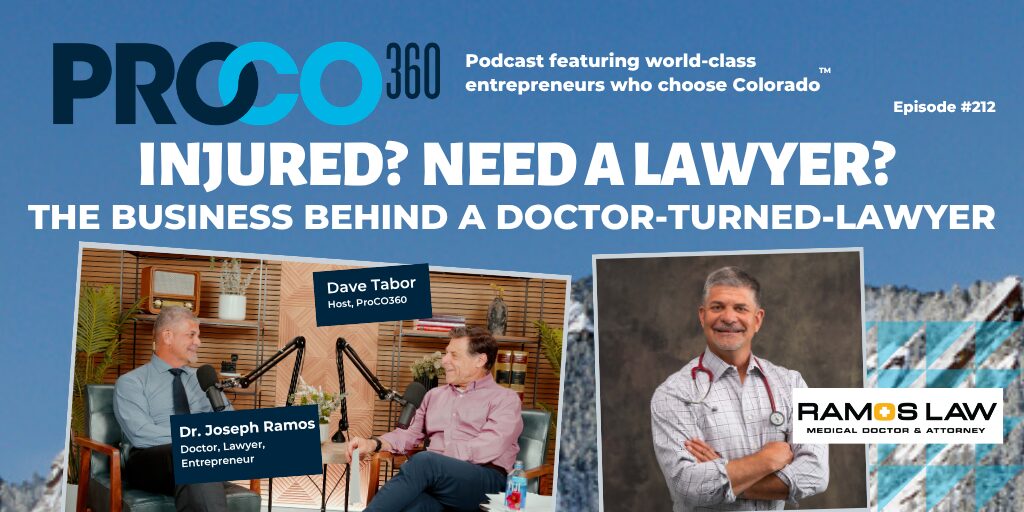
“The phone here rings 168 times an hour… but of all of those people we probably take 1-3%.”
Dr. Joseph Ramos
Injured? Need a Lawyer?
- I've been fascinated by personal industry lawyers that advertise and every time I drive past one of those billboard ads, I wonder what's actually going on behind it. Finally!... I talked with Dr. Joseph Ramos, a board-certified emergency medicine physician who left Denver Health to practice personal injury law. He's testified as an expert witness over 100 times, and that experience showed him a gap between how attorneys and doctors see an injury case — one he decided to build an entire firm around closing. What stood out to me most was how deliberately built the business is. Ramos Law runs its own call center handling 168 calls an hour, and Joseph shared how he structures pay for his staff attorneys so they're pursuing the firm's interests, not their own. We also got into what's really behind those massive verdicts you see in the ads — and why the number on the billboard isn't always the number that matters. It's a rare look at a doctor-turned-attorney who built a firm on medical evidence and transparency instead of billboard hype.
Speaker 1 0:06
I was presenting this as evidence to the people of the motor vehicle crash. I would have thought bullshit. That’s exactly what your adjuster said. Bullshit. You make stuff up your standard attorney. Yes. The phone here rings 168 times now. I have my own call
Dave Tabor 0:22
center. 168 times an hour,
Dr. Joseph Ramos 0:24
but of all of those people that call in, we probably take one to 3%
Dave Tabor 0:40
Give me a few examples of questions you ask that uncover the real stuff from the I want Ramos to get me a bunch of money.
Dr. Joseph Ramos 0:54
I am on a mission to change that exact perception of personal injury internals.
Dave Tabor 1:02
Welcome to the ProCO360 Podcast for people who love Colorado and love hearing from Colorado’s most inventive and successful entrepreneurs. I’m Dave Tabor. Today’s episode will satisfy a forever curiosity of mine. If I’m the victim of an accident, who should I call? So, which TV commercial star, which billboard photo, bus placard, phone number, all that? Seriously, I’ve always wondered about the business side of personal injury law. So, I’m really excited to learn about that today with my guest, Dr. Joseph Ramos. And having Joseph Ramos is kind of a bonus for me too, listeners, because if you’ve listened to my past episodes of ProCO360, you know how I value extremely value a great niche, and medical doctor turned attorney is just that. So Dr. Joseph Ramos spent years treating trauma patients, then went to law school and built Ramos Law, which now runs offices across Colorado and one in Arizona. We’re going to get into that doctor to attorney niche. We’ll also dig into personal injury law, the billboards, TV spots, all that huge marketing budgets, and serving clients. How does that all actually work? So, Dr. Joseph Ramos, Joe, welcome to ProCO360.
Dr. Joseph Ramos 2:18
Hey, thanks for having me. I’m really, really excited to be here, and it was exciting to learn about your business today before we got started. Yeah, and
Dave Tabor 2:24
listeners, we talked before we even started that I was going to ask you some probing questions about this whole notion of of personal injury law, and you said go for it. Absolutely. So, having said that, though, I am going to toss you a softball to begin with. Okay, let’s hear. Which I hate to do. I hate to toss softballs at the beginning? But okay, how did this all happen? You went from being a trauma surgeon to being a lawyer who has this law firm. How did that all? How did that all happen?
Speaker 1 2:48
Well, and it was actually to make sure that it’s the record straight here. Emergency room. I’m a boarded emergency medicine physician.
Dave Tabor 2:56
Got it.
Speaker 1 2:57
That’s what got me out to Colorado. Was in those days it was Denver General. It had recently turned Denver Health Medical Center, and down here it was known as the Knife and Gun Club. Yes, remember here? Yeah, remember the the written book on that? Yeah, yeah, yeah. And it turns out in trauma and emergency medicine, there there are these treatises in different specialty fields where the where people have written the book is what I mean by treatise, and attendings here the two main leading books in training trauma and emergency medicine was written by the two by two of the attendings at Denver Health Medical Center, Vince Markoviche, Peter Pons, Tintinelli had been there. They were the the leaders, and so to come train here was an honor. I had never been to Colorado, so it was really a treat. I came out here and yeah, came out here and started my life down at the trauma center. That’s what got me to Colorado. Yeah, that’s what got me in medicine here, and then you know my my law school career followed thereafter.
Dave Tabor 3:57
Yeah, but what made you decide that being a trauma doc wasn’t enough.
Speaker 1 4:02
Well, you know. So here’s the thing: I love medicine. I love trauma. In fact, I’ve told you know our staff gets tired of hearing me say this, but you know, if God came down tomorrow and said you can only do one thing, I’d probably do medicine. I love it. Really, really love it. I there was just I got to testify in a lot because everything that happens bad in life usually starts or ends up in the hospital, and I was seeing this over and over and over, where you know there’d be questions about which angle did a bullet hit someone, what was the bruising pattern here, what was the cause of death here, what was the actual injury, at what level was the spinal fracture so there was paralysis, blah blah blah. When these attorneys take any cases to court, they need a doctor. They need an expert, and so I started acting as an expert. I testified over 100 times as an expert, which is a lot. To do that, you probably have to write 1000s of reports because every report doesn’t end up when they ask a question doesn’t end up in testimony, but I. 1000s of reports and testifying over 100 times, and through that, begin to see really what I describe as a as a major gap between law and medicine, and it wasn’t the gap I had always expected, and that that prompted it
Dave Tabor 5:12
all. So what’s the gap?
Speaker 1 5:14
Well, the gap that I always expected was just you know doctors hate attorneys. That’s the that’s you know really I I didn’t say many nice things about attorneys to any of the attendants or residents. I was an attending 10 years at the University Hospital, did my time at Denver General down here. So
Dave Tabor 5:31
all right, in your ads, I’ve seen a few. I’m sure you say you know I I can be the best lawyer for you because I understand medicine. Yeah. So, what’s an example that you’ve seen where a non-medical doctor attorney would have seen it differently or missed something that you saw? A really specific example.
Speaker 1 5:52
Oh man, I know there’s a zillion. I have so many. I know. Let’s start with one, and that is the gap I ended up eventually discovering when I would go testify in these cases. I ended. I begin to really dawn on me that if the attorneys don’t know the medicine, they can’t represent the injured person fully, not in the way that’s that really gets a jury to understand. And I start saw this time and time and time again. So here’s some examples to answer your question. We had a case just not too long ago where a person, an elderly gentleman, had slipped and and fell in a place where a condition shouldn’t have existed, he broke his hip. They come in, they ask us to look into it. We look into it all. About six weeks later, he dies of a heart attack. The gentleman does, and we were dealing with him on a fractured hip. But I know from doing journal club after journal club after journal club, that post hip fracture in the three months following post hip fracture, your your risk of having a myocardial infarction, a heart attack, goes up somewhere between 18 and 25% because you get so many inflammatory mediators traveling throughout the body, that it that goes everywhere, not just to the hip that was fractured. So you can actually tie the hip fracture directly to the heart attack. Now think of that, right? A medical doctor would.
Dave Tabor 7:05
Yeah, yeah.
Speaker 1 7:06
One of my first cases that I actually did super well on is I had a person with an Achilles injury, a heel injury, and it was where the Achilles attached to the heel, and there was a lot of inflammation. The person had been in a motor vehicle crash, and this had started not immediately after the crash. They went to the you know the hospital for neck and back injuries or something else, but within about a week or so, they began to have this heel pain, and it became more and more inflamed, more and more inflamed. And pretty quickly, they had a tendon tear there, and I was presenting this as evidence to the people in the motor vehicle crash. I
Dave Tabor 7:40
would have thought bullshit. That’s exactly
Speaker 1 7:43
what the adjuster said. Bullshit. You make stuff up your standard attorney. Yes, I send him literature to shows you know 10 times your body weight transfers through your Achilles. 10 times your body weight. So if you work 200 pounds, 2000 pounds through the flexion of the of planting the sudden you know planting against the floor is a sudden inflammatory condition. I gave them the medicine, inflammatory conditions, tendinopathy, forced through the that, and they paid for it. Because here’s the thing: most attorneys go after money like they beat their chest, like a 10,000 pound gorilla. Give me the money, or I will sue you. That’s so wrong. If you give the insurance the information, reasonable information without stretching the truth, they’ll look at it reasonably. If they don’t, they’ll end up with a bad faith claim. But you need to give them every chance to look at it reasonably. And here’s what I found: they’ve been very reasonable to my firm
Dave Tabor 8:36
because you’re able to bring other things to light that maybe others wouldn’t have. Absolutely. So, has your job changed then from being okay? I’m going to say a lawyer, whatever. I mean, you’ve got hundreds of cases going simultaneously right now because of the size you’ve been proven. So, has your job changed now to one where you’re just kind of looking at these things from a medical perspective? You don’t run any cases yourself anymore? Do you?
Speaker 1 9:01
No, I do because I have a passion for it. So if you think about this, I’m on my second career, but I’m young in this career. I really got Ramos Law going in pretty significantly in about 2012. So to have a firm with you know about 70 attorneys, 300 staff members assisting them, nine offices. We’re now not only in Arizona and Colorado, but also in in Wyoming, it has grown tremendously. But I, because I’m so young into it myself, I still love it. Not too long ago, I’m sorry to say, I just lost a trial. I love it, and I work on cases aggressively. One thing has changed, and that is, I like to look at all complex injury cases, the MRIs, the CT scans, through my medical eyes to see how I want to do this. I like to talk to the attorneys and explain what an injury means to someone for their future. And there were so many injuries that I began to get bogged down where I was the bottleneck. So what I did was I hired a couple doctors that work in-house. I have an in-house medical division. I hired a billing manager from a major medical practice. In town, hire two office managers. So that
Dave Tabor 10:02
was actually a question I was going to have for you: is how can you possibly scale your medical training applied to legal cases? Yeah, and you’ve just answered it. That’s by hiring more doctors
Speaker 1 10:16
in house, which most law firms would think, what a waste of money, what a waste of overhead! Not when you take our approach to the cases. It’s it’s not only necessary; it’s mandatory. Okay,
Dave Tabor 10:27
got to shift gears now. Yeah, when you were a physician working operating rooms, patients came to you. Most people, at least I think of physicians as like you think of them as service oriented, but not marketing aggressive marketing types. In order to grow and compete in this world that you’re in, you have to be an aggressive marketer, right? What kind of mental shift had did you have to go through to do that?
Speaker 1 10:57
Yeah, it was a huge one. I’m glad you asked that, Dave. I um, I don’t like that part of it. I don’t like the marketing part.
Dave Tabor 11:03
How can you say that and have your face everywhere?
Speaker 1 11:05
I know. I really don’t. It took took a lot of thought. That doesn’t make any sense. I know. It took it took a lot of thought and literally prayer between me and my wife decided to do this. But why we decided to do it was people kept saying, “I wish I knew about you six months ago. I wish I knew my so and so was in a garage. My aunt. My uncle. Anyway, long story short, we dove into that arena, and I quickly lost us $750,000. My wife was the first time ever in our in our lives together where she questioned one of my business decisions. She said we were down 750 in a year, and she said, “Are you sure about this loss stuff? She said it differently than that. Yeah, probably with more emotional. Yeah, yeah, yeah, yeah. So it is a, it is. I don’t, you know, looking back, thankfully, I went into it kind of blind and and ignorant because I had no idea what I was getting into. I mean, at that time, and you know, still today, you’ve seen these advertisers in town, these these law firms. They’re everywhere, every commercial. Yeah, yeah. And I jumped in and started competing, and and it’s worked out well.
Dave Tabor 12:01
And I read doing some research for this again. Listeners like massively curious that firms like yours can spend 15 to 20% of revenue on marketing. That’s like more than you know, like Nike does single digits. Like what the hell?
Speaker 1 12:17
Easy that much. Yeah, yeah. 20% is absolutely an easy amount. You know, million or millions per month. You know what? That’s
Dave Tabor 12:28
it’s it’s massive. You got to have some cojones to compete. And I even read things like listeners, if you know about like search engine optimization and pay per click and stuff, that you could pay as much as like $400 for a click
Speaker 1 12:43
for a single click that doesn’t for a single click doesn’t even come to your firm.
Dave Tabor 12:46
Yes,
Speaker 1 12:46
yes, that’s 100% accurate.
Dave Tabor 12:49
Mind boggling. Yeah,
Speaker 1 12:50
it like I say, I’m glad I didn’t know what I was getting into. And then and then who would
Dave Tabor 12:57
have the courage to do that?
Speaker 1 12:59
And well, once you start getting some successes. You know, I’ve always been someone who I don’t mind. You know, to me, success is a journey, and I don’t mind expensive journey. I don’t mind investing in that journey. Yeah, so we do that heavily.
Dave Tabor 13:13
That’s incredible, and it’s been
Speaker 1 13:15
fun.
Dave Tabor 13:16
So let’s talk about the stats, though. Okay, what percentage of clicks Become clients.
Speaker 1 13:22
Oh gosh, probably 1% to 3% Yeah,
Dave Tabor 13:28
that would mean basically 404,000, $40,000 of paid click and paid search for a client
Speaker 1 13:41
using that example, yes, and which is why I don’t do that. I started out that way, and part of probably part of my 750,000 in losses that we talked about. Now I’d have to look back to tell you what percentage of it was that. I thought this pay per click thing was the thing. Here’s what it is for businesses like this. It’s like crack cocaine because you know you’re paying and people are clicking. You’re paying people are clicking and you’re seeing the clicks and you’re seeing how many people it takes through your website. But then what’s an actual case that converts? And by the time they do that, and it’s very very very low, and and so but it it gets you. And then here’s what happens: the minute you turn it off, crickets, no calls. Yep. So I am not involved in that type of advertising rarely ever. If I have some particular I am targeting, maybe briefly. Yeah, but it’s very brief with a set budget that turns it off at a certain point. Yeah, because it’s just not wise advertising. Well, it
Dave Tabor 14:32
was interesting. Well, I searched for Ramos Law, and you weren’t first. Yeah, one of the one of the even bigger name firms came up first. I’m like, wow! If I click, what is that going to cost this guy? Yeah, and pretty interesting. Okay, so more more ratios. Then, so of all the people who contact you, what percentage of those become clients?
Speaker 1 14:54
Well, that that answer has changed. Oh, what percent become clients? Yes. Okay, so I just had this. Last month’s conversion rate from calls. We so we have different ways.
Dave Tabor 15:04
Incoming calls.
Speaker 1 15:04
Incoming calls. About 54% of the clients that the initial impression is that they pass the first screen. About 54% of those will become a client. But that first screen, give you an example. Yeah, yeah.
Speaker 1 15:20
The phone here rings 168 times an hour. I have my own call
Dave Tabor 15:24
center. 168 times an hour.
Speaker 1 15:26
168 times an hour. I have my own call center.
Dave Tabor 15:28
That is astounding.
Speaker 1 15:29
Yes, and and 70. I think now 72 people on phones. Wow. But of all of those people that call in, we probably take one to 3% Okay, I want to ask you some questions first, but I’m looking across the studio here at Danny. Yes, like does that number freak you out? It’s not. I’m like, holy cow, that volume is freaking nuts. Okay, so let’s talk some more about the volume. Everybody, I’m I’m
Dave Tabor 16:00
guessing that a lot of people. I’m getting agitated here because this is what I really want to get into. I’m guessing that most of those people who call just want like somebody to write them a big check for not much of anything.
Speaker 1 16:13
There’s a lot of them. Yes.
Dave Tabor 16:14
Yeah. So, what questions do you ask? Give me a few examples of questions you ask that uncover the real stuff from the I want Ramos to get me a bunch of money.
Speaker 1 16:26
Yeah, the the it’s actually it’s so much easier than you think. It’s not very scientific early on to determine. First of all, you know we look to see who was at fault in the crash and what their injuries are, and if a person says I got rear-ended, and you say, “Okay, so we know that the person. That’s a good start. Okay, yeah, that liability is probably going to end up being clear. And we ask him about injuries and said, “Well, I’m not really injured, but I saw these commercials on TV that I can get a lot of money. You know, I know what we’re not the law firm for you. The call pretty much ends there gently. We’re not the law firm for you. We take care of injured people, and injuries are important to us because it’s it’s our ethics and our integrity on the line because injuries are pay or recoveries are paid for injuries not for pretty pictures not because you were hit it’s not you know there’s there was this attorney ran this commercial get a wreck get a check
Dave Tabor 17:13
yeah this is not
Speaker 1 17:14
that firm
Speaker 2 17:15
yeah at
Speaker 1 17:15
all and what about
Dave Tabor 17:17
well what about that stuff that you were talking about earlier that’s like weird they’re like no I don’t really. Nothing really hurts. My toe hurts, or whatever. Like, like, how do you discern between those? Oh,
Speaker 1 17:27
real injuries are clear. The person where she had the Achilles stuff. That the only reason that became a challenging medical issue was because the Achilles stuff came out after a couple weeks of the tendinopathy developing. But she had neck and back pain. She had a total car. Was towed from the scene of the crash. She went to the hospital by ambulance. There’s somebody with a high potential of injuries, you know, pretty substantial injuries, and and you can just tell there. There are people who will tell you frankly off the bat. Not really that injured. There are people that will tell you, you know, my neck hurts, but I’ve always I’ve had prior neck injuries. It’s about like it has been. You know, they get this interpretation that you know again, getting a rec equals a check, and it doesn’t. It’s a real quick way to lose credibility as a law firm, in my opinion.
Dave Tabor 18:09
Do you need credibility in your line of work? Seriously, no. I’m
Speaker 1 18:13
glad you asked that because I’m I’m I’m out to change. Lawyers are the brunt of many jokes and deserve it and deservedly so, they’ll sue on anything, they’ll do anything, they’ll take anything. That’s the idea out there, and I think there’s probably some truth to that. I think because law schools pump out more law students than there are possibly jobs for, and they start to take anything to be a lawyer, and then they’re taught to you know zealously advocate for clients. So what they do is, in my opinion, they take on things that that bring their own credibility at an issue.
Dave Tabor 18:45
Don’t you think that if I were talking to any of your competitors in the same way, that they would say the same thing?
Speaker 1 18:51
Probably they probably would. The difference is is that between them and between us is if if you talk to the competitors and you ask them, do you selectively screen? Do you you know whatever? What what do you screen? And if they talk anything medicine, they’re probably making up about half of it.
Dave Tabor 19:08
Okay, so when you’re saying that too, and I I respect everything you’re saying, I find it quite interesting. And but I mean, aren’t they all screening in some way for profitability.
Speaker 1 19:25
Well,
Dave Tabor 19:27
before you answer that, okay, think about it for a second because I forgot to thank my sponsor. I want to remind listeners this is ProCO 360, named best Colorado business podcast since 2021. I’m your host Dave Tabor, and this is a podcast for people who love Colorado and the stories of Colorado businesses and entrepreneurs. My guest today is Dr. Joseph Ramos of the Ramos Law Firm. I want to take a moment to thank my great friends at Via Technologies. They host ProCO 360. They’re great help. I appreciate all the help your team gives me to manage our website. Also, they are building a great and growing. Client-focused business. They work with some really smart clients who hire them to collaborate on strategy and technology to help them grow their businesses using web-based tech and digital marketing. So, wanted to take a moment again to thank my friends at Via Technologies, and then get back to Joe because I asked you a question about screening for profitability, and honestly, the like that’s what it seems like to me. Now, hearing what you said, maybe I feel differently, but still, it seems like a law firm like yours screens for are these cases that we can win and earn profit.
Speaker 1 20:40
Yeah, so you’re right, but this will take a little bit of explanation. Any company or any business owner who told you that they didn’t screen or look at profitability before they did anything-I don’t care if it’s a printing company, yeah, whatever-they’re lying if they say don’t look at. You know, that’s fair. So, so that applies across the board. Myself and any other law firm out there is looking at. Here’s the difference: when most when and you can tell this by the ads when a law firm advertises how much they get people, I got billions recovered. I got this settlement. So and
Dave Tabor 21:12
so got me 400,000. Blah blah blah.
Speaker 1 21:14
What they want is any client that they can get a margin on, and that’s their idea of profitability. You yep. This is an $8,000 case. I can get it done for six. Sign it up. I’m not here to. Sometimes you work smarter, not harder, and sometimes volume doesn’t equal the same ultimate outcome financially, and we get a tremendous amount of volume of calls, but as you could tell from earlier in our interview, the screen I have set up the filter is has very very fine pores at the end of it about what gets through. I want to help a lot of people, but I can refer people. There there are law firms out there right now that survive almost single handedly based on my referrals to them of what we don’t take. I want to, you know, medicine is complex, law can be complex, and that’s where I want to work. That’s where I want our focus. So our attorneys do some really incredible things, and just to tell you that that’s not lip service. Our Colorado Trial Lawyers Association every year that there’s things, there’s these wards you can buy and these stamps you can put on your thing. All these outside companies, Colorado Lawyers’s peers elect the best attorneys in Colorado for five different awards. Two of the last three years, this firm has gotten those awards. That’s from our peers from doing real law, right? We just came from the CTLA convention this year. They invite speakers up to this thing that they think are the finest attorneys in Colorado. Our law firm had a speaker in that last year and this year. Last year we had two. This year we had one. We so our peers are recognizing like we do the real deal, and I think part of that is not putting out there. Hey, if there’s a possibility to get profitability here, come to us. You know, good for them, good for their business model. Not good for me.
Dave Tabor 22:58
So you must, especially. I’m going to use this term because you’re a medical guy. Triage, your your your clients, and you know I’m guessing that some are high volume transactions. Like this is going to be a quick settle. We can help them. Let’s do it. Others, you know, are going to be very complex, very expensive, and very time consuming. Yes. How do you think about those?
Speaker 1 23:18
Well, the first thing is is just transparency with the clients from a business perspective. It’s easy for me because, unlike many law firms, I don’t run a line of credit to run advertising or to pay anybody. I pay for most of my advertising cash up front. Took me a while to get going that way, but you get better deals, and it takes off a lot of stress. I can sleep every night, and so when it gets to so now, if the business end of it’s covered. It gets to the client aspect, and the client aspect is transparency right up front, because sometimes you know log moves slow, and if I think to litigate and get to the end of a case successfully is going to take us 18 months, 20 months. The client may have been expecting three or four from TV commercials they’ve seen. Right, they just need to know up front if they want to push a different direction, we honor the client, but I want them to know before we do what their options are, what I think the risks are, what I think the benefits are, why I would do one versus the other. If it was my family, and I think by doing that, you form a really loyal client-based group, and it’s probably now here at Ramos Law, probably 30% of all of our referrals, maybe even a touch more-it varies from month to month-are from past clients, and that is great. That’s saving me money. There’s another business, a business person there.
Dave Tabor 24:30
Sure, it’s an easy sales cycle and the whole bit. Now, it’s argued, or maybe the perception is true, that having a contingency fee model aligns you with your client. You only win when they win. That’s true of your firm too, right? That’s exactly a contingency fee.
Speaker 1 24:48
Yep.
Dave Tabor 24:49
And I don’t know what are they-35, 40% or something like that. Yep. Very easy.
Speaker 1 24:52
If it settles versus if it litigates, anywhere from 35 to 45% We have a four-tiered fee system that depends on how far in the case we get. What. We get paid.
Dave Tabor 25:00
I see, and so when you do that, that one could always say that your needs are aligned. Like I have a financial planner; they get 1% and you know, if I grow, they grow. Blah blah blah, that kind of stuff, right? But in your case, couldn’t you be more interested in settling than the client? You know, I mean, how do you make sure that you stay aligned in that way?
Speaker 1 25:24
Well, there’s a business, a really strong business principle here that’s even outside of ethics. First of all, start with ethics and character because it’s most important thing to me, and I have integrity and I have a sense of responsibility, and I can’t look a person in the eyes and tell them, “Yeah, you should take this 90,000. I really think it’s worth 100. I can’t do that. But assuming you’d even believe that, think of this: whatever an insurance company, because they they they are big data gathering businesses. If they understand that my firm will take 10,000 less than a case is worth, if the policy limits are 100, and I’ll take 90, they just gather data on me. What do you think they do over the years? That’s what I get from then on downstream. So it makes it easy for me from a business perspective because it’s not that case, it’s not that fee, it’s my business. It’s the next 1000 cases I damage if I settle for $1 less. Imagine this: if you do just 100 cases, and you settle every one of them for $10,000 less than they are, that’s $3,500 per case in attorney fees less. Multiply that times 100 cases. 100 cases is nothing for this firm. That’s nothing. Imagine what my business losses would be at the end of the year by allowing them to have me take anything less than fair, so I just don’t do it. I don’t do it because it. That’s why I’ve been able to grow. We do it. We do it right. I’ve taken a longer, slower road. Thank God, it’s been fast. I think compared to most businesses’ growth, but it’s paid off.
Dave Tabor 26:56
How many clients you have at a given time?
Speaker 1 26:58
Oh man, 1000s. Because I really, well, yeah, yeah. I mean, I’ve I’ve nine offices in three states, 1000s of clients simultaneously. Yes.
Dave Tabor 27:06
So then, as you’re all the the values you were just sharing with me about how you think about cases and you’ve got how many attorneys?
Speaker 1 27:14
About seven, I think 72 now.
Dave Tabor 27:16
So they probably have varying values based on you know their kids going to college, or someone is sick, or this and that. I mean, how do you manage how they perceive these things?
Speaker 1 27:26
Well, one of man, this is good, man. This is really good. I like this. I’m high fiving a personal injury attorney. What the hell? I like that. So one of the things that I do is this. First of all, one of the reasons that I pay for all my advertising, all my expenses, and I have all the stuff, you know, paid for upfront, and I and I took that route, was because I’m not financially pinched like a lot of people. Now, I don’t want that attorney to be financially pinched either, right? Attorneys that work for pure contingency in a law firm, you have to worry about what their motivations are.
Dave Tabor 27:59
Yeah,
Speaker 1 28:00
what is their school bill, their private school bill for their kids? What is their car payment? I don’t have a single attorney that works for contingency only. I pay salary plus an amount, and the reason is is I want every one of them not to have to worry about their next month, their house payment, their car payment. If they settle zero, they make zero money. I get the list every month. Usually, there’s 10 to 12 of them that brought in $0. Sometimes more, $0. It’s okay. It all balances out over long term. If you have good people practicing good law who care about people, you will do well. So, they have their salaries that take care of them. When they’re doing well on cases, they do really well, and I think that’s how you do it. I think if you put your attorneys, okay, how successful you are, if you put your attorneys on a pure contingency basis, now it may not be just my values that’s depending. And a lot of law firms do
Dave Tabor 28:49
that, right? They do a lot. Is your base enough that people can pay their bills?
Speaker 1 28:52
Oh, well enough. What? Every one of them over six figures for as a base, as a base, yeah. Well, and it ranges in experience and trial position, but not one under six figures, not one, and and you know, so they absolutely all have their their lives covered, yeah, and then they can just go up from there. That’s cool. All
Dave Tabor 29:11
right, let’s talk about what I told you. I wanted to talk about before we wrap, before we get started, and certainly before we wrap up, and that’s this whole reputation of of plaintiffs’ attorneys. Yes, that it’s a racket. All the things that you’ve heard, like okay, what do you think?
Speaker 1 29:30
Yeah, I was worried. Well, I’ll tell you how worried I was about that when I used to go to dinner parties early on, and people would say, “Hey, what do you do? I was going to ask you that exact question. What do
Dave Tabor 29:39
you say at parties? I used to say, you know,
Speaker 1 29:41
I’m a doctor, and I would run from the attorney thing because attorneys have, in many cases, a well-deserved bad reputation. But here’s what I’ve realized over time. I was asked recently by someone, “Do you think you help more people in law or in medicine? And I think I felt more people in law. So now I don’t run from it. And here’s why. I am on a mission to change that exact perception of personal injury attorneys. Nobody likes them until you need them.
Dave Tabor 30:07
Well, for sure. Until you start
Speaker 1 30:08
getting harassed by a company, an insurance company who’s not going to pay you, questioned that your condition was pre-existing, you didn’t have the right gap insurance or the right bodily injury coverage or uninsured motors. Until you find yourself in a hole and you go. What do I do? Let me go to somebody who does this every day. Are you thankful, right? So my goal is to educate the public and to do right by people. You know, my firm is something we do that very few firms do. I never take more than the clients. There are some firms where, you know, the attorneys make more than the clients. Believe it or not, because the medical bills get paid out of the client settlement. So if you get $100,000 settlement, the attorney fees are 35,000, and the person has 60 grand in medical bills. What’s left over for them? 5000. But I can’t do that to people. So, so what do
Dave Tabor 30:50
you
Speaker 1 30:50
do? So statutorily, we’re allowed to our attorney’s fee. So we take a $35,000 attorney’s fee. There’s five left over for the client, and we split our attorney’s fee with them.
Dave Tabor 30:59
Really?
Speaker 1 31:00
Yeah. So we don’t get $1 more than they do.
Dave Tabor 31:01
Is that legal?
Speaker 1 31:02
Absolutely. Yeah, absolutely.
Dave Tabor 31:04
Obviously, you’re a lawyer, and you just told me that. Absolutely, attorney
Speaker 1 31:07
can depend can base their fee on what they feel is fair for the work they’ve done. So while the client has signed a deal with me that it’s allowed me to maybe exceed them by 30 grand, I’m not going to hold their feet to the fire on settlement day on that. That’s just again looking people on the other side for sure. How could you do that? Yeah, yeah. And that’s the kind of things I think over time that are changing this perception of personal injury attorneys. If more personal injury attorneys would do that, this perception would change. If more personal injury attorneys would tell clients, “No, sorry, you should not be suing somebody for that case, perception would change. Somebody’s got to start.
Dave Tabor 31:39
Yeah. Huh. All right. My belief is that we all pay for large settlements. That sure, the insurance company might pay today, but they’re always going to get their money back. They’re just going to raise premiums, and so if you get crazy big settlements for your clients. I’m going to pay for that.
Speaker 1 32:05
Massive misconception.
Dave Tabor 32:06
Tell, explain that then.
Speaker 1 32:08
So, and this goes all the way back, and you can look this up. Go back and look at like when we had personal injury protection back in 2001. We had PIP in Colorado. They paid a mandatory $100,000 of medical in any case, plus did an attorney’s fee settlement. The promise at that time by the insurance lobby to our state legislators were: if we could just get rid of this $100,000 that we have to pay for this care, insurance rates would go down. They’ve not. They’ve gone up every year. Now you might say, then that well, that’s because of these settlements or these lawsuits. Not at all. How does State Farm when we sell these wildfires burning? Who’s paying for all those houses? State Farm, Allstate farmers. Well, I
Dave Tabor 32:45
will eventually.
Speaker 1 32:46
Exactly. When when there’s a hurricane, when there’s a flood, when there’s anything. So what they do every year is they lump all of this into what their ultimate profit’s going to be. So many people perceive the what we do because we’ve sued someone who has an injury to get them back a recovery to help them in the future as the cause of these rising rates. The truth is, until there’s no fires, no wind damage, no hail damage, no you name it, right? These rates are going to keep going up, and guess what? Even then they might. I’ve never seen them turn around and say, you know, this year we only paid 100 million in car crash claims, so we’re lowering rates 3% No,
Dave Tabor 33:25
but I did get a rebate check from my insurance company recently. wasn’t big.
Speaker 1 33:30
I did. I need that insurance company. I did, but all right. So why is it that the perception, and I think maybe you’ve answered some of that already, Joe. The idea that all these ads are saying, you know, somebody got me this, somebody got me that, but the idea that these larger payouts or maybe any of the payouts are kind of bullshit. That they’re just inflated by firms like yours to get people money, and that it’s just bullshit. Yeah. So there’s a couple things on that that you have to realize. The first is, and this doesn’t answer your question, but but I think the public needs to know this: most massive payouts or massive verdicts get advertised never get paid out. The reason is we have caps in the state, so we’ve literally done trials where you walk in, the jury gives you a $5 million verdict, they leave the room. They think they took care of this person because of the evidence you presented, and then the judge reforms the judgment back to all the caps. So, and and and for example, in our state, my medical malpractice is one example. Up until about a year ago, if you died, your life was worth $500,000. 500,000. I could go sue for your family once you’re dead, get a 1012, $14 million verdict to replace your income for them to take care of them, to replace their loss of a dad, of a you know a husband, so on so forth, whatever they place that value on. I could sue for that. The minute that the jury that gives us that value, think they take care of you, they leave the room to reform back to the to the caps. Now those caps. Now going up over the next five years to be like about 1,000,005, but if you think about it, if I lost my wife, million five, really, if a jury heard my story, and heard about me and my wife, and they felt like you know maybe the income she contributed or what she did, how she was in my life, our kids’ lives, all just everything was worth 5 million. Why is it worth 1,000,005? And that’s not even now. That’s going to take three more years, four more years to get there. Right now, her life would be worth 511, five 600,000. So, point being, first of all, first point is most large verdicts never get paid out. Yeah, you get them on paper. You look good. Check in the mail. Much smaller. The McDonald’s coffee case.
Dave Tabor 35:40
Yeah.
Speaker 1 35:40
You know everybody talks to spill coffee to yourself, get money. Do you know how much she got?
Dave Tabor 35:44
No.
Speaker 1 35:44
Well, rumor is 3.5 million. Look it up. Look it up in the in the. I heard the verdict
Dave Tabor 35:48
was 10 million.
Speaker 1 35:49
That was 3.5.
Dave Tabor 35:50
3.5. All right.
Speaker 1 35:51
I think they settled that case. They finally settled. I think for 280,000.
Dave Tabor 35:55
That’s how much she got. Yeah.
Speaker 1 35:57
So she didn’t have to her vagina.
Dave Tabor 35:58
Yeah, I heard that it was actually pretty bad. When I did looking into it, how could this woman get so much money? And it turned out it was really bad, really
Speaker 1 36:06
bad.
Dave Tabor 36:06
So, but the the but then all these ads that say so and so got me this much money, the the or those are probably the amounts of the of the verdicts, but not necessarily the payouts. That’s
Speaker 1 36:21
exactly right. When you see the, you know, there’s some law firms are putting up these maps with pins with 2 million, 7 million. Those all version
Dave Tabor 36:29
sizes.
Speaker 1 36:30
There’s guys like me on this that I don’t advertise that way. Just shaking my head, man. So misleading, so misleading.
Dave Tabor 36:37
Wow. And
Speaker 1 36:37
that’s why people start to think, hey, I got in a wreck. I can get a check.
Dave Tabor 36:41
Yeah, yeah.
Speaker 1 36:42
It’s not true. It’s just not true.
Dave Tabor 36:45
All right, interesting. So you’ve already. I’m going to ask you one, and then we’re going to switch gears for our final kind of wrap up part. We’re almost way over, but that’s okay. So if you could change, do you change the industry? Would you put your thumb on the scale to make your competitors behave differently.
Speaker 1 37:06
Yeah, you know I would absolutely. Anything that misleads people isn’t right, and it creates a lot more work. You know than because I have to I have to realign people who think that I’m not fighting for them because I’m not promising them millions of dollars, and the other thing is is that is that you know I have to live in their shadow in the image they create, and I just don’t see anything good about that. So in my opinion, attorneys can should they be able to advertise? Yes, like any business. How it got to this crazy stuff about you know telling people or promising them the value of their cases and and showing people these checks and how much I just I’m just not into that. It’s it’s it’s not fair to those of us in the industry who don’t do it. It’s not fair to the people who are seeing it and responding to it. It’s like advertising that you know a a fast food hamburger is all natural. Fair enough. All right. As we wind down, I when I when I drove and I did a little research, I saw that your partners with the the Broncos, the Mammoth, Rapids, Rockies. I saw your tailgating vehicle and your parking lot, which looks pretty cool. Yeah, thank you. So talk about that and sort of how that plays into your whole business and into your whole way of thinking about the community. Yeah. So what I realized is that Colorado is a sports state. I came from Nevada. That was where I grew up at. We had no professional football team when I was there. The Raiders were much later. And so when I came to Colorado and I got into this sports culture, I mean, there are 20-year waiting lists for Broncos tickets, right? So there is a massive audience with sports teams. But here’s what’s really important: sports athletes have they have all these people that look up to them, that are followers of them, that you know they put them on a pedestal. And what I begin to realize is that if you can, if you want to make a difference in people’s lives, which is is my goal, and we’re a part of a lot of charity, a lot of stuff in Colorado to prove that you want to make a difference in people’s lives. Get to the people that they’re going to look up to. Get to the people who have the eyes. So it fits for me in two ways. Number one, it’s a great advertising platform because we’re a sports state. But number two, all these eyes for most people now. Maybe when we get to be 50s or 60s, we’re not we don’t quite idolize these athletes like many. But I’ll tell you, you’d be surprised up that up until that age how many people you know if Garrett Bowles is over in my suite at the game, you’d be surprised how many people will stop by wanting pictures. They want this that all this stuff you know they idolize them if you connect with good people, and you with good values with these athletes, they’ve got a platform. Now you can now you want to talk about impact. That’s not just advertising impact. That’s personal impact, and that’s why I align with the sports teams and the sports players.
Dave Tabor 39:55
That’s cool. What else should we talk about before we wrap up? As far as like where you. Heading what you’re doing with Ramos,
Speaker 1 40:02
you know where are we headed with Ramos? That’s a great question. Here, here. I guess here’s one thing I would wrap up with. I anybody who who ever thinks about Ramos, the law firm, or even any personal injury attorney. Let’s just do this for all personal injury attorneys. Before you form your judgments of them, find out who you’re dealing with. Look into them, learn about them a little bit. What do they do? You don’t believe how many people I’ve had come to our law firm that say, you know, I I can’t believe you actually support support you know Dare to Share or CU Young Life or I saw you support the Broomfield High School team or I saw you with Pomona Wrestling. Like, why do you do? They learn that we actually believe in charity. You know, Halloween candy for all these kids up in Northgate. $10,000 worth of Halloween candy for them. You know, it’s not. It’s not how much you can put in necessarily $1 amount with any of that. But what are you really doing? What do you put? You can tell a person by where they put their time and where they put their treasure. And I think that for personal injury attorneys, it gets back to that, you know, that image. I it’s one thing I don’t like. It’s one thing I try to to build and repair every day. And I wish every single person at least looked into my law firm, looked it into that, because behind everything, you can tell a person by again where they put their time and their treasure. That would be my message.
Dave Tabor 41:21
All right, I think that’s a good note to end on, shall we? Sweet, well, it’s been fun. I’m your host, Dave Tabor. Today on ProCO360, you’ve been listening to my conversation with Dr. Joseph Ramos of the Ramos Law Firm. Joe, fun conversation, awesome, and that was so fun to actually, you know, have a moment of high five with somebody like your industry has fastened me forever, and I’m glad we got to talk in depth about it. Hey, thanks! I enjoyed the time. Good listeners, glad you’re here on ProCO360, where we say live, work, love Colorado, because you and I and my guests can be successful anywhere and choose Colorado. You make the show successful by subscribing to the ProCO360 podcast, if you haven’t yet, it’s a huge help if you submit a review in the app. That’s it. Live, work, love, Colorado. Awesome. All right. Well, that was a fun conversation. That was awesome. You let me dig into everything I wanted to. Appreciate all the questions. I love them. Good, great questions.
Transcribed by https://otter.ai