


I said to everyone who joined the firm: “You’re not joining the legal profession – you’re joining the energy industry.”
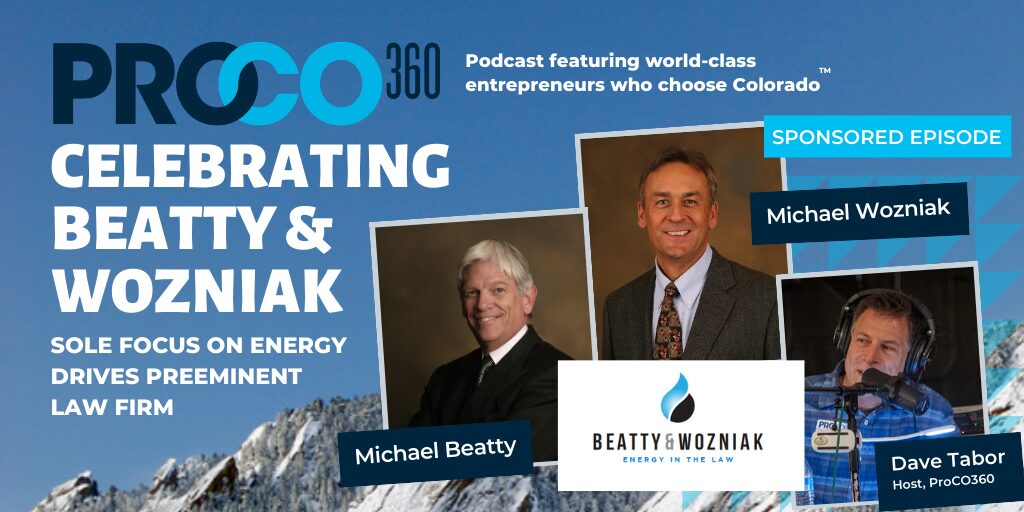
Michael Beatty, with Michael Wozniak, co-founders of the Beatty & Wozniak law firm
Sole Focus on Energy Drives Preeminent Law Firm
- When Jen Lester of Philosophy Communication asked me to create an episode celebrating the founders of the Beatty & Wozniak law firm (https://www.bwenergylaw.com) she said, "These guys are great, they're characters, you'll love them." I trust Jen so I agreed. I had no idea how much fun this interview would be, how much I would enjoy Mike and Mike, and learning about how they built the firm. This episode is more broadly instructive than about creating a thriving specialty law firm. Mike Beatty and Mike Wozniak illustrate how having the courage to go all in, 100%, with focus on a niche, can win, and win big - and how they did it. And not just any niche - it has to be the right niche - we talk about that. And we talk about how to have a successful partnership, clients as friends, partners as friends, and living ones' values. Initially this was going to be a privately distributed episode. It was just too good not to share (with permission) with everyone. It's one of my favorites.
Beatty & Wozniak PROCO360 Audio Transcription
Dave Tabor:
Welcome to a special edition of ProCO360. I’m your host, Dave Tabor. ProCO360’s mission is to shine a light on the notable entrepreneurs and leaders who shape Colorado’s business landscape, and today we’re celebrating the extraordinary lives and 30-year careers of two of our state’s most influential figures, Michael Beatty and Michael Wozniak, co-founders of the Beatty & Wozniak law firm.
From arguing landmark cases before the U.S. Supreme Court to founding a boutique firm that became a national powerhouse, these two men have defined what it means to lead with expertise and integrity. Today, we’re stepping inside their partnership to explore the stories, the shared passion, and the bond that built a legacy.
Join us as we go all in on the careers and friendship of Beatty and Wozniak. Michael, Michael, actually you guys go by Mike. Welcome.
Mike Beatty:
Thanks so much, Dave.
Mike Wozniak:
Thank you, Dave. Appreciate it.
Dave Tabor:
Listeners, Mike Wozniak is in Scottsdale right now, so he’s remote on Zoom. If I refer to you, Mike, as “remote Mike,” listeners, you’ll understand that.
But guys, start with the origin story of Beatty & Wozniak.
Mike Beatty:
Mike, since you called me, do you want to go first?
Mike Wozniak:
Yeah, I will. I’ll back up a little bit, back to even just before the origin.
I can tell you all that in the early ’90s, late ’80s, we were doing a deposition of a guy named Jack Grindberg. Grindberg had sued a lot of my clients, and it turned out a lot of Mike Beatty’s clients. The way I first met Mike was he walked into the room while we were deposing Mr. Grindberg, and Mr. Grindberg said that he was getting physically ill.
And I said, “Why are you getting physically ill?”
And he said, “Every time Mike Beatty walks into the room, I get sick.”
And so that’s how I first met Mr. Beatty.
Dave Tabor:
And you decided that was partner material right there?
Mike Wozniak:
Actually, right there.
Mike Beatty:
Yeah, actually my response to that was, “That’s the greatest compliment I’ve ever received as an attorney in my life,” which Jack didn’t like.
Mike Wozniak:
A few years later, honestly, Dave, what had happened was I was representing a lot of producers and oil and gas producers, and they had gathering agreements with a company called CIG out of Colorado Springs. I was working with some of the more junior lawyers, like Becky Naker, and everything we would do, I would hear had to be run by some guy named Beatty.
And I kept thinking, who is this mysterious man behind the screen? It turned out that it was Mr. Beatty.
So I was doing a lot of work. We were on other sides of deals because I represented producers and he represented the pipeline companies. That’s how we first met.
Mike Beatty:
Yep.
Dave Tabor:
Now, back then, 30 years ago, the laws and regs around oil and gas, it wasn’t anything like it is now. Was practicing law for the energy sector basically easy back then?
Mike Beatty:
No. No, it was actually terrible back then because natural gas prices were regulated at the interstate level. They were deregulated at the intrastate level. There was confusion all the time. There was really chaos.
And then all of a sudden, during the deregulation phase of natural gas, what happened is that there was litigation constantly between producers and pipelines as they were trying just to stave off bankruptcy.
Dave Tabor:
So how did you two come together and make the firm?
Mike Beatty:
The most important thing to say is that we had very close mutual friends. We had never met each other, but we had individual friends who were very close to both of us.
Over the years, I had heard, “You really need to meet Mike Wozniak.” Mike had heard, “You really need to meet Mike Beatty.”
And what happened is that I ended up getting a phone call from Mike asking if I would be interested in joining his firm. I said that I would reveal everything, but only on one condition. At the time, I realized his incredible reputation. I knew what it would be like to be able to get him to come over and join me.
So I said, “Look, I’m going to open my books. I’ll be open kimono, but you’ve got to make a promise to me, and that is: if it’s better for you to join my firm, you’ve got to join me. If it’s better for me to join your firm, I will make a commitment right now that I will join your firm.”
And that’s the way we turned.
Dave Tabor:
Which way did it go?
Mike Beatty:
Well, it’s Beatty and Wozniak.
Mike Wozniak:
And that answers the question, yeah. Unfortunately, he wowed me.
I was the managing partner of a firm called Dorsey & Whitney, a very large national firm, and I was heading their Denver office. I had a great job, but at that time in my life, it was a little bit of an easier job. I had opportunities, like Mike did, to get on various boards of directors. We had opportunities with clients to join them and invest with them. I was also trying to get into the political realm.
These were all things that a national law firm didn’t appreciate. They created conflicts in their eyes. They were also regulating our rates.
And I knew that Mike Beatty was the absolute best pipeline lawyer I had ever heard of, and I was a decent producer lawyer. We decided it would be amazing if we could bridge the gap, because normally we’d sue each other. But we said, “Well, is there a way that we might be able to take both sides of that industry and combine it?”
Dave Tabor:
Backing up, where did the interest in oil and gas come from? Mike, you go first.
Mike Beatty:
Mine is a little unusual.
I went to Houston. I practiced at one of the big firms, Vinson & Elkins, but I said, “I’m not doing energy work. I want to be a trial lawyer. I’m not going to do energy work.”
I ended up becoming a law professor at the University of Idaho. My wife ended up with a Ph.D. from Washington State and got a job at the University of Colorado in Colorado Springs. I promised that I would go help her career, so I moved to Colorado Springs.
I had no way of getting a job in that town. I was just on a sabbatical, is what I was doing. I was offered a job at Colorado Interstate Gas Company. I took the job, and it changed my life. From that point on, I ended up being an energy lawyer, and I loved it. I loved the industry and I loved the opportunity to practice in it.
Dave Tabor:
Mike Wozniak, how’d you develop this?
Mike Wozniak:
Mine was a little different. My last year of undergrad school, I actually took a class in environmental law. It really wasn’t law. The new environmental movement was just coming up in the mid-’70s, and I really enjoyed it.
They kept using hypotheticals the whole time about how this energy industry was doing terrible things, and I kept thinking to myself, there’s got to be two sides of that story.
So when I graduated from the University of Colorado Law School, I had the opportunity to go work with a real estate slash oil and gas firm. I started off doing real estate and gradually got into the regulatory side of Oil and Gas Commission work. I didn’t start that until ’82, but I probably did 500 Oil and Gas Commission hearings over the years on the producer side.
That really became my focus before I met Mike.
Dave Tabor:
It seems that a lot of law firms will have an energy department. You guys chose to focus exclusively on energy, on oil and gas. That sounds like it’s worked out, but when other people say, “Oh, our firm does that,” or “this firm does that,” what do you say?
Mike Beatty:
Well, actually, that was a very conscious decision. That was something I was totally committed to.
And I said this to everyone who joined the firm: “You are joining an industry, and it’s not the legal profession. You’re joining the energy industry. You need to believe that you are part of the energy industry.”
You still have to have the skills of a lawyer, but the key to success and the key to getting trust from your client is to be able to tell them never to ask that question: “Now, what do you mean by an MCF or an MMBtu? What is that? How does gas processing work?”
Dave Tabor:
Don’t they also have to know that you’re on their side? The energy industry is constantly badgered by people, sometimes rightly, sometimes with misunderstandings. Don’t you need to align philosophically at a deep level with your clients in this space?
Mike Beatty:
That’s really a fun question.
One of my comments is that there’s never a great general counsel of an energy company who’s not a Democrat. There’s never a great president of a company who’s not a Republican, because you need to be able to understand the process. In order to be an effective general counsel, you’ve got to be an entrepreneur. You’ve got to be a real believer in the energy industry if you’re going to be the president.
So it does work. I was Roy Romer’s chief of staff at one point and then chairman of the Democratic Party. I was a big Democrat. But I truly believed then, and I believe now, that natural gas is a much better alternative than coal and can really make a big difference in terms of moving us to wind and solar.
Dave Tabor:
Yeah. Wozniak, you’ve been nodding and just waiting to get in. What’s your take?
Mike Wozniak:
Well, here’s the funniest thing, which is a really cute story.
I had this great job as managing partner at this other law firm, and Beatty and I decided when we were going to get together, we were going to do something totally different. As you said, Dave, all these other law firms have a department: “I have domestic relations, and I have a little energy group, and I have this.”
We said, “Nope, we’re going to do it for an industry.”
I remember directly after we made the announcement, I was walking down the 16th Street Mall and I bumped into two of my old friends I practiced against at Holme Roberts & Owen. They both said, “Mike, you’re making a big mistake. You can’t put all your eggs in an industry basket. You guys are going to go out of business in three years.”
Well, obviously there is no more Holme Roberts. There’s still a Beatty & Wozniak.
Dave Tabor:
If you’re tied to an industry, and everybody knows about the ’80s when there was a huge oil dip and all that, did your business almost go away when oil companies were in hard times?
Mike Beatty:
No, not at all. In fact, we were busier than ever because they were involved in litigation. I’m a trial lawyer, so I was constantly busy. I had people lined up outside the door trying to get us to take care of the case.
Again, the reason they wanted to do that is that I never said to anyone, “I am a litigator, and it makes no difference whether it’s a patent case or an automobile accident or domestic relations.” I said, “I know one industry, and I can take care of you on that. I know the regs. I know the rules. And it makes all the difference.”
Dave Tabor:
I’ve got to believe it does because, in my experience meeting a lot of executives from the industry, they feel picked on a lot. Having someone in their corner who’s a believer, or at least is on their side, has to be a huge advantage.
Mike Beatty:
It is. And you see it now in the tech industry, which is that litigators are saying, “We are solely involved in the tech industry and that’s all we do.”
So this idea of specialization is incredibly important, especially as the rules, the laws, and everything become more and more complex and society becomes more complex.
Mike Wozniak:
When litigation wasn’t busy, I had a title group. When things started getting busier again, the regulatory area in Colorado was continually doing new rules and regulations. Oh my gosh. So we had a group that would do that.
There was always some part of the industry that was very active.
Dave Tabor:
Mike Wozniak, I mean, I’ll ask you both. The energy sector has gone through cycles of popularity, we’ll call it that. Do people ever take you off to the corner at parties and thrash you or ask you? Are they more curious? Do they have some sort of judgment around the world in which you work?
Mike Wozniak:
Absolutely. Always.
Dave Tabor:
Good or bad, right?
Mike Wozniak:
Oh gosh, I mean, it was great, and Mike will certainly attest to this too.
We had some great friends. I’d always get invited to parties in Boulder, and as soon as people would say, “Well, what do you do?” at first you try to say to yourself, do I say I’m a natural resource lawyer? Do I say I work in energy because energy can be solar, everything? Or do you just come right out and say it and say, “I’m an oil and gas lawyer”?
So I usually just, especially if I knew they would be really upset, I’d say, “Yep, I’m an oil and gas lawyer,” and then we’d start the discussion.
But if you’re really honest about it, I would be able to say, “Listen, one of my jobs is to ensure that all the oil and gas companies do comply with the environmental regs and do comply with all of the Colorado regs that are in place.”
People soften up a little, and I would portray it as saying, “Listen, we are, just like judges, the people who interpret the law. We are the people who ensure that people follow the rules, and we can produce energy in an environmentally sensitive way and comply with all the regs that are necessary to make sure that you have the energy.”
But the last thing I’ll say is, right now if people ask what you do, they say, “Are you just like a landman?”
Dave Tabor:
Of course not exactly, but was there a moment when you guys realized that focusing on a niche, on the oil and gas industry, was the right call? Was there a moment in time that you looked at each other and felt that way?
Mike Beatty:
Yeah. That’s the simple answer to that question.
But from early on, the biggest problem we had was what Mike pointed to earlier, which is that people were saying, “Could you really succeed if you had a lawyer who was representing producers and another lawyer who was representing pipelines?” There had been a history of litigation as a result of deregulation.
Once that deregulation was over, people really realized that it was critical that they begin to work together, because division made it easy to conquer them.
My point, and I tried to make this all the time, was to say: the history of the world, whether you like it or not, is the history of energy. What you see all the time is people who need energy, and if you have it, you succeed. If you don’t have it, you’re going to fail. It’s critical.
So Mike is totally right. A big responsibility we had was to make certain that people did it responsibly. It didn’t bother us at all to go out and get the head of EPA Region 8 and say, “I want you to be in our law firm.”
And people would say, “How could you do that?”
And you’d say, “Because it’s critically important that we comply.”
Dave Tabor:
Is that what you found in your careers, that as you guided your clients to comply, they would? We’ve all heard stories of companies acting like, “OSHA? What’s OSHA? That’s for other kinds of companies.” So talk about that.
Mike Wozniak:
The companies that we had the most fun working with and being dear friends with were the ones that, yeah, Dave, there was always that “Do I have to?” and what I always felt best about was saying, “Yeah, we have no choice. We are going to do this right, and we’re going to comply, and you’re going to be successful.”
As long as you could do that and they’d look you in the eye, sure.
The really small companies could say, “I can’t afford it.” Some of the regulations were expensive, and we would try to find ways to make sure they were still in compliance.
So the answer was yes, people did, and not necessarily grudgingly. The really good companies were happy to work with us to do it right.
Dave Tabor:
Ultimately it’s less expensive to do that, right?
Mike Beatty:
The one thing I’d say about the process itself is that it’s pretty easy to show somebody that if they don’t, it’s going to be a pretty miserable life for them. We can point to examples all the time of people who have been dragged through litigation for years and years and years.
Dave Tabor:
Did you guys ever disassociate from clients with whom you just couldn’t align on how to run their company through your legal lens?
Mike Wozniak:
Sure. There were a number of times Mike and I would just get together and say, and don’t take this wrong, but, “We’re going to fire these guys because we cannot.”
Our integrity was so important. When I would appear before all of the Oil and Gas Commissions all throughout the West, you wanted to make sure they knew that when you stood up, you were telling the truth. I think Mike had the same experience in front of judges.
There were a number of times when we just sat down and said, “Yep, it’s time to disassociate,” and we would. That’s the best thing you can do for your integrity.
Mike Beatty:
I actually had a case where someone came in and told me a set of facts, and on that basis I began litigation in order to support them. During the course of discovery, I found an email that showed that what they had told me was absolutely untrue.
And what I did was I said, “I can withdraw, or what we can do is settle this and get this thing taken care of.”
He said, “Well, I guess why don’t you start the negotiation to settle it?”
And I said to him, “Why don’t we start by you writing a check, and I’ll take it over?”
I walked over and I said, “The position that we took is not viable and not one that I’m willing to proceed upon.”
And the person said, “It means a lot. I’ve always heard a lot about Beatty & Wozniak, and this confirms everything that I’ve heard.”
Your credibility is everything. You just never put it at risk.
Dave Tabor:
When you think about the whole aspect of integrity as you develop reputations as lawyers, your job is to help the client get what they want. Where does that intersect with integrity and with your own reputations?
Mike Beatty:
I don’t want to get maudlin here, but there wouldn’t be a Beatty & Wozniak if we didn’t both feel that way and understand that it was that important.
I’ll also tell you about a client agreement that was very important in making our firm.
We had one client who said they had acquired a client of mine. They said, “We’ve looked at the contract, and they have a retainer agreement with you, Mike, and we think that’s really an unreasonable contract. We’d really like to get out of it.”
I said, “Fine. I don’t want anyone to be represented who doesn’t want me to represent them.”
They said, “But I know that you’ve incurred some costs as a result of the agreement that was made. We’ll give you six months and let you work through it, and then we’ll terminate the contract.”
I said, “Fine. No problem.”
They called me a few months later and said, “If this is working for you, I think that we’d like to continue on with the agreement.”
I said, “I’ll explain to you what I will do, and that is: we’ll continue on at the rate that you said you would pay, and I’m going to handle all of the litigation that you have at that price, at that fixed price, not an hourly rate. I’ll do it.”
“And the only thing I ask is that there’s going to be an uncle clause for both of us.”
He said, “What’s the uncle clause?”
I said, “If all of a sudden you’ve given me too much and I need more lawyers or more assistance or more paralegals, I’m going to come to you and say, ‘Hey, I can’t do it the way that it’s presently structured.’ We’ll either increase the retainer agreement, or we’ll go our separate way.”
“And on the other hand, if you ever think that you’re paying me and you’re not getting value for it, you just call me and I’ll either lower the rate or we’ll go our separate ways.”
He said, “Don’t you want to write that up?”
And I said, “No. I want us to shake hands on it, and I want us to live that way.”
And we lived that way for 20 years in a relationship.
That’s indicative of the industry at its best, that you can do those kinds of things. The person who was engaged with it said it was the most important thing he ever did because he’d get involved in litigation, and I’d be handling the case, and somebody would sit down with him and say, “We can pay millions of dollars to lawyers, or we can try to settle this case.”
And he’d look at them and say, “Doesn’t bother me. I’ve got a fixed cost.”
Mike Wozniak:
The interesting thing about that, Dave, was I have never heard of any other firm that would just say, “We’ll do all your litigation for a fixed monthly fee. You pay us. I don’t care if you’re sued 20 times or zero. You’re going to pay this amount of money every month.”
Then I took that model Mike used and I went to at least three or four other companies that I wasn’t doing litigation with and said, “We will handle all of your work, and I’ll become your outside GC, if you will, and we’ll do your regulatory work, your title, whatever, and you pay us blank dollars a month.”
Ultimately, that was very successful for them and very successful for us because then you didn’t have conflicts. You just knew you were going to do all that work, and you got a fixed fee every month.
Dave Tabor:
That’s a model that all the attorneys are trying to figure out, but they can’t quite get there, and so people still want to know your hourly rate and blah, blah, blah. But in your case, that’s cool because you also don’t have to deal with all that administrative junk, so that kind of streamlines things.
Mike Beatty:
Let me add one other thing, and this is an important point: it gave us an incentive to resolve things as quickly as possible. We never would say, “Hey, let’s do some more depositions.” But if you’re paid by the hour, that’s the way that you do it.
Mike Wozniak:
Just think of a client right now who says, “Look, I don’t care. How much is this going to cost?”
And you say, “Well, I don’t know, but the longer it takes me, the more it’s going to cost you.”
What a horrible situation that hourly rate is. It’s terrible.
Dave Tabor:
Things are changing very slowly, from my observation of the legal field, but I would ask you guys how you’re engaged in the firm today. I picture both of you having an office on the upper, upper, upper floor of the building, and young lawyers have to climb like a thousand steps to ask you a question about mineral rights. How do you engage now?
Mike Wozniak:
Yeah. Well, I had had some medical issues, and so I had to tell the firm, “Look, I need to step back some.”
Mike and I sat down and said, “Do we want to have a legacy firm that will carry on after us, or do we want to” — and it sounds strange — “sell the firm, merge with a bigger firm, get a contract for the two of us, frankly, and ride off into the sunset?”
And we said, “No, let’s sort of give it to all the young people,” because we never really charged them. We just took our capital account out and became advisors.
Frankly, they took our offices and made one little office that we share, which is really disappointing because it’s got all of Beatty’s memorabilia in it. So that’s been a problem. When I go in there, I feel sort of emasculated. It’s really bad.
Mike Beatty:
Well, it’s a great joke other than the fact that I was at the firm today and we don’t have that little office anymore.
It was a contractual provision that we would have offices, secretarial help, and those things. They’re wonderful to us. They really are great. But because I’m now with my grandchildren in Connecticut and Mike’s in Scottsdale, it doesn’t make sense to keep that office.
Dave Tabor:
What advice would you give now to your founding-partner selves?
Mike Beatty:
One, everything is built on trust and credibility. We’ve already talked about that. That is a critically important thing.
Secondly, the decision to have a high specialty rate is, I think, also critical because it engenders trust.
The other thing is recognize where your client is. It never helped us to sponsor something at the symphony level, because most of the guys who were energy executives were listening to country music. So you have to know who your audience is and work with that.
Another thing that I think is important is that decision-making needs to be centralized. I think partnership is really a miserable way to do business where everybody comes in the room and talks about whether they’re going to hire this secretary or receptionist or how much money they’re going to spend on candy. Let’s get past that.
The key is being successful and letting everyone know we’re all going to make a lot of money, but in the end, Mike and Mike have got to be able to make a decision as to whether we open a new office or whether we don’t.
Dave Tabor:
Cool. Mike Wozniak?
Mike Wozniak:
A couple things.
First of all, you’ve really got to be passionate about what you do. You can’t halfway do it.
If I look back right now today, at our ages, and if I can count my best 20 friends, they’ve all been clients. I’ve always believed that you have to care so deeply about your clients that they really become your best friends. I have no friends, really, if you think about it that way, that somehow weren’t involved in the energy business.
Part of that was because I honestly believe that when a client had a problem, it’s my problem. I don’t go home from the office at 6:00 and say, “Forget it.”
All the people that say lawyers are under such stress because they take all these problems and internalize them — yes, that’s right, and that makes you a better lawyer because you really deeply care.
I knew everybody’s spouses and what they did for fun. I think that’s part of what it is to be a real advocate for your people, and that’s so important.
Mike Beatty:
I apologize for “remote Mike,” but he misspoke. What he meant to say was that his 20 best friends were his partner and his clients.
Dave Tabor:
I caught that, and I thought, wow, okay, I’m not going to jump in on that. But yes, of course.
All right, guys, I’m going to switch us to something I’m calling the lightning round, because there’s a lot of fun stuff to talk about and we don’t have a lot of time left.
It seems that the best partnerships have sort of a yin and yang aspect, where the partners complement each other’s strengths. I want to ask you guys about a few of them.
Which of you is the optimist and which is the realist?
Mike Beatty:
I’m the optimist and he’s the realist.
Dave Tabor:
You agree?
Mike Wozniak:
Yep.
Dave Tabor:
Which of you was more focused on getting business and which one wanted to do the work?
Mike Beatty:
Neither one of us wanted to do the work. We both wanted to get the grief.
Mike Wozniak:
Yeah, we both loved to bring in business.
Dave Tabor:
That’s funny. Which is the good cop and which is the bad cop?
Mike Beatty:
I’m definitely the bad cop.
Mike Wozniak:
Absolutely he is. Absolutely. I love to be loved.
Mike Wozniak:
Yeah, Mike would always tell me, when someone was having a problem, “Just tell them they’re good and give them some love.”
I’d say, “Give me a break.”
Dave Tabor:
So did you have to act like the bad cop sometimes?
Mike Wozniak:
Sometimes it came natural to me.
Dave Tabor:
That’s great. Which one of you is better looking and which one’s smarter?
Mike Beatty:
Honestly, while he was single, I had women call me and say, “Could you set me up with Mike Wozniak?” If I had a dollar for every time, it would make me a rich man. They would talk about his incredible blue eyes. He’s got the greatest blue eyes in the whole world. And I would say, “You don’t want to do this. You don’t want to do this.” But they didn’t listen.
Mike Wozniak:
I have nothing to say to that, except that my spouse had passed away, I had three daughters at home, and I didn’t have time for any of that. Unfortunately, if it was today, things would be different.
Dave Tabor:
So Mike Wozniak, does that by default then make your partner the smarter one?
Mike Wozniak:
I think so. And the only part I’ll say about being smarter is we used to have a joke that we could make all firm decisions because we always agreed at the urinal. We could both stand there and get it done.
Dave Tabor:
Quick decisions, I hope.
Before Beatty & Wozniak, Michael Beatty, you were chief of staff for Governor Romer. Michael Wozniak, you served as three-term mayor of Cherry Hills Village. Were those jobs harder than running a law firm?
Mike Wozniak:
The difficult part for me, and it was during while I was at the law firm, was realizing how slow government moves and why it’s so important to the process to form a task force to determine the right course of action and to have three readings of every ordinance.
So I learned a lot about that, but it was also a very satisfying job for me. Eighty percent of it was wonderful. Twenty percent of it was, as you say, very difficult, and it’s hard to please all your constituents. You just have to realize you can’t. You’ve got to do what’s right and what you feel is right.
Mike Beatty:
For the lightning round, I’ll just quickly say that it’s the reason that you see people who have been in business be unsuccessful in government. You have to build consensus. You can’t make the decision and say, “This is what we’re going to do.”
It helped me as a trial lawyer because I recognized that I had to persuade people, and so it helped me with the jury because I knew I had to get all those people to agree with me in the end. So I worked very hard. That’s why I loved being the good cop. That’s why I was always there to give people a hug. It was an important part of the process, and I think it makes you better.
Dave Tabor:
What about when you were chief of staff for Governor Romer? That was before you had your own law firm. Was that harder?
Mike Beatty:
It was much more difficult. First of all, you’d have to adjust to the fact that you weren’t going to get paid very much. It genuinely was a sense of public service. But I think that Mike and I both have that, so I didn’t really worry about it.
Dave Tabor:
Last question. You both have grandchildren. I don’t have them yet, but we’re looking down the road at it. Wisdom, to me, is a funny thing because I want to impart my wisdom on my kids, and I can’t wait to impart my wisdom on my grandchildren, and yet they may not be open to that.
If there’s one highly relevant thing that you want your grandkids to know, from your perspective, what is that?
Mike Beatty:
Character matters. For me, that’s a very easy thing to say.
People want to bring us back to the America of old, and they talk about all sorts of things, but they leave out the one thing that really does reflect the America of old, and that is the importance of character, the importance of honesty.
I think what we really need to do is recognize that a handshake means something, that an oath means something, that these things matter. If we don’t have those, we really have lost it.
It’s an old Learned Hand comment: if the Constitution lives within people’s hearts, you don’t need to write it down. If it doesn’t live within their hearts, no amount of pen and ink is ever going to save this country.
Dave Tabor:
That sounds old-fashioned in today’s world of social media and all the stuff that we see. How do you bring that to life for them so that it feels relevant?
Mike Beatty:
You tell stories about knighthood and the things that the Knights of the Round Table stood for and why that’s important. They love the guy on the horse with shining armor, so you connect those things with character. That’s the way I’ve found that it gets across to them.
Dave Tabor:
Michael Wozniak, how would you answer that question?
Mike Wozniak:
Well, that’s a very difficult one.
I tried to tell my kids that every night before I go to bed, I ask myself if I was kind to anybody today. If I wasn’t kind to somebody, then I say to myself, “Boy, I better be kind to two people tomorrow.”
I think that sort of idea of respecting everyone and realizing that everyone has had difficulties in their lives is important. You just need to realize that sometimes people have a bad day, and you’ve got to respect them and treat them the way you want to be treated.
It’s hard, though, because you’re right. If you’ve got a grandchild — my oldest grandchild is just turning 13 — with social media and everything else, does any of that get through to them? All you can do is hope and try.
Dave Tabor:
What haven’t we talked about, guys? How should we wrap up?
Mike Wozniak:
My only issue is I want to tell you that the joy of my life was working with Mike Beatty because not only was he the smartest litigator I’ve ever seen, he also had this ability to take the most complicated scenario and dumb it down so that a juror could understand it.
He also had a theatrical thing, and I’ll tell one story. It was in front of a federal judge in Wyoming, and there were like 54 defendants, and this plaintiff said he had all this evidence.
So Beatty got the clerk to let him into the courtroom the night before, and he put 54 boxes up there, just stacked them up. The judge said, “Mr. Beatty, what is all this?”
And I’m going to shorten this. He said, “Well, Your Honor, there are 54 defendants, and the plaintiff says he’s got evidence, 54 boxes of evidence.”
So he said, “Let me show you.”
He took the first box and opened it, and it was empty. He took the second box and opened it, and it was empty. And he said, “This is how much evidence the plaintiff has.”
He went for the third box, and finally the federal judge said, “That’s enough, Mr. Beatty.”
There are not too many people who can pull that off, and that’s why I respect and love Mike so much, because he could do things like that that were unbelievable.
Mike Beatty:
Frankly, you’ve got to have fun. And that was one of the great things about being Mike’s partner: we were able to laugh every single day. We had something that we enjoyed, and we were doing something we both loved.
Dave Tabor:
Wow. Well, guys, that’s a good note to end on.
I’m glad you’ve joined us for this special look at the lives and legacy of Mike Beatty and Mike Wozniak. It’s rare to find a partnership that spans three decades, and even rarer to find one built on such deep-seated passion.
Their journey from a two-man startup to a national powerhouse is a true Colorado success story.
If you’ve enjoyed this conversation, be sure to subscribe to the ProCO360 podcast for more stories from leaders and entrepreneurs who are making an impact in our state. I’m Dave Tabor, and I’ll see you next time.