


“My advice is listen, listen, listen because what we can’t do is the way we’ve been doing it.”
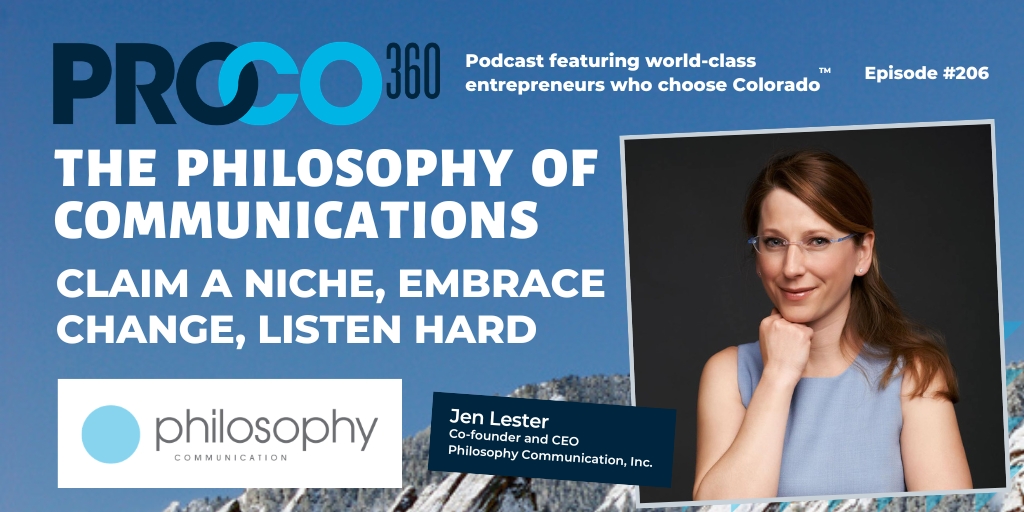
Jen Lester, Co-founder & CEO, Philosophy Communication, Inc.
The Philosophy of Communications
- I needed a brainstorming session about how AI will influence service industries... yes, about the work itself, but more intriguing to me was to spend some time thoughtfully considering the impact on the relationship between client and service provider when AI resources are in the mix. It seemed to me that before AI, clients would select the service provider that fit a Venn diagram: personal compatibility a sense of wisdom and expertise, and execution capability. Now AI seems to have disrupted how clients view services providers,, and I wanted to explore that with my longtime friend and trusted PR/marketing expert Jen Lester, Co-founder and CEO of Philosophy Communication. I loved the conversation!
I think the number one reason people don’t want to give you a solid answer is fear. I just did you a favor, because now you know where to put me in your brain. My advice is, listen, listen, because what we can’t do is the way we’ve been doing it. It’s antiquated. It’s not real time. It doesn’t move fast enough. You go back to those bloody CEOs and you tell them, give me a new bloody metric, because you can’t judge me on followership and engagement, if you are going to water down anything that I do that could possibly create that engagement.
This is the Proko 360 podcast for people who love Colorado and love hearing from Colorado’s great entrepreneurs, entrepreneurs who have something special going something that drives my curiosity. I’m Dave Tabor, host of proko 360 I’m a former tech entrepreneur, and I love having these conversations and sharing them with you. And by the way, today, I’ve known today’s guest for years, so this is going to be fun for me. Jen Lester is co founder and CEO of philosophy communication, a full service marketing, public relations and digital agency, and over the last few years, Jen has introduced me to several of her clients, and they have been, actually, Jen. They’ve been really great guests on proko 360 and so it’s finally time to talk to her on the podcast, rather than just talking about like an agency, which, you know, is kind of like, okay, but not that great. I really want to pick Jen’s brain about what’s going on in the agency business, even more broadly, in the service industry business. And then we’re going to shift gears and talk about how AI is affecting those very same things. So Jen, glad you’re here on proko 360
Great. Thanks for having me, Dave. And
you know what? I think we will have time I’m going to ask Jen. Jen did a wild and crazy and expensive thing for their 25th anniversary. So before we’re done, if I start wrapping up, you stop me, and we’re gonna talk about that
sounds good,
all right, so let’s open it up. I mean, you and I have talked about the idea that the service industry right now is having what you might call an identity crisis. And by that, I mean they struggle. They don’t struggle internally with their identity, but customers, clients, perspectives, may be struggling with who’s who and why is one different from the other. So you are in PR and by the way, before I even ask you to answer that question, I’m gonna give a little speech, because yes, because I I think service industry companies really have a tremendous difficulty in differentiating. I ask every banker,
100%
I ask every banker, what makes you different, what makes you special? And they all say the same thing. We’re big enough to provide all the services you need. We’re small enough to give an individual, you know, all they all say, this is the very same thing. Makes them different. And then you go to agency websites, for example, whether it’s website web creators or they all say the same thing too, that you know, that we’ve got all the technical expertise, but the thing that makes us different is that we get right in there with our clients. We care about their outcomes, and we drive results together. The same thing makes them different, right? So how, like, how do you see this? It drives me crazy.
Well, so Dave, why do you think it is? Why do you think these people can’t give you an answer, and I know the answer?
Okay, I think there’s two reasons. One is they’re not that different, in fact, and the second is they’re lazy communicators. Those are the two things I see. And maybe you’re shaking your head, maybe, am I right? Am
I wrong? I think the number one reason people don’t want to give you a solid answer is fear.
Oh, yeah.
I feel like they are operating out of fear. And if you want to know something, I see right now in the industry, across the board, everybody is doing business out of fear. Nobody is doing business in this really sort of place of strength, their fear they’re going to lose a big account, their fear that you’re going to make someone mad. So they’re saying everything that’s so vanilla such. There is so much vanilla blather out there right now. And if you look at creative, start looking at Creative like things like outdoor billboards, messages, things you’re reading it, there’s so much just vanilla blather, and it’s because of fear. No one is willing to take any risks, and that by doing so, they say nothing.
So let me to clarify what vanilla blather means. And I think I’m on the same page with you, and I’ve thought about this from a fear person companies like whether it’s a web developer, and accounting for no one wants to have somebody say no because, like, they aren’t for them, like, they don’t want to be put in a box. Yeah, they’re
boxed.
Yes, which is actually, like, the exact wrong attitude, isn’t it?
Yes. And let me give you. A great example, and I’m going to sort of simplify it for our listeners today. Let’s say you and I met at a party, and I’m an interior designer, and I say, Hi, Dave, I’m Jen Lester. I’m an interior designer. You’re like, great. I just became throw away. Yeah, right. But if I said, Hey Dave, I’m an interior designer, and I really create a segment of helping recently divorced men. What just happened?
Well, two things, if I’m recently divorced, I’m going to hire you right now, right? If I’m not recently divorced, I’m thinking of who I know who’s recently divorced,
that’s right, and so the fear that people have. So this is what we just did to the brain by saying that little extra thing that I said, right? I just became a file in your brain, right? I just got filed in your brain, whereas, if I would have just said interior designer, I would not have been filed. So what I actually did for you is I did you a favor. And I think that people are operating from this place of fear so much around communication that, but what they don’t realize is they’re not doing them any favors to that listener. You want to do the favor to the listener. We’re so much about ourselves, but I just did you a favor, because now you know where to put me in your brain, right? And I think that’s part of the problem so. And then the other thing I hear from people all the time, or clients that we work with, but we do so, but I do it for everyone. And first of all, I say, lie, you don’t do it for everyone. You do it for people that have the amount of money that can afford you. You do it for somebody that might live in a region. So this notion that we’re for everyone, if that’s something that you say, and you think, I think you should throw that away, because there is something that should be unique and special to you that has some sort of selectiveness, you know, even you know, you could take a food item, a food item isn’t for everyone. Maybe you’re losing weight, maybe you’re gluten free, whatever it might be. And so I really think this operate, you know, people operate from this place of fear, and they’re afraid if I say I’m only for divorced men with interior design, I’m not going to get this business out from over here on the left. The truth is, this is called outward messaging versus inward messaging. At philosophy, we have certain industries that we do really, really well in. But do we work and do marketing and PR programs for all sorts of business? Absolutely, my outward marketing will focus on the industries that we have really shown our core areas of excellence, but we take any business that is the right fit for us. So we don’t say so if I was a really good let’s go back to the interior designer. Example. Interior Designer, I’m gonna work. I’m gonna have business if I’m good.
But
what people don’t think about is, when you are having conversations with people, give them something they can file. Otherwise you’re just wasting air.
Yeah, that it reminds me of a story I had a neighbor, and I think you’re going to be completely on board with it, like he was a real realtor, but he was also like a handyman. He could fix anything, right,
and he
had remodeled his whole house from crap to something really cool. And I’m like, why don’t you position yourself rather than I just thought, Who do you sell to? I sell to? I sell everything, all kinds of houses, every neighborhood. I can do it like That’s dumb. Why don’t you say that you help people find diamonds in the rough, out in the marketplace, and help them envision how they can turn this house into something special. And he’s like, I might lose business. I’m like, No, that’s the number
thing people say, that I will lose business. I might lose business. You don’t. You actually are doing the what they need. You need to think is, I’m doing people a favor,
yeah, and
it’s a total reframe, but you’re absolutely right here that I hear the other thing, they don’t want to. They’re too afraid to tick off an audience, so they don’t, they say nothing. And to me, I don’t want to take your marketing money if you’re going to say nothing. It’s such a waste. But so many people are so afraid. If you look at what’s happening in the industry right now, overall, with businesses, they are so risk averse and
in messaging,
in messaging and creative, really,
of risk averse messaging. Well, because you can’t name a client, but maybe you can. You can
see, you know what, who, who I think is doing a really good job. How about that? I can tell you who I think is doing a good job.
Yeah,
and I don’t necessarily. There’s a company called sexy pizza. They have decided the whole company was born out of helping to legalize pot in the state of Colorado, they also have a nonprofit that they support. It’s something like unharmed, where it has to do with addiction and providing needles or whatever, two things. I’m not actually on the same page around all these things, but you know what? I love the. They are willing to say what it is they’re about. And I, you know, I know the owner very well, and he’s like, this is what we’re about, this is it. And he’s willing to stand true to it. And I guess I have so much respect for that,
you
know. So I think it’s harder for me to say, you know, who’s not? A lot of I would say Dave. The majority of companies aren’t doing,
I
almost want to say 90%
maddening to me. It is, yeah, and I know that these companies could do so much better if they wouldn’t be, to your point, scared, yes, scared of declaring a niche, and most niches, like, for example, this real estate guy that told you about who can see a diamond in the rough house, right? How small is that niche? And so, like, okay, maybe it’s only a third of the homes, but to that 1/3 of the audience, he’s the number one guy. You know, who else I love? I love the legal firm that says we are motorcycle riders who do laws. They
do an excellent job.
Oh, my God,
because you’re like, okay, they’re the motorcycle
yes, if I have, you know, what could, could the other guys represent me? Yes, I ride a motorcycle. That’s right. So,
so they did you a favor? Do you see how it was a favor?
Yeah, they
do.
So they get 90% of a big audience versus 1% of a huge audience. Like, no. So anyway, that’s my
Yeah. I was sitting around with some, you know, recent like 20, maybe 20 or 22 to 26 year olds that are all being hired by these big corporations to do social media. And I was sitting around and talking with them and social media, first of all, there’s, that’s a rough job, right? It’s hard job to do for corporations. And I was asking these young people about their job, and they were so frustrated, because here they’re being measured on how much engagement, how they’re growing followers. But the CEOs of the companies are like, but you can’t say that, but you can’t be do that, but they have these such high risk, wonderful ideas that would cut through the clutter, but not one CEO, yet they’re being and I said, you go back to those bloody CEOs and you tell them, give me a new bloody metric, because you can’t judge me on followership and engagement, if you are going to water down anything that I do that could possibly create that engagement.
Wow. I mean,
it’s not fair, right?
So they should be judged on safety, huh? No, I mean, you know. And I’m
like, you know? And I actually went back, when I came back to the office, and I sat down with the head of our digital and social and I asked ally, I’m like, Ali, do you feel like that? And she’s like, Absolutely, with some of the clients. And I’m like, it’s hard, because we you’ve got to do a little bit of risk, but you have to be willing to stand in it and just be like this. We aren’t for everyone. This notion that you have to be about everyone you know, does it come from this notion that we all need a trophy? Everybody’s got to be exactly No, we’re not the same. We’re complex.
So does that mean that you should at philosophy, if you’ve got clients that want to hire you to do vanilla blather that you just
like, Oh, we’ve done no, we’ll do vanilla. We try really hard to talk them out of it. I mean, you know, I mean, because it’s a collaboration, you have to, you have to suggest what works. You have to say, I mean, I can’t say, you know, there have been times like we’re not going to take your money for
that. Yeah, I’m
not going to do that because it won’t work. So there are times, you know, but we also say you have to test it, and then we have to use research to let them know what works and what doesn’t work. The clients are collaborative in the process, and you know what they are in the trenches, so I have a lot of respect for their point of view. So I don’t want to sound like we we can’t listen to what they’re saying, but it can be very difficult when the metrics are just, you know, and then you’re stymied.
Have you been able to talk safe minded executives into a different course?
Yeah, for sure. Let’s.
Can you give an
example what we’ll do? So we talk about this, we don’t so agencies can come across like, Oh, you guys just want to do the fun thing, the creative thing and like. So what we do is we base it in, I use the language substance in the office, but really research and insights. We will show. We’ll tell a story that might be, here’s what your competitors are doing, here’s what their messaging is looking like, here’s what so, so we let them come, you know, we and then we say, here’s what we recommend. But it very, very collaborative. We don’t just say, you know, this is what our gut is telling us, even though it is what our gut is telling us. But we use research and insights and say, let’s try it. So for instance, you know, if it’s this social post, is it better to say, now hiring or join our team, you know, and we’ll use the data to inform some of that messaging or some of the communications around it. So are you curious? You know, when I know which one worked?
Yeah.
Now, hiring,
really,
yeah,
I would have guessed the other.
But. Here’s the cool thing, join our team works when you’re kind of creating more of a career mindset. So sometimes the data doesn’t take into account some of the psychographics. So for you, by saying I would have guessed, join a team probably from you know, where your business background comes from, it’s
a little
bit more aligned with what you’re trying to do culturally.
So you could also segment the applicants by the language that
you use Exactly, right?
Wow,
that’s very interesting.
So, but yeah, so you have to do that fine line you try and come to the collaborative place. Sometimes you just have to walk away and say, I’m not going to take your money. This is not going to work.
Yes. Now some of those, though, it makes me think that some of your clients must be like, when they either become clients, or you’re looking considering doing work for them, or they are like, some of them must like, kind of get you fired up. Your eyes light up. You must be like, I can’t wait. I can’t wait. And you’ve introduced me to some of your clients that you know are like that. I mean, some sleepers too, like happy teacher. That was why listen. Listeners, if you haven’t heard that episode from happy teacher, that would blew me away. I thought I was doing you a favor, and that was incredible. You
mean, Dave, I did you.
Yes, you did. I filed it away just like you said. So I love it, yes And so, anyway, but, but what do when, like, the company isn’t that interesting in its initial look, you know, is that? Is that? Does that become your charge from a differentiating standpoint?
To
do that, to bring them to life?
Yeah, absolutely. So we look, we try and convince the client, we give them opportunities. We’ve gone is so far. Let us pay for it if we believe in it. You know, we’ve done that before. Anything to try, because sometimes people can be a little set in their ways, right? So if we really believe in it, you know, we will do just about anything to to convince them. Let us just try it.
Okay. Want to take a break here and thank listeners. This is proko 360 named Best Colorado business podcast since 2021 I’m your host, Dave Tabor, and this is a podcast for people who love Colorado and the stories of Colorado businesses and entrepreneurs. My guest today is Jen Lester of philosophy, communication. I want to thank our sponsors VIA Technologies, and they host the Proko 360 website, and I love working with them, their team and so forth, but they’ve done a great job of attracting really, really smart clients to the technology that they offer, and then collaborating with them. And Jen mentioned collaborating, but VIA Technologies, collaborates with their with their clients to develop some really cool tech around the web. Also Denver ventures. You may know them in the past as Denver angels. We partner with Denver ventures to feature great Colorado companies, and boy, we have had some really great episodes with our friends at Denver ventures, and you’ll see their logo on many past episodes. Okay, so I want to shift gears, Jen and I want to because you and I have been toying and teasing around the idea of how AI is actually shifting how consumer, well, not consumers, clients really value agencies or value service companies,
or
devalue
or, Yes, that too. So okay, so jump right in, like, talk about that in general. I have some things I really am curious about.
So to talk a little bit about what AI is doing to the agency client relationship. And it is, I think it’s, it’s devaluing the agency, to be perfectly honest. The wonderful thing that is occurring is clients are becoming almost as smart as the agency. They’re able to do research. We could write a plan. They also can put it through a few different llms and come back with different thoughts. Trust is being, I think, questioned right now. Do they really know everything? And the truth is, agencies know everything that they know, right? But do we know as much as perhaps what Claude knows? So it is
probably not an aggregate,
probably not an aggregate. So this is a humbling moment for agencies. I think it’s a growth moment for agencies, but it is very, very tricky when you now the clients feel like they know as much, if not more,
yeah, than
an agency. And so we have to combat that.
So I’m going to come back to that term use growth, because I can’t tell if you said that because you believe it or because that’s like, what you should
say.
So we have to, or we’ll be out of business. Yeah. I mean, it’s not a choice.
Yeah. So here’s my thinking. Is like, when, before even I was gonna say 20 years, two years ago, when, when, you know, AI wasn’t part of a planning process for most of your clients, right? They would hire an agency based on first they’d interview, they see how good the fit is. Then they would hire an agency to think everything through, to create the plan, and then to do it. It seems like now
you. So
people feel like they can just go to Claude or go to another get the plan and then just say, Hey, do it
or hand it to you.
Yes, and say, do this. And that so devalues. And like, how much will you pay somebody to implement versus somebody who’s done the entire strategy thought and right? I mean,
well, I’ll try not to cry right now. Dave, it is really humbling right now. I mean, we have got to it is very humbling with what what’s happening now. How do we combat
it?
One of the things, I mean, we have to be even more on our games. We know that our clients are taking our work and testing it against the different llms, so we need to make sure that we’re doing that. We also need to look at our role slightly differently, because so much strategic thinking is starting to occur, and those in the llms are just going to get smarter and smarter. We have to look at things as if we are orchestrators of technology. So yes, they might hand you a plan now and say, go do this. Where we got to write the plan, and say, here’s what we’re gonna go do. Some of the fun, I have to say, is being taken out of it, and some of the creativity. Because I will tell you what comes back. I know everyone can say, well, that your prompt wasn’t right. You know, I don’t know. I mean, some of the fun is being so we need to make sure we’re bringing the fun the creativity. We still have value that, I think, the agents don’t have to our level. For instance, we pressure test things, we will know if that makes sense or not. Some of the things that get recommended aren’t things like we had a wonderful tool that we use for some it was an AI research tool. It came back with some really terrific advice, but in recommendations. But it didn’t know our industry did a level that we did. So we didn’t, if we were working in a silo, we would just gone and implemented all those things we know to pressure test things and know that that’s not going to work. Where I get a little nervous or concerned is the younger generation, because, like, for instance, the largest agencies in the world right now, they’re not hiring account coordinators, right,
right?
And I am lucky to have a couple decades of experience, so I can rely on phone calls and relationships and things to bring together. What is this younger group gonna do if they’re not given the opportunity to kind of fail as much as I have failed,
right?
Yeah.
So there’s some, you know, some things. And I’m worried about the trust thing. I’m worried that, you know, one of the things that makes communities strong is the reliance on each other. And I know I’m getting a little, you know, you know, high, high level here. I worry when we can’t rely on each other, what this great independence is going to yield.
Well, this great independence is interesting to me, because you said they’re not gonna have the opportunity to fail that you did, that I did, and so forth, right? But maybe they won’t fail as often because Claude or chappy GPT will tell them what to do so they don’t fail. Is that, like, maybe they won’t need to fail as much.
They probably won’t, you know, I think that’s a really good point. I never thought about that. There’s something fun and failing though, but
Well, I think it is life enhancing, for sure. Don’t
you think,
yes, not in the moment, but yes, it is in hindsight and and even some of the idiotic things I’ve done in the past, like AI would not have prevented they just wouldn’t like, no, if I was drinking in college, AI would not have stopped me from doing some of these. But you know, the other thing that that one of the joys in in professional development is having success. And you know, knowing that you thought it through, that you created this plan, that you created this but if all you’re doing is implementing what an artificial intelligence engine told you to do, and it works. Your client just thinks of you as a widget maker, not as like a service provider with intelligence that’s got to be like the impact on the people and the
mindset and the mentality, the thing that I’m struggling with. So listeners send me a note. Help me out here is around trust, because I see trust right now completely eroded. People are working in these echo chambers, in vacuums, to the point of like, getting a plan, getting a block, getting whatever they might need, and then sending it over. There’s no discussion, there’s no collaboration, there’s no
really,
it’s not it. And I think the pendulum is going to swing, like, right now, everybody’s like, Oh my God, these are such great tools. Look what I can do, you know. And so I do think about, you know, are, you know, I’m waiting for us. Are we going to swing a little bit back again where, you know, the clients are, and they’re so busy. I mean, clients are sending notes like, you know, just get this out. Just. Do this versus you could have a little meeting about it, and you could talk about it to make sure we’re thinking of all the angles. Now it’s to your point. It’s almost like you’re this widget, if you will. And just getting it done, it will swing again. But the other thing that’s going on, people are making up their mind before they hire an agency like 75% of the time, they fully know who they’re going to hire before they it’s all online. It’s almost like, you know, the online dating, they just know that this is the one they’re going to marry, you know. So I think it’s, it’s kind of an interesting time right now where we’re trying to figure out how, how do you have trust if no one really wants to communicate with you, and the communication is just this sort of, it’s very one to one.
Yeah, do you think so? I don’t buy the idea that when a lot of people are talking about various artificial intelligence agents like, I don’t buy the idea that they’re going to be limited and that that, you know, they’ll never replace human thought and human interaction. Like, I don’t, I don’t know if I buy that, because I think as they get better, and they get better and they get better, all the mistakes that maybe they make today, they’re good. So
it’s totally relevant,
yeah, so I think, like, okay, then how do we, how do you think about because you’re out of business, if you don’t have human the human relationship,
are we? Are we just these orchestrators? Now it does the business change?
Well, exactly
become just orchestrators, right?
So is that, that’s my point. Is that as the human orchestrator, if you will, like, that becomes, that becomes your business model.
That becomes the business model. I mean, you know, I’ve been through two recessions. My advice to the staff, it’s changing a lot. We’re seeing, you know, people lay off 60% of their staffs right now. It is, it is interesting. There’s a lot of companies getting gobbled up. A lot of, you know, sort of, you know, everybody’s coming together. But I think, you know, my advice is, listen to the customer, listen to the client, put your head down and do good work. But and then we have to adjust. So if this, if orchestrators, is what we’re going to become as agencies, then we got to figure out how we become the best orchestrators in the industry. But we have to listen right now, right now. My advice is, listen, listen, listen, because we have to figure out we can’t. What we can’t do is the way we’ve been doing it. It’s antiquated. It’s it’s not real time. It doesn’t move fast enough. So there is a certain, you know, there is a certain sense that we must, you know, I had a business meeting with my staff this morning, and I was like, We must listen and be effective. We can’t, you know, efficiency, AI, and all this talk about efficiency, that’s the wrong word. It’s, How do we be effective?
Yeah, well, speaking about meeting with your team, I want to shift gears before we before we wrap up, because you had a very unusual meeting with your team in Greece. Talk about that, because I got a couple questions about
it. Yeah, so recently we returned, 25 years old, which is hard to believe it’s gone by. I mean, I can’t believe I get paid for this job. Dave, it’s, it’s great, it’s a great job. But we, you know, we were sitting around and and we’re like, you know we should do. What should we do? We always, whenever we do a brainstorm, we say, Money is no object. So if anyone ever conducts a brainstorm in their company, make sure you say first money is no object, because that makes it more fun, right? So we said Money is no object. And one of the co workers, Jen Malkia, she’s like, we should go to Greece and study philosophy, the origin of thought. Like, yeah, that, yeah, we should. That’s hilarious. Well, next thing you know, we started planning, and we took our staff and their plus ones, if they cared, to bring plus ones, and we studied the origin of thought in Greece. And it was absolutely it was fabulous. We had a professor come from the local university who talked about communication. And what was interesting, Dave, not law has changed,
really,
yeah, in terms of, you know, courage, truth,
these key virtues,
these key things, I mean. And basically, it was really interesting because he, he spent a lot of time talking about courage in terms of communication and thought, and then the theater of communication. And those are things it was just like philosophy communication could have been. I mean, those are the things we talk about all the time at our firm. And then we were in Greece, and this professor who teaches philosophy is talking about the very things that are foundational to our company. Was really
fun. So during this retreat, I guess you’d call it, yeah, trip. Was it a trip? Was it more of a trip, vacation together, or was it a retreat?
It was, it was a trip we had sanctioned. We we called it internally lifelong learning.
That’s.
So, and we had a whole calm strategies to our clients around it. So we made sure that they were taken care of. So we made we, why were we doing this? What was the point of this? So it was, it wasn’t necessarily just, you know, we had a lot of fun, don’t get me wrong, but we really it was about lifelong learning, which I’m a big believer in,
yeah. Is that, you know, circling back all the way back to niche. I mean, is that an identifier of your I mean, how many agencies would take their employees to learn about philosophy in Greece? I mean, that’s, that’s a, I don’t know if it’s a niche exactly, but it’s certainly a differentiator.
Yeah, well, I’ve had some ex CMOS of like Tropicana or Coors reach out to me and said, Never in all my years they were at the biggest agencies in the world. Would they ever have done anything like philosophy communication did. And I thought that’s great. And the reason why I actually like telling the story that you know, I hope it’s contagious for other businesses, because I think really focusing in on your people and the great work that they do for your clients. I mean, what is more valuable than that?
Yeah, I think that’s probably a good note to end on, unless you’ve got something, something that you just can’t wait to get out.
No, I’m just, I can’t wait to get out of the seat. So nerve wracking. I love being I love it when my clients are in the seat. I have a new appreciation for them.
Oh, that’s so great. Well, I’m gonna wrap up. I’m your host, Dave Tabor, today on proko 360 you’ve been listening to my conversation with Jen Lester of philosophy communication, and yes, it was great to have you on proko 360
thanks for
having Yeah. I mean, we’ve had several of your clients, and they’ve all been interesting and interesting niches, whether you’re sausage or burritos or happy teach. I mean, just really fun client, sexy pizza. So really fun. Listeners, glad you’re here on proko 360 where we say live work. Love Colorado, because you and I and my guests can be successful anywhere. And choose Colorado. You make the show successful by subscribing to the Proko 360 podcast. If you haven’t yet, it’s a huge help if you submit a review in your app. Thanks again. To show sponsors, Denver ventures and VIA Technologies, that’s the show, live work. Love Colorado.
You.