


“The branding connotes the positive image of the quality of the food inside.”
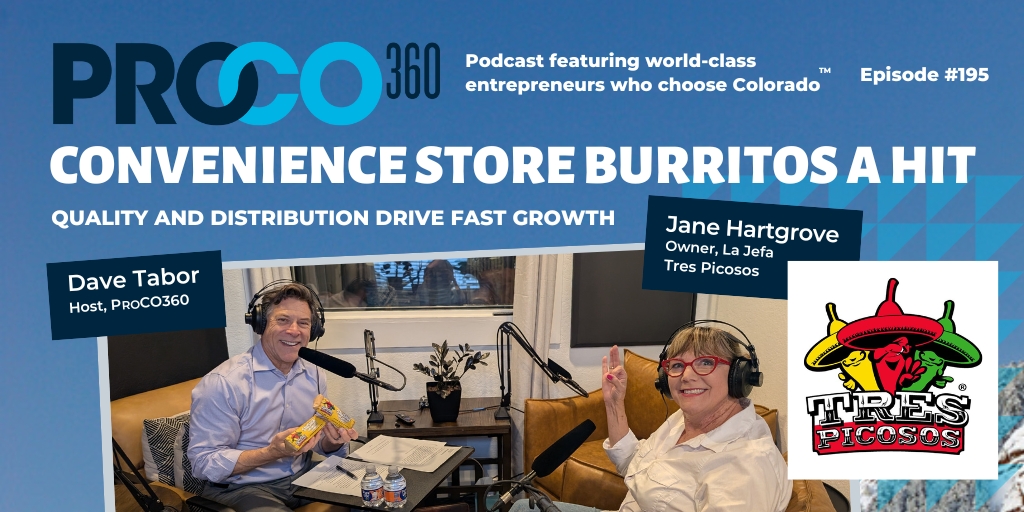
Jane Hartgrove, Owner and “La Jefa,” Tres Picosos
Convenience Store Burritos a Hit
- Intrigued is what I felt entering this interview because so many things about the Tres Picosos business had me scratching my head. A non-Hispanic owner of a burrito business, selling high-quality products through convenience stores, and the burrito making is outsourced. Completely NOT what I would have thought to be the making of a successful burrito brand and Mexican food company. It was fun to pull that string and see how it unwound. I believe in Jane’s success, and remain a bit baffled as you’ll hear in the episode!
Tres Picosos PROCO360 Audio Transcription
Dave Tabor:
This is the ProCO360 podcast for people who love Colorado and love hearing from Colorado’s most inventive and successful entrepreneurs. I’m Dave Tabor. I’m excited about this episode because I’m with Jane Hartgrove, owner and officially la jefa, the boss of Tres Picosos Burritos.
In the past, I’ve had owners of restaurants and product manufacturers, but never the owner of a company that has had success by distributing through convenience stores and grocery stores and has grown so amazingly fast. Jane was kind and shared samples with me, and by the way, Jane, Tres Picosos burritos are great.
Jane Hartgrove:
Muchas gracias.
Dave Tabor:
We’re going to talk about your burritos. We’re going to talk about growth through distributors and growing a business in a massively competitive market. So Jane, glad you’re with me on ProCO360.
Jane Hartgrove:
Thanks for the invitation.
Dave Tabor:
I gave a quick overview. I’m sure you can do a better one of Tres Picosos.
Jane Hartgrove:
Sure. Tres Picosos makes burritos deliciosos. We started in 2005 when a retailer, a convenience retailer in metro Denver, came to us asking us to make a product for them. They had a burrito line that was wrapped in foil. It was coming to their stores every day, about 35 stores, and they were concerned because it was not a USDA-inspected facility where those were being made, and we had the full production capabilities with USDA inspection.
Dave Tabor:
When you say “we had, back up.” Sure. Who is “we”?
Jane Hartgrove:
Yeah, my family’s company. We had a production facility, and we were making a variety of different foods, including green salads, like a chicken Caesar or a Cobb salad. We were making seafood salads, which would be like a dip, like a clam dip or crab dip. And we were also making sushi, among other things.
Dave Tabor:
So you’re already a commercial kitchen, right?
Jane Hartgrove:
Yeah, exactly.
Dave Tabor:
Okay. So continue.
Jane Hartgrove:
Yeah. So it’s a wonderful spot to be in when the end customer asks you to make this particular product line. You’ve already got the marketplace built in already.
Dave Tabor:
Why do you say you have the marketplace built in?
Jane Hartgrove:
Well, because we were taking over a position. They were already there, and we just took over that particular position.
Dave Tabor:
So they were already selling into convenience stores, and their customers are like, “We’re not so sure this is safe. We better get this done right.”
Jane Hartgrove:
Correct.
Dave Tabor:
Got it. All right. So now, though, you’ve scaled and you’ve gone from a few burritos wrapped in foil. So what’s that journey look like in a condensed version?
Jane Hartgrove:
Oh my goodness. Fits and starts, but it has been such a wonderful adventure. We started with the foil-wrap burrito line, and we were distributing to about 135 stores every day.
Dave Tabor:
So how many burritos is that?
Jane Hartgrove:
Oh, I don’t know, but if each store sold between 70 and 90 burritos every day, there you go. So we were doing what’s called direct store distribution, and after a certain amount of time, we realized that we needed to diversify and have a paper-packaged burrito as well.
The foil-packaged burritos were always meant to be served hot because foil is very authentic Hispanic. Thanks to our friends at Chipotle, it was becoming more and more ubiquitous. Everybody recognizes this.
Dave Tabor:
Foil is fresh.
Jane Hartgrove:
Exactly, yes. So we wanted to serve the cold case as well, and for that application, the paper packaging is much better. Our burritos have always been handmade, a mano, hand rolled, hand wrapped, hand labeled.
Dave Tabor:
That’s interesting. I never thought about the difference between, okay, so you see something that’s in foil and you think fresh. You see something in paper and you think frozen or refrigerated. Is that?
Jane Hartgrove:
Well, it depends. The paper packaging that we use is hand wrapped, and the label works to seal the package. But there’s also a mechanism called flow-wrap packaging. You’ve seen that with the crimped ends and a thin seal. We have that as well, available in a clear film, which is dual-ovenable, and that’s made for larger-scale food service operations.
Dave Tabor:
I’m still intrigued by this notion of foil versus paper, and it almost seems to the consumer like they’re two completely different kinds of product. Is that wrong?
Jane Hartgrove:
No. The product is exactly the same on the inside of the package, but it just depends on the operational characteristics of the customer or the food service operator that we’re trying to serve. So it’s in response to customer demand.
Dave Tabor:
So if you want something that is served fresh, then it’s in foil, right? And if you want something that you can freeze, that’s frozen, you want to then do something later, then it’s paper or something else?
Jane Hartgrove:
Yeah.
Dave Tabor:
Huh. Okay. I never thought about that. And in my mind, the subliminal part is, right, if I see it in foil, it’s ready to eat kind of thing, right?
Jane Hartgrove:
So foil is always meant to be served hot.
Dave Tabor:
Okay. So now you’re not a typical owner of a Mexican food business. How did this happen? You speak Spanish, and you wear a sombrero, except here in the studio today, right? So you’re not a typical Mexican food entrepreneur.
In fact, a few months ago I had Karla Morales of Santiago’s, and she is. So how did you become what you are?
Jane Hartgrove:
Well, it was a natural extension of the product line, and I’ve thoroughly embraced the Mexican culture. Mexican culture gives us so much to work with. First of all, the food, the rich family history, the dedication to high quality. It’s just lovely. It’s absolutely lovely. So I maintain that I don’t have to be Hispanic in order to be a proponent of wonderful Mexican food.
Dave Tabor:
Do customers want to buy from a Hispanic woman rather than somebody who speaks a little Spanish and loves Spanish culture? I mean, come on.
Jane Hartgrove:
So far it has not been a hardship for me whatsoever.
Dave Tabor:
Is it because you embrace it happily?
Jane Hartgrove:
Oh my gosh, I just love it. I mean, I can’t pass a mariachi band without dancing.
Dave Tabor:
So has that become part of who you are? I mean, ultimately, what’s that transition like?
Jane Hartgrove:
I don’t know if it was really a transition, but I’ve got a pretty vibrant personality, and so it was just a natural offshoot of me being me.
Dave Tabor:
Well, cool. All right, I want to shift subject a little bit because I’ve had your burritos, and thank you for the samples. They are so good. So good. And not at all what I would equate with buying at a convenience store or even at a grocery store. So how do you do that?
Jane Hartgrove:
Well, it’s an unwavering dedication to quality assurance and high-quality ingredients. We will not compromise ever on those things. When shrinkflation was running rampant, especially during the quarantine, we always maintained the eight-ounce burrito.
We use a three-ounce tortilla, which is actually proprietary to us. I’ve got a special formula of this tortilla so that it maintains heat when it’s heated. It’s a hot-hold tortilla. And the five ounces of good filling, we don’t have to junk up the recipes or dumb it down or make too many additives. No. Good clean food, and its simplicity makes it very, very authentic and delicious also.
Dave Tabor:
But I’m a skeptic, actually, that when you scale a food product, that it can maintain its quality. If you make 10,000 of something, they don’t taste as good as if you make three in your kitchen.
Jane Hartgrove:
It is true. So when we’re making these very, very large batches, the recipe does get modified somewhat. The ratios are a little bit different, sure, absolutely.
And so the short answer, though, to your question is that we have a co-pack business model. That means I hire a contract manufacturer to make the burrito line according to my specifications. And we’re very, very precise, very, very exact.
So with this, when we scale, if I needed to, if I outgrew the production facility that has my contract right now, then I would be able to put on a second contract manufacturer or a third. And I probably would diversify in regions of the country in order to serve, because we’re sold in 49 states, plus our friends in Guam.
Dave Tabor:
Well, I gotta ask. The thing that I find super intriguing is really how you scale and still have a product that tastes sort of fresh, that tastes like it was just made. That seems like a mystery that’s lost. Is it because when most companies scale, they start cutting corners on costs?
Jane Hartgrove:
Very likely. Again, we have an unwavering commitment to quality and high-quality ingredients. I get to say what kind of eggs, and it better be our specific tortilla, and what kind of the cheddar, mild to sharp. I get to specify all of those things also.
Dave Tabor:
This is really interesting.
Jane Hartgrove:
A few years ago, well, we always had the idea that we would like to sell the great ingredients that are inside the burritos in bulk to food service, and so under our sister brand called Naughty Chile Taqueria, we make the high-quality ingredients in bulk. Like instead of a taco beef burrito, you could buy 20 pounds of the taco beef itself. So again, quality assurance. If we’re making all the ingredients that go into the burritos and then we’re making these ingredients available to food service as well, it’s just that same level of high quality and level of commitment.
Dave Tabor:
And you’re privately held at this point?
Jane Hartgrove:
Yes. We’re self-funded.
Dave Tabor:
Yeah, because that’s the intriguing piece to me. In today’s world of significant inflation, where customers are only willing to pay a certain amount for a product, you mentioned shrinkflation, but without that then you end up with price escalation, correct? Inflation. So how? I mean that’s got to be constantly knocking at your door all the time.
Jane Hartgrove:
Yes, it is.
Dave Tabor:
How do you think about that?
Jane Hartgrove:
Well, again, unwavering commitment to high quality, so we have not cut any corners regarding quality. Buying power is really important too. So if I’m buying 150,000 pounds of eggs every year, then I can get better pricing from my vendors.
Dave Tabor:
So part of your ability to maintain quality is growth because you can scale and buy at better prices.
Jane Hartgrove:
Yes. We get better pricing.
Dave Tabor:
That’s very interesting.
Jane Hartgrove:
Cool, right?
Dave Tabor:
All right. I want to back up again and talk about this idea of, we know zillions of people who’ve made something in their kitchen, whether it’s burritos or cakes or cookies or whatever, and they want to scale. They want to turn things into a business. “Oh, you should be in that business,” people tell them. And it’s a lot harder than it seems, right?
So when you think about two or three critical elements, now you were already in a commercial kitchen, so your story is going to be different, but if I were making cookies and I said I wanted to go into business, what are two or three critical fail points that you would say only if this?
Jane Hartgrove:
Well, you’re right to bring up scale so frequently. It’s really, really important. Just because you’re a good baker does not mean that you would run a really good bakery. Look at what the core competency is. Is it baking, or is it the business of selling the baked goods? So you’ve got to have both sides of that coin. You have to have the manufacturing side, and you’ve got to have the sales ability as well.
Dave Tabor:
What I’m reading into that is that you should expect to lose money potentially until you can scale to a point where you can buy product ingredients at a cost-competitive price.
Jane Hartgrove:
Yes, but that’s not the only criteria, of course.
Dave Tabor:
But that’s a major threshold. If I’m making cookies in my house and now I want to create a bakery, I’ve got to expect to lose money till I get big enough, or till I sell enough to be able to buy ingredients cheaper than people can buy at Costco, right?
Jane Hartgrove:
It could very well be.
Dave Tabor:
Wow. Does that feel discouraging for you? If you were going to advise me, would you just say, “Dave, unless you’ve got deep, deep pockets to lose money for a long time, you’re not going to succeed”?
Jane Hartgrove:
Well, seriously, it’s like what they say about the restaurant business: How to make a million dollars in the restaurant business? Start with 5 million.
Dave Tabor:
Yeah. But that’s probably, it’s an interesting… Now okay, along those lines, let’s say you see a Mexican food truck. Do you look at them with a romantic notion, “I wish that were me again,” or do you look at them and say, “Oh my God, you have no idea what you’re facing”?
Jane Hartgrove:
More the latter. It really is hard.
Dave Tabor:
Yeah, it’s very difficult. Do you think most of those are making any money, or are they just creating jobs for themselves? Or will they ultimately make a living and then scale and become something more of a business?
Jane Hartgrove:
Again, it takes that very special mix of the business acumen in addition to the good product.
Dave Tabor:
Do you teach people business? When they come to you, do they say, “Teach me how you did what you did”?
Jane Hartgrove:
No. No, they don’t.
Dave Tabor:
Do they not come to you?
Jane Hartgrove:
I don’t know what I would say in that instance, but I do know that if you pick what you love, it’s really not like work at all.
Dave Tabor:
Come on. You just said if you’re a good baker, you might not be good at running a bakery. So it’s not just if you love it. You have to be able to run a business, and you have to be able to sell.
Jane Hartgrove:
Well, right. It also goes back to what is your core competency. So if the baker’s core competency is baking, their core competency might not be business.
A long time ago, I worked at Water Ski magazine in the late 1980s, and when I got my job there on the editorial side, I didn’t know how to water ski. And everyone goes, “Jane doesn’t know how to water ski. What the heck?” I said, “Well, hold on, hold on. I think the core competency is writing, not water skiing.”
Dave Tabor:
That’s interesting, though, although everybody would assume that you should at least appreciate it, have a visceral appreciation for it.
Jane Hartgrove:
Oh, I learned. That was part of it.
Dave Tabor:
And how good did you get?
Jane Hartgrove:
Not very. At least I could slalom.
Dave Tabor:
That’s good, because writing about it, I mean, it’d be the same as me writing about Mexican food. Like, I eat it, but I don’t know why.
All right. I want to take a quick break here. You’re listening to the ProCO360 podcast, named Best Colorado Business Podcast the last five years. I’m your host, Dave Tabor. This is the podcast for people who love Colorado and the stories of Colorado businesses and entrepreneurs.
My guest today is Jane Hartgrove, owner of Tres Picosos Burritos. Hey, I want to thank some great partners. Via Technologies hosts ProCO360, and I appreciate all the great help their team gives me around managing the website. They are a digital marketing firm with a smart crew focused on helping their clients grow their businesses.
I also want to acknowledge Denver Ventures, and we’re partnering to feature great Colorado companies. Go to ProCO360.com and check out these partners. Hey, thanks to my friend Jen Lester of Philosophy Communication. She’s in the other room. She’s looking at me like… anyway, Jen connected ProCO360 with Jane for this episode. Really appreciate that.
All right, let’s see. So I do want to talk with you more about the marketplace, Jane, because it seems, I don’t know, I guess there were 1,000 brands of burritos sold somewhere in this market. I probably wouldn’t be that far off.
Jane Hartgrove:
Yes, you are right. There is a lot of competition in the marketplace, and that hasn’t bothered me too much. I hate to lose the sale, but when it’s called a cutting, when you cut the food against a competitor and when we go head to head with that, we do really, really well. Again, the high quality and the delicious recipes.
Dave Tabor:
What’s a cutting? You mean when you say just a test, a test of the food? But who’s doing it?
Jane Hartgrove:
Let’s talk about the convenience store marketplace, because convenience retailing has increased in quality and prestige over the past 10 years. They realized that most gas stations were not getting the same amount of revenue previously from petroleum or tobacco or sodas. So with those things, the fountain, the petroleum, and the tobacco sales diminishing, they realized that food service is their destination.
They’ve got a captive audience when they’re coming into the store. They want things fast. They want it good. They want to know what they’re getting and that there’s good value for the money. Now value doesn’t mean cheap. It just means that I am paying a fair price for the goods that I’m exchanging for the money.
Dave Tabor:
I remember in college, I’d go into convenience stores and get nachos, and they were horrible. But I’d been drinking. It didn’t matter. But they were horrible. And even now, when I picture convenience store food, I think of either hot dogs on a roller or those other weird taquito things. That stuff is such garbage. But it’s like three sandwiches for $3. So that’s my perception of convenience store food. Am I wrong?
Jane Hartgrove:
Yeah. Yes, you are. Convenience retailing is increasing in prestige. It is. It’s the place to be.
Dave Tabor:
Prestige is a funny word. They’re convenience stores.
Jane Hartgrove:
I gotta tell you, there are more than 150,000 convenience stores in the United States. With grocers starting to sell petroleum, the convenience stores which sold petroleum want to sell food. So all these lines are getting blurred, and that one-stop destination, you know, real estate comes into play as well. Convenience stores are typically located in high-traffic areas.
Dave Tabor:
You used the word prestige. That is a funny word to me. I think of the movie Step Brothers where they create this company, Prestige Worldwide. Prestige and convenience stores. What am I missing here? I’m just not seeing it.
Jane Hartgrove:
Well, candidly, we’re in this middle market. You’ve seen some convenience retailers come into the Colorado space, like our friends at Maverik, and come and go. QT. These are all very prestigious convenience retailers in my world.
Where I started in convenience retailing on the East Coast, you’ve got our friends at Sheetz and Wawa.
Dave Tabor:
They do seem sometimes, the newer ones seem to be more pleasant places and maybe more conducive to changing food product from the ones I just referenced to the things that you sell.
Jane Hartgrove:
Oh, it’s totally changed.
Dave Tabor:
So you think those old crappy dirty ones are just going to go away?
Jane Hartgrove:
Yes, I do. I don’t think that they can survive in this new world.
Dave Tabor:
Wow. And so that opens the door for nice products that can be distributed in that way.
Jane Hartgrove:
Exactly.
Dave Tabor:
Interesting. All right. You seem like growth is a priority for you. You say you don’t like to lose sales. You’ve been growing like crazy. Is that an objective of yours, to have growth?
Jane Hartgrove:
Oh, absolutely.
Dave Tabor:
Why?
Jane Hartgrove:
There’s two ways to grow in my world. I can grow with more sales with the existing product line, or I can diversify into other Mexican components. I’ve been looking at tamales, and I’ve been looking at quesadillas, among others.
Dave Tabor:
It is interesting, because some products just don’t lend themselves to the kind of packaging and distribution that you would have, right?
Jane Hartgrove:
Correct.
Dave Tabor:
Talk about your branding, because very cute labels. I know you take a lot of pride in your website, you talk about the logo and all that. Does a brand in a convenience store resonate, yes, compared to a restaurant, a fast-casual restaurant or something where the branding is everything? Talk about how you see branding.
Jane Hartgrove:
Oh, I just love branding. It’s my favorite part of my job as la jefa of Tres Picosos. The branding is really important because it connotates the positive image of the quality of the food that’s going to be inside the package.
Dave Tabor:
I mean, these are three cute little peppers dancing. How does that convey quality?
Jane Hartgrove:
We’d recently changed the packaging. We updated it from a very gritty, old-school Mexican style, like street graffiti. It was a little bit darker. Now our colors are much more vibrant. We haven’t changed the logo since we added the “os” to the name. We originally started as Tres Picos, which means three peaks, and I changed it to Tres Picosos because it personifies the three hotties, the Mexican peppers.
So the logo remains the same, but we wanted to have more of the Mexican flag feel and the very, very bright colors that are really typical, stereotypical, of Mexican culture.
Dave Tabor:
Yeah, cool. I’m going to switch gears because I saw, I think it was on your website, that you have three children, and you had hoped that your children would be a microbiologist, someone in finance, and someone in law who could all sort of help you run your company. That’s not what happened. So what happened?
Jane Hartgrove:
I’ve got two daughters who are in finance and one son who is an engineer.
Dave Tabor:
So are any of them interested in the business?
Jane Hartgrove:
Oh, absolutely. They just love the Tres Picosos. In fact, there’s been talk of the three of them getting matching tattoos that say Tres Picosos.
Dave Tabor:
How about if they each got one of them, exactly, and then they put their arms together? All for one. So what have you changed about how you operate in the last few years? And by the way, have your kids, as they grew up, brought ideas to the business that help shift its direction or how you run things?
Jane Hartgrove:
Yes. Well, they’re all very creative. I mean, hello, coming from two entrepreneurial parents. I should mention also that I am in business with my husband, Schultz.
So with having a long time to mention that, he’s integral. He is. He’s in charge of sales, and he just has a very, very well-rounded background in a variety of sales, also with QSRs and quick-serve restaurants too. So his food background was more extensive than mine at the outset.
So where were we with the kids? No, I don’t foresee any of them going into the food business. If so, I would insist that they have a robust career ahead of that in their own chosen profession.
Dave Tabor:
Yeah. It seems like your business is really hard. You’ve got to source ingredients, you’ve got to make everything and distribute it, and then you’ve still got the risk of health and all those kinds of things that come with anything in the food business.
As you’ve scaled, what have you found?
Jane Hartgrove:
Well, it’s not that hard when I have a very good relationship with my contract manufacturer. So I bought the brand from that family company in 2005 and I incorporated as a woman-owned business. So I outsourced everything at that point. Previously we had owned manufacturing, we owned the facility, and did the distribution as well. So it really changed the business model.
Scaled back, I could outsource marketing to my friends at Philosophy, and we engaged a brokerage firm to represent our products across the nation.
Dave Tabor:
So that’s just a sales arm, a sales broker?
Jane Hartgrove:
Yeah. And gosh, so with this, I could run it pretty easily by myself. But as I grew, remember, we always had the idea that we wanted to sell the good ingredients to the same marketplace, but in bulk. And so we started a sister brand called Naughty Chile Taqueria. And that’s when my husband joined me. He was off in the QSR world, and when he joined me, we were able to launch Naughty Chile as the food service component of Tres Picosos.
Dave Tabor:
So this is pretty interesting, because I’ve always thought, like I owned a business a long time ago, and if I were to do it again, I don’t want a hard one. The idea that you can oversee contractors who are making the food, distributors who are getting the food in, and so you sit at a lofty level overseeing people who are really good at what they’re doing and sort of waving your arms like you’re an orchestra.
Why don’t most people do it that way?
Jane Hartgrove:
I don’t know. It could be part of the E-Myth. When you’re talking about the baker and building pies, that’s the basis of it. Just because you make really good pies doesn’t mean that you’re good at a business where you sell pies.
Dave Tabor:
Well, I think there’s something to be learned here. You can have a great business. You can own the business. You can own every part of the business that you find joyful, branding, conceptualizing the whole thing, but you don’t have to build it. You don’t have to do everything.
Jane Hartgrove:
Right, right. In management lore, there’s the Jack Welch thing, the right horse for the right course, and outsource immediately the things that you’re not good at. That is really, really important.
Dave Tabor:
Well, it’s important. It’s also sometimes hard to find the right partners, right? I mean, outsourcing… I used to do that quite a bit, and I made more money, and I actually had more fun when I outsourced more than when I brought on my own employees. That’s when the headaches start.
The nice thing about bad contractors is that you can get rid of them if your contract’s okay. But ultimately, finding the right partners is key, right?
Jane Hartgrove:
It is.
Dave Tabor:
And you’ve had the same ones for a long time.
Jane Hartgrove:
I have changed contract manufacturers a number of times.
Dave Tabor:
Why? How?
Jane Hartgrove:
Oh, you know, just changes in the marketplace, a disagreement, or again, outgrowing their facility where they just couldn’t keep up. So those are some of the typical reasons.
Dave Tabor:
So thinking back way back to when you just bought the brand and you started doing this yourself, what do you wish you had known then that you do know now?
Jane Hartgrove:
There was a situation where we were offered a position in a marketing program of one of our biggest distributors. And the marketing program was to put equipment into the convenience stores whereby they would stock our products in there, among others.
So it was a pay-to-play thing. If we contributed to the equipment, certain however many hundreds of dollars per store, just for my contribution, versus the other food that was in the same equipment. And we were taking over somebody’s position. We were supposed to have a bunch of stores already grandfathered in. We thought, this is beautiful. I mean, we’re already having 700 locations, and they’re growing at a rate of 200 per year. This is fantastic.
Oh my goodness. I learned that if everybody is thinking alike, then somebody isn’t thinking clearly. And that’s a quote from General Patton. So always look for, wait a minute, is this too good to be true? What am I not seeing here?
Dave Tabor:
So what weren’t you seeing?
Jane Hartgrove:
The downside. Well, the distributor wasn’t managing the program well. They were just using our funds to pay for the equipment, but they weren’t stocking the burritos or, ostensibly, the other foods that went into the program very well in each particular retailer.
Dave Tabor:
Yeah. So you put the money in, and you didn’t get necessarily exactly the sales.
Jane Hartgrove:
Correct.
Dave Tabor:
Wow. All right. Now you’re based in Colorado. The brand was built in Colorado. What role has Colorado played in your success?
Jane Hartgrove:
Colorado’s a spectacular place for food. It is a hotbed for QSRs, fast casuals. A lot of brands have started here. I think that Colorado is very much like Silicon Valley is for high tech. Colorado is for food. It’s just a wonderful place for food.
Dave Tabor:
A lot of the foods we think of coming out of Colorado are sort of the natural health foods and such, but there’s also, to your point, a lot of quick-serve restaurant brands have started here. Some really famous ones, including in your sector, in the Mexican food business, right?
Jane Hartgrove:
Absolutely, yeah. I want to make sure that our listeners know that Colorado really should stay on top of being a very business-friendly state. There are some regulations that feel good, like cage-free eggs. I mean, if 60% of my sales are breakfast and I’m going through 150,000 pounds of eggs every year, then what does this do to the cost of the burrito? Because the eggs are more expensive now.
So all those things, minimum wage, all of these things, it all goes into the equation. And there are a lot of Americans who think that businesses can absorb all of this, like the minimum wage, and again, it’s simple economics that every 10 cents at manufacturing equates to 30 cents at retail. So oftentimes the regulations are hurting the same people that they’re trying to help.
Dave Tabor:
Yeah, we’ve seen that a lot. My day job is at the Colorado Chamber of Commerce, and our main focus is how do you keep Colorado a vibrant, competitive state. And we certainly don’t want costs of regulation to drive, say, your contract manufacturing across the border where it can be done cheaper, and now the jobs leave Colorado, and it only increases costs, right?
All right. What’s your favorite… People must come to you and ask you for advice now. As you start getting known and your brand starts building, they must come and knock on your door saying, “Teach me. Help me out.” What kind of advice do you like to give?
Jane Hartgrove:
Pick something that you love. Everybody understands that if you pick something that you love, then it really doesn’t seem like work. And also be true to yourself.
I’m an Anglo-Saxon woman with Eastern European heritage who is selling Mexican food, but I love it so very much. There was one sales call that I did in Utah, which I think is a more conservative state, and I went to the presentation and I toned it down. I wanted to be sure that I came across very clearly. But I didn’t do my regular Mexican dancing or my “arriba, arriba,” and I totally tanked because I wasn’t being true to my own self.
Dave Tabor:
Are you good at “arriba, arriba”?
Jane Hartgrove:
Oh, yeah.
Dave Tabor:
Let’s hear it.
Jane Hartgrove:
Arriba!
Dave Tabor:
Oh, nice. Thank you. So when you think about that, that is really a great story, that you can’t modify who you are for your audience, right? Is that what you tell others?
Jane Hartgrove:
Absolutely, yeah.
Dave Tabor:
What’s your favorite story that, when you think about your business, says, “This is why I’m in this business”?
Jane Hartgrove:
I have a couple. I mean, at trade shows, gosh, it’s just a big old love fest. When colleagues and friends from the industry all congregate, everybody has to come over. Even the trade association, the National Association of Convenience Stores, when the trade girls come over and say, “Oh, I have to get my burrito for the day,” it’s just absolutely wonderful.
Dave Tabor:
Do you feel like you’ve sort of arrived? Are you like a quick-serve celebrity at these things?
Jane Hartgrove:
I hope so, because I am wearing that sombrero, and it is a point of destination for a lot of the attendees.
Dave Tabor:
So cool. That has to be gratifying.
Jane Hartgrove:
It’s the relationships too. I mean, I’ve made wonderful friends in the convenience industry, and I hope to make those same kind of friends as we move into the grocery industry. I mean, shoot, we vacation with these people. It’s lovely, really.
Dave Tabor:
I was going to end, but I’ve got to ask you a couple questions that go around my mind. The convenience store industry, I think… did you use the word lovely?
Jane Hartgrove:
I can’t remember. I’m sure it sounds like me.
Dave Tabor:
There just doesn’t seem like there’s anything lovely about it.
Jane Hartgrove:
You and I are going to Maverik and a QuikTrip. We’re going to do a little field trip so you can see how great it is.
Dave Tabor:
Well, what will we see? What do you perceive as great about an industry that I think is like—
Jane Hartgrove:
Hot foods. Hot foods, hot foods. And very high-quality foods.
Another anecdote about how I knew I had come: when we were selling our burritos in foil wrap to Maverik stores early in our business life cycle, I went to do store visits. And I went into one Maverik location and there were no burritos in foil on the hot glide. I was so disappointed. I’m like, “Oh, bummer.”
But then the bakery manager said, “Oh, miss, can I get you something?” And I said, “Oh, I was looking for the hot burritos.” And she goes, “Oh, oh, I’m so sorry. They’ve all sold out.” So that absolutely was a big light bulb moment for me.
Dave Tabor:
Okay, good. So they’re selling plenty. They’re just having trouble keeping up.
Jane Hartgrove:
Oh, wow. And then similarly, I don’t want to lose a customer, but in this particular instance, the program was so successful that the retailer decided to do it themselves, and so they started making the products in-house, and now we sell them our Hatch green chile.
Dave Tabor:
Audience, yes. Oh, that’s great. Well, let’s end on that note.
I’m your host, Dave Tabor, and today on ProCO360 you’ve been listening to my conversation with Jane Hartgrove. It’s been great to have you on. Thanks, Jane.
Jane Hartgrove:
Thank you. Muchas gracias.
Dave Tabor:
Listeners, glad you’re here on ProCO360, where we say live, work, love Colorado, because you and I and my guests can be successful anywhere and choose Colorado.
You make the show successful by subscribing to the ProCO360 podcast. If you haven’t yet, it’s a huge help. If you submit a review in your app and tap like, you’ll be able to get all the upcoming episodes delivered to you.
Thanks again to show sponsors Via Technologies, Denver Ventures. Happy to have them as partners.
That’s the show. Live. Work. Love. Colorado.