

“I can see a new stadium going in powered by FlexEnergy Solutions.”
Doug Baltzer, CEO, FlexEnergy Solutions
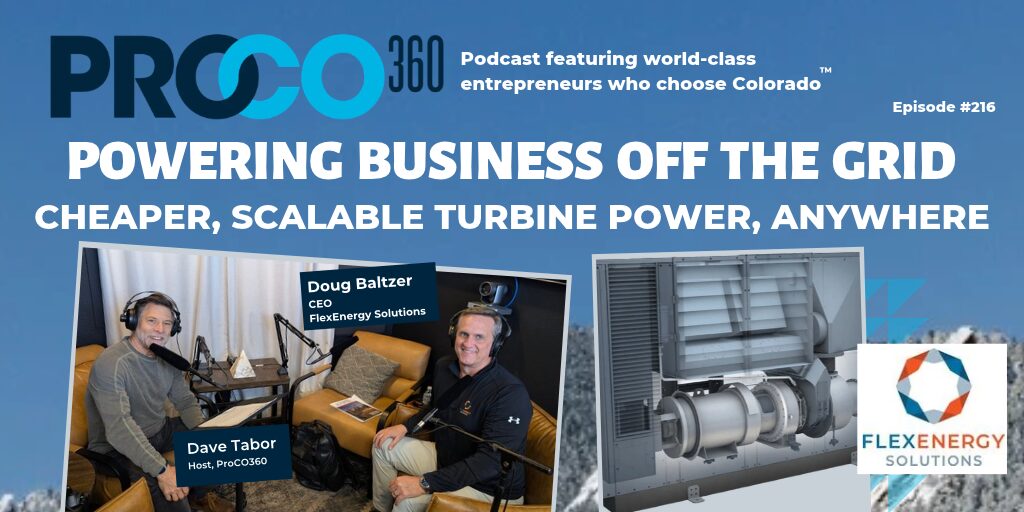
Powering Business off the Grid
- Companies are facing higher power bills, sometimes an unreliable grid, and even lack of grid access – so more of them are making their own electricity. Doug Baltzer, CEO of FlexEnergy Solutions, builds the compact gas turbine machines that let them do it - in oil fields in North Dakota, at a movie studio in Southern California, and in the basement of a condo tower across from Central Park. The ROI is tremendous – sometimes in 12-18 months!... and that made me wonder why everyone isn’t doing it. Doug’s answer surprised me, and the utilities are part of the story. I also learned that a turbine sitting in a basement can be about as quiet as a refrigerator, and that gas the oil fields have been burning off as waste could end up powering data centers. By the end, I wanted Doug to put one in my house – spoiler alert – his current model will power 600-1000 homes, so I need to wait a bit.
Doug Baltzer 00:05
There’s a large movie studio in Southern California, and they’re paying their price for electricity from the utility is so high they’re looking to take and do their own power. Right now, their high-rate utility costs are about 30 cents a kilowatt hour. With my product, including the fuel, be somewhere around 11. It’s right across from Central Park. We’re installed in the in the basement in the cellar, and we’re giving them electricity for their primary loads. But they’re also using the heat off of our exhaust system to feed their boilers, and that provides steam into the building. I could see something like a new stadium going in, and you see it powered by Flex Power.
Dave Tabor 00:44
Welcome to the ProCO360 Podcast. This is a podcast for people who love Colorado and hearing stories of Colorado’s most inventive and successful entrepreneurs. I’m Dave Tabor. Today’s episode features Doug Balzer, CEO of Flex Energy Solutions, a Colorado company providing standalone energy for its clients. We’ll talk a lot more about this. And but regarding standalone, think about the need for electricity to run a manufacturing plant, oil and gas facilities, maybe a data center or a hospital. These are in places where the electrical grid doesn’t exist, or where the grid can’t provide consistent energy in a cost-effective way. We’ll talk about that market, why it’s become controversial in some cases, and how Colorado-based Flex Energy Solutions is taking all that on. Doug, welcome to ProCO 360.
Doug Baltzer 01:33
All right, excited to be here. I appreciate the invite. You’re
Dave Tabor 01:36
welcome. You know, I gave kind of an overview, but talk about the problem that you’re solving,
Doug Baltzer 01:41
yeah. I think for a long time we saw ourselves as a clean alternative to utility power or on-site power that was generated by diesel generators or natural gas generators that have really dirty emissions. But more and more today, we’re solving problems on high electricity rates, unreliable grid, and power where you can’t get power anymore. So really looking for you know solutions that that benefit customers on a wide range of problems they’re having.
Dave Tabor 02:10
Yeah. So give an example of you know I guess a typical application of Flex Energy’s solution out in the field. What’s it look like?
Doug Baltzer 02:19
Okay. Well, we’re we’re a pretty simple product. It’s a very small, compact generator run by a small gas turbine engine, and it’s about 10 feet long and eight feet wide. It can be installed inside a building. We’re we’re down in the cellars of some buildings. It can be installed on a roof, or it can be installed in a you know oil and gas field that’s way out remote areas in a hot dusty environment or a cold winter environment like North Dakota or Canada.
Dave Tabor 02:48
Yeah. So instead of essentially having a big plug into you know the utility company, they’re plugging into you or multiple versions, multiple stacked versions of Flex Energy is that right?
Doug Baltzer 03:03
That’s right, Dave. And we’re doing everything from giving them 100% of the power they need to maybe 50% of the power they need, kind of reducing their overall energy charges from the utility company.
Dave Tabor 03:14
Got it. So it could be supplemental. Correct. But now you mentioned it’s a you’ve got an engine powering turbines.
Doug Baltzer 03:21
That’s right.
Dave Tabor 03:21
So turbines are way in the news in all kinds of ways. But so help us understand basically what that is. What’s a turbine doing, and why is it so critical to generating power?
Doug Baltzer 03:32
Well, a gas turbine, different from an engine generator, really provides a low maintenance product. It’s very clean, highly reliable, versus you know, and it’s it’s a similar product that big utilities do in big natural gas power plants. We’re just a very shrunk down version of that type of product.
Dave Tabor 03:51
So how does it? But how does a turbine generate energy or electricity essentially? Because you’re using you have an energy input to make the turbine move, and then how does it create electricity?
Doug Baltzer 04:02
Well, the prime mover is done by really by hot temperatures. So, think of 1100 degree temperature that’s that’s forced down at pressure onto the turbine, turning the turbine engine, and that hot energy, that hot fuel, can be done through natural gas. It can be done through waste wasted gas, like what you’ll see in an oil site or a landfill or a wastewater treatment plant, or it can be the same utility gas that customers have right in their buildings.
Dave Tabor 04:33
So it’s this hot pressurized is it air?
Doug Baltzer 04:37
Yeah, hot air is
Dave Tabor 04:38
being forced through this turbine that then spins and generates the current needed to create electricity.
Doug Baltzer 04:44
That’s right.
Dave Tabor 04:45
Okay.
Doug Baltzer 04:45
Most of our products take a fuel source, a natural gas fuel source. It goes and mixes with air, hot air, into a combustor. That combustor generates that hot air down into the turbine engine.
Dave Tabor 04:57
So that’s okay. So that’s how we’re propelling the turbine. Got it. Okay, now thanks for explaining that at a very fundamental level to someone who doesn’t understand it. So, but turbines have been in the news a ton lately, and they seem to be like the limiting force in being able to spin up more. That’s a pun, I guess. More data centers and other applications. So, how what’s the connection between what we’re seeing in the news about a shortage of turbine engines and so forth, and what you’re doing,
Doug Baltzer 05:24
it’s very similar. We’re just a little smaller scale than like the big 50 megawatt, 100 megawatt gas turbines the data centers are using. We’re on the smaller scale data centers where you’d see 5020, 10 megawatts of power. Our small gas turbines are rated at 300 kilowatts, so three of those make a megawatt, or we have a two megawatt gas turbine as well. So we’re on the smaller end of the gas turbines, but very similar. But ours is typically going to be a lot cleaner emissions than any other product in the market.
Dave Tabor 05:53
Okay, so two things. One is guys in the energy world are always talking about megawatts. I have no clue. I had to look it up again to remember. A megawatt will power typically 600 to 1000 homes. That’s
Doug Baltzer 06:04
right.
Dave Tabor 06:04
So, if you’re delivering a two megawatt standalone, you’re doing 1200 to 2000 home equivalent.
Doug Baltzer 06:10
That’s right.
Dave Tabor 06:11
Right. So, the other piece has to do with the emissions, the cleanliness of the emissions. To what extent is that of interest to your clients, your customers?
Doug Baltzer 06:20
More and more, it’s becoming a driver for our clients. They’re looking for carbon reduction. They’re looking for how they reduce their their overall greenhouse gas footprint. You know, if they start looking at power from the utility, our and they switch over to us, we’ll actually reduce their overall emissions versus what a utility will do on a megawatt basis. So it’s becoming more and more pertinent. And in some areas where air quality is very strict, we’re one of the few pieces of equipment that can get permitted and allowed to run 24/7.
Dave Tabor 06:49
So, in a non attainment area like Denver, that’s right. Even though a company might be able to hook up to the grid, they might choose your solution in order to to reduce emissions and maybe have a better chance of permitting.
Doug Baltzer 07:03
That’s possibility. We have a customer in Manhattan that did that, and that’s to meet a local law of reducing their carbon that they were getting penalized for from the utility.
Dave Tabor 07:12
Wow, that’s kind of so. Do the utilities like you? I mean, you’re actually delivering a better product, and you’re often cheaper, right?
Doug Baltzer 07:20
Yeah, typically they’re they’re not the most friendly to us, but more and more, I think they’re seeing us as a way to supplement what they can’t do and what they can’t deliver. So hopefully, that relationship will will improve as we go.
Dave Tabor 07:33
Yeah, because there’s a lot of talk about peak energy need and how utilities don’t want to build more infrastructure to meet you know, a 1% of the time kind of scenario. So, are you and is Flex Energy ever being, I guess, bolted on in remote areas where they can avoid having your nodding? You know what I’m going. That’s right.
Doug Baltzer 07:54
That’s right. Some people call it peak shaving. We we see it as the reverse of that. We take a base load off for the customer, so then they never hit the high peak rates for where the utilities charge them. They’re always at the lower rates because we’re at a base load power for them.
Dave Tabor 08:09
I didn’t even think of that. So you can basically their ROI in installing yours is calculated based on the peak rates they never hit.
Doug Baltzer 08:19
That’s right,
Dave Tabor 08:20
and that delta could be a pretty fast payback, I would think.
Doug Baltzer 08:24
Yeah, sometimes it’s less than a year.
Dave Tabor 08:26
Wow. Okay, so back to this whole turbine thing, and you know, there’s so much in the news with even like Denver-based or Colorado-based Boom Supersonic has you know sort of shifted some of their focus to creating turbines. That’s right, and you know even away from supersonic jets because of the demand going on. Is that what you’re seeing now? This demand change, high demand. Yeah, we we
Doug Baltzer 08:50
get requests for power from a megawatt at a time to we just had a request in Latin America for 100 units at one time. So yeah, we’re getting a wide range of requests and demands, and we’re just trying to fill that pipeline and that backlog for our manufacturing.
Dave Tabor 09:07
So you mentioned manufacturing. What are you making in Colorado versus assembling in Colorado versus just outsourcing?
Doug Baltzer 09:15
So the design of our turbine is is our design, but we do hire third party companies to do some of the heavier machining and manufacturing, but it’s done under our supervision. They have to meet our specifications, and then when that equipment is done, they send it to us. We do final machining on our parts, and then we do the full assemble and a test of the of the gas turbine itself.
Dave Tabor 09:38
So, what’s try explain maybe what does it look like to have a? Do you call it a factory? I mean, it’s really an assembly. Is it okay? So, what is it? What’s your factory look like in Colorado? How many people and what are they doing?
Doug Baltzer 09:50
So we’ve got just about 50,000 square feet. Most of it’s dedicated just to the manufacturing, assembly, and the testing of the equipment. Right now. We’re sitting at about 30 people, but with what I told you in our demand side, we’re looking to double that in the next 12 months, and we’re also looking to increase our footprint by about another 50,000 square feet.
Dave Tabor 10:10
Wow! All right, and this is all; these are all prepaid orders for companies that. So, who’s? What are some interesting new applications that you’re getting orders for?
Doug Baltzer 10:20
So, one of the cool ones that we’re excited about is there’s a large movie studio in Southern California, and they’re paying their price for electricity from the utility is so high they’re looking to take and do their own power. So we’re going to be put pre providing power to all the movies being produced at this theater over the next 10 years now. Wow!
Dave Tabor 10:40
So then, do they have to bring in? Can they use existing like natural gas lines, or do they have to bring huge? You know, they they’re going to use. No, they just run
Doug Baltzer 10:50
right off the natural gas that’s already fed into their building,
Dave Tabor 10:53
and that’s going to save them from because now they’re converting electricity at a lower cost using natural gas versus buying electricity off the grid.
Doug Baltzer 11:00
That’s one of the customers I quoted you. That’s almost at a 12-month payback on buying the equipment. Wow!
Dave Tabor 11:06
So how much will they save over 10 years?
Doug Baltzer 11:08
Well, pretty simply, I like to put everything apples to apples comparison. Right now, their high-rate utility costs are about 30 cents a kilowatt hour. They can, with my product, including the fuel, be somewhere around 11 cents a kilowatt hour, so it’s almost three times less.
Dave Tabor 11:25
So, are you charging enough?
Doug Baltzer 11:26
Yes. We want a good solution for our customers. We want to be there a long time. So, yeah, we’re trying to see. You know, that’s kind of on the high end, but then we want to come into Colorado, where Colorado is now averaging 14 cents a kilowatt, 16 cents a kilowatt, and we’re trying to show savings there for our customers. Yeah,
Dave Tabor 11:43
but that’s interesting, I guess, because this is a new application, movie studio, right? You guys are probably happy to deliver what they need, show promise, show solutions, and then I guess you can raise your price for someone else. So, what are some what are some other interesting applications that aren’t yet, you know, that that you’re just chomping at the bit to deploy.
Doug Baltzer 12:02
Well, we got one installed, but it took a year and a half to get the permit to turn it on and commission it. It’s installed at a Manhattan building. It’s a 47-store condo. It’s right across from Central Park. We’re installed in the in the basement in the cellar, and we’re giving them electricity for their primary loads. But they’re also using the heat off of our exhaust system to feed their boilers, and that provides steam into the building. As you know, New York City, most of the heat is steam generated, so we’re kind of a double whammy for them. They get electricity and they get hot air for their steam into the building.
Dave Tabor 12:35
That’s pretty cool. Now I think of a the turbine engine, turbine driven engine. Well, is that that’s not correct? It wouldn’t be a turbine-driven engine. It’s
Doug Baltzer 12:44
it’s a small gas turbine engine.
Dave Tabor 12:46
Okay, but it’s in the bottom of a building that seems
Doug Baltzer 12:49
that’s right
Dave Tabor 12:50
unsafe.
Doug Baltzer 12:51
Oh no, it’s. I mean, the gas is already piped into the building. That’s where their boilers are, and that’s where all their heavy equipment is. And then the exhaust gets piped out of the building that’s not captured into their boiler system, so it’s it’s very safe.
Dave Tabor 13:06
So that means like you are a portion of the solution. They must have had to hire some other kind of really significant HVAC engineering company to figure out how to put all this together, make it work, or no?
Doug Baltzer 13:17
Yeah, it’s pretty simple. You’re just running. You’re just capturing the ZOS and a pipe eating into their boilers, or you’re running hot water. We have a heat exchanger that can run hot water into that that same system and give you hot water into the building. But yeah, I mean it’s it’s not as easy as just plug and play with the electricity. Certainly more installation complexities, but we’ve been doing that’s called combined heat process. We’ve been doing CHP installations for 20 years,
Dave Tabor 13:43
and how long of a payback are they going to have?
Doug Baltzer 13:45
It’s very similar, but you know their rates of utility aren’t quite as much as Southern California, so they’re about a 12 to 18 month payback.
Dave Tabor 13:52
Why isn’t everyone doing it? I mean, if it’s that, it’s not as complicated as I originally thought. It’s safer than I would have dreamed, and so why isn’t everybody just doing it? It seems simple.
Doug Baltzer 14:03
Well, I think people mostly have that fear of just unplugging from a utility. That fear is becoming less and less as utilities become more unreliable. But yeah, I think it’s just it feels safe to be able to have the local utility just give you the power you need, regardless. You don’t really look at how much you’re paying until that monthly bill keeps coming in and increasing month after month. Then you start looking. What are my options?
Dave Tabor 14:27
I would think as some of these bill, I think of like New York City and their co-ops or their condos and they’ve got condo associations. At some point, somebody says, “WTF? Like, how much are we paying? Is there another option?” Yeah. So, who markets that solution? Is that a like who sold this solution to this to the building in New York?
Doug Baltzer 14:48
Yeah. Typically, those are coming to us through like an engineering firm or an environmental firm who’s having problems with what kind of equipment they could get into a building. Usually, there’s some. Third party that’s coming in consulting for a building on their overall energy use. It could be from windows to the heating and cooling, and then they look at their electricity use.
Dave Tabor 15:11
Are you working with any of these companies that take a cut of energy savings?
Doug Baltzer 15:16
We’re not. We’re very familiar with them. Yeah, but no, we don’t work directly with them,
Dave Tabor 15:22
maybe later, maybe later, maybe this afternoon. There’s a lot of there’s a lot of different models
Doug Baltzer 15:26
out there. Yeah, we’re a small company. We’re trying to say here is the simple one we provide. You can rent it. You can buy it. You can buy power from it. You know, and let other people do the the other crazy things.
Dave Tabor 15:37
So at some point, are utilities going to look for legislation or policies that prevent you from cherry picking away their peak their peak rates that I mean that wrecks their financial model.
Doug Baltzer 15:53
Yeah, I hope not. I hope they see this as an advantage to you know Excel already knows that they’re going to have trouble meeting demand in the coming years,
Dave Tabor 16:02
but Excel earns an ROI on every investment dollar they make. So, yeah, maybe not. I don’t know.
Doug Baltzer 16:10
Right, but if if there’s a customer downtown and Excel says we can’t have power for you in two years, they can’t sit around and wait.
Dave Tabor 16:17
Yeah, that’s right. Yeah, yeah, that’s interesting. Okay, what are so that’s another good example. What’s one more good example of something, an application where you know I wouldn’t have expected it today?
Doug Baltzer 16:28
Well, we have we have a six. No, it’s an eight megawatt project in New Mexico for an oil and gas company. This is eight megawatts at one site, and we step the power up to high voltage utility lines, so 22,000 volts are being it’s stepped up to on a transmission line, and it’s distributed out to about four or five different pads. So it’s like a little microgrid. This company built the the infrastructure themselves, and then they just put us on the ground to power all of their all of their different sites from one point.
Dave Tabor 16:58
Wow, do you see that potentially as a solution for home development?
Doug Baltzer 17:05
It’s possible. I mean, home. You know, as you said, takes a lot of homes to use a megawatt of power. You’d have to have all the homes kind of consolidated together. The one thing the utilities do that prohibits us from from selling power to multiple users is the regulations that they put in place. So typically, we’re a one-to-one solution. So we have to have one customer using the power, not selling it to multiple people.
Dave Tabor 17:28
So you know, having a developer say, “I’m going to build 1000 homes. I’m going to power it with Flex Energy. I’m going to run natural gas pipe to this location. Then we’re going to serve energy to all these homes.” That’s not cool.
Doug Baltzer 17:40
Not not from the utilities’ point of view. Well, of course, but it’s yeah because that’s
Dave Tabor 17:44
efficient for them to serve.
Doug Baltzer 17:45
That’s right.
Dave Tabor 17:47
So, where there’s least friction for you is where it’s inefficient for utilities to serve their customers or what would be their customers.
Doug Baltzer 17:56
It’s a high cost utility. It’s a long wait time to get utility, and and really the combined heat process is a highly efficient. So every you know element of fuel you’re putting in, you’re using 80% of that. And if you’re capturing the exhaust heat and reusing that, so it becomes a really efficient solution for our industrial customers.
Dave Tabor 18:17
Yeah, you know I was I did want to talk about that some more because you have to pull in energy to create energy. It’s not like using renewable or solar or anything like that. You actually have to have a energy, basically a fossil fuel input, right?
Doug Baltzer 18:33
Yeah, I mean it can it can run off just direct heat. So like if you think of biofuels or something like that, but it takes a lot of that heat to to move that turbine. I would think so. Typically, it’s a some kind of wasted fuel or natural gas fuel.
Dave Tabor 18:47
Okay, wasted fuel. I’ve heard about this because years ago, Crusoe Energy was on ProCO 360, and they were using flared energy to power Bitcoin mining in little standalone things. I mean, there’s still versions of that going on, right?
Doug Baltzer 19:04
Yeah, yeah. We were partnered with Crusoe for a short time, but yeah, Bitcoin. But more and more, it’s just it’s more about data centers, and they’re trying to find where they can find large volumes of fuel that are are pretty low cost, and and oil and gas more and more is becoming a partner with them.
Dave Tabor 19:19
Well, and and really in the form of those what would have been flared and burned natural gas, excess natural gas coming out of oil oil wells, and the industry was just burning that, flaring it. That’s where you see these tall pipes with flames, and environmentalists are not happy about that, and it’s a waste. So, is it possible to capture that power one of your turbines, and have like a a cell, a small cell of a data center. You know, have those cells broken out and then all combined.
Doug Baltzer 19:51
Absolutely, yeah. That’s that’s one of the things we keep working with is converting that wasted gas, that flare gas, to electricity. What can you set on there? For a long time, as Bitcoin, but more and more data centers are looking at it. You know, I always say, why wouldn’t the utility buy it as a renewable? You know, they see wind and solar, and they’re paying a really good rate to put that on their grid. Here’s a flare gas. If you convert it to electricity, and and our emissions are cleaner than than the utility, why wouldn’t the state want to put that power into the grid?
Dave Tabor 20:21
So, let’s go back to another question, which was: you know, we think of the data centers being built, and they’re very offensive to some communities. There’s a lot of controversy around it, right? But could you take a massive data center, break it into 1000 pieces, put one piece conceptually next to every flare, capture that, power it, and then have you know have all that data fed back in as if it were one. Yes,
Doug Baltzer 20:45
yeah, that that is definitely a solution. Now the big data centers will tell you, well, we get so much more efficiency by doing a it’s not a gigs of data center power. Yeah, yeah, yeah. I could see that. If you’ve got a wasted fuel, no one’s taken advantage of. It seems like there should be motivation to to utilize it. Wow.
Dave Tabor 21:01
Okay. When you think about manufacturing in Colorado, and you’re you’re sounds like you’re doing combination of manufacturing and assembly and fine tuning and all those things to deliver product in Colorado. What are you seeing in Colorado that you know as you think about friends and peers around the country or around the world, how’s that working out for you to be here?
Doug Baltzer 21:24
Yeah, obviously I’m from Colorado, so I loved bringing our manufacturing here. We’ve been in New Hampshire for 25 years, so it was a big move to move manufacturing here. But I’d already established corporate office here, so we had a presence here for for 10 years, we have most of our a lot of our business runs from Canada down into Texas and New Mexico, so it was a very central place for us to put
Dave Tabor 21:49
it. But
Doug Baltzer 21:50
I will tell you, it it’s not the easiest business climate to move a manufacturing facility. Just the finding buildings, the permitting costs, the time it waits. Matter of fact, the city we’re in, you know, they’re they’re struggling between are we light industrial or heavy industrial, and if we’re heavy industrial, we can’t actually be in in the city that we’re at, so we’d have to move again. Wow. So yeah, there are definitely a lot of challenges being here, but we love it, and so we’re going to do as much as we can to stay here.
Dave Tabor 22:20
Well, and and whether it’s Colorado or every state is doing whatever whatever it does to regulate usage of fossil fuels versus renewables, do you guys have a dog in the fight on that? Like, you know, does that kind of policy affect your ability to grow and do business?
Doug Baltzer 22:37
No, I think it’s a shame it’s even become a fight. You know, there was a time we we wanted all the resources on the table, and you start picking the best ones. What do I need? I need something cheap. I need something reliable. I need something clean. And for a while, you know, and and then it just became one-sided, and it was we can’t do anything in fossil fuels. Well, real realism is starting to come into the equation. We’re not going to eliminate it. So why not we keep using it the best way we know how? Yeah, nobody produces oil and gas cleaner than we do in the U.S., and our product utilizes natural gas cleaner than any other product in the U.S.
Dave Tabor 23:14
I want to talk some more about that, but we’re I’ve been remiss in thanking sponsors, and I want to remind listeners this is ProCO 360, named best Colorado business podcast since 2021. I’m your host, Dave Tabor. This is a podcast for people who love Colorado and the stories of Colorado businesses and entrepreneurs. I’m with Doug Baltzer today, CEO of Flex Energy Solutions. I want to take a moment to thank the sponsors that keep the lights on at ProCO 360. First, Via Technologies. I want to thank them for hosting ProCO 360 and all the great help your team gives me managing the site. Via Technologies has actively grown into the role of AI advisor for its clients. Via is helping them discover valuable ways to apply AI to their businesses and leading them to effective deployments. And we’ve got two new sponsors, so this is great. Wrapping up 2026 and into 2027, Philosophy Communication, and I’m happy to partner with my longtime friend Jen Lester, CEO of Philosophy Communication. They’re a marketing, PR, and digital agency. They’ve built a business managing Colorado’s top leaders, and believe that look if you don’t manage your reputation, someone else will. So learn more about taking charge of your reputation online or otherwise by contacting Philosophy Communication. And finally, PDS PDS is a staffing company specializing in serving clients in aerospace, defense, and IT. With Colorado’s emergence, actually in many ways the national leader in some of these sectors. In some many ways, I am glad to have PDS supporting Colorado’s growth as a sponsor of ProCO 360. All right, back to Doug. So the the last thing you said your your energy or the. The energy you generate using Flex Energy Solutions is the basically the cleanest. Are you just comparing to utilities, or are you clean comparing to other sorts of energy overall?
Doug Baltzer 25:11
Well, I think overall, if you took in the all-in cost for a solar panel or for a windmill turbine, you know what it took to produce it, get it here, install it, operate it, and then how long does it last? 10 years, 15 years. But naturally, we tip we’re compared against other types of generators, like a diesel generator, a natural gas engine generator, or other gas turbines. We’re going to be cleaner by 90% than most diesel generators and natural gas recip generators, so and we’re cleaner than 90% of the utilities on a megawatt to megawatt comparison in the United States right now. So, we think we have a really good solution for today’s problems and for what’s coming in the future.
Dave Tabor 25:53
So why are you sitting here talking to me instead of making more turbines? We
Doug Baltzer 25:57
we are trying to run at full capacity right now, and I’m just getting the word out, trying to talk to people about our solution.
Dave Tabor 26:04
Yeah, that’s now, and it sounds like it sounds like the demand should just be. You said you’re going to be doubling.
Doug Baltzer 26:11
Yep.
Dave Tabor 26:12
So, what about nuclear? Any thought about how you could be playing with small footprint nuclear if that’s ever if that ever gets released?
Doug Baltzer 26:21
Again, that’s one of the things that should be on the table. I love nuclear. I think it’s a great long-term solution or something that can come in and help build up into the nuclear because nuclear is, I mean, they want to get to the smaller sizes, but they’re not there yet. Yeah. Um. So 100 megawatts maybe, but if a customer needs, hey, I need 10 megawatts today, 20 megawatts tomorrow. That’s something we can step into and do right away.
Dave Tabor 26:42
Wow! All right. So now, as you look at the future, I asked you what some interesting installations might look like today that you know I wouldn’t think of. But as you look several years down the road, what kinds of applications for your flexibly deployed energy do you see?
Doug Baltzer 26:59
I see. I see them still continuing to grow in the commercial industrial lot, and when you see new developments, people want to stay in the city. But as prices become more and more expensive, and lead times become longer and longer, and reliability is a challenge, I could see something like a new stadium going in, and you see it powered by Flex Power. I could see a large building getting up, and it’s being powered by Flex Power, and then obviously we love our oil and gas customers. So as they look and find new remote places, we’re on offshore platforms. We’re in the jungle. We’re all over the world supplying power to remote oil and gas operations, which we’re excited about.
Dave Tabor 27:36
That’s is it noisy?
Doug Baltzer 27:38
Nope. Ours is the quietest product you’ll find on a generator side, so we’re somewhere around 60 dBs at 10 meters, and we can get down to about 55. So the equivalency is like a refrigerator noise or a TV noise. No way. Super quiet. Wow.
Dave Tabor 27:52
So why wouldn’t why wouldn’t you produce them for me? Like a little, I don’t know what how many kilowatts it would be? But 3030 kilowatts. So why wouldn’t you just sell me one for whatever two or three grand and let me run natural gas into my house and power
Doug Baltzer 28:10
it? I would love that to be part of our options in the future. It takes a lot of money and time to develop a new size gas turbine engine. They’re not. It takes a lot of engineering, a lot of R and D, a lot of development costs. We’re kind of a small company. We love the products that we have commercially right now, but I do see that as something we’d love to bring to market in the future. Really,
Dave Tabor 28:32
you think that’s? I mean, because I’ve got gas coming into my house, and if I could just run that,
Doug Baltzer 28:38
yeah, I’m looking at a home generator right now, but it’s not yours. Turn on when the power goes out. Yes, that’s right. I would love to run it all the time and reduce my usage rate. I don’t know if how you’ve noticed your utility bill, but mine’s gone up probably 30% in the last four or five years. I’d love, and and they do it by shape. They do peak time and and low time. So I’d love to just cut using you know stop using the peak time hours and use a generator like this. Would
Dave Tabor 29:03
that be more efficient than solar home installations? Probably not more.
Doug Baltzer 29:09
No, I think it’d be equal to, but it’d be it’d be there when you need it. The problem with solar and wind, yeah,
Dave Tabor 29:15
yeah, is
Doug Baltzer 29:15
it’s not as dispatchable power like what our our equipment would be.
Dave Tabor 29:19
Yeah, yeah, yeah. All right, that’s interesting, listeners. I look, Doug. I in a few years I want to be able to put your product in my house or outside, outside or in my basement, wherever it would go. All right. So last question, because I mentioned that Philosophy Communication is a new sponsor, ProCO 360, and you lead, and you’ve you’ve gone from being chief operating officer, weren’t you? Chief operating officer, now your CEO.
Doug Baltzer 29:44
Yeah, I was. Yeah, president and chief commercial. Chief commercial officer. Now
Dave Tabor 29:48
CEO. All right. So, and you’re running a very technical company. So, what’s your philosophy of being a technical leader, one who leads by. Knowing technology versus being a leader of people.
Doug Baltzer 30:06
Well, you know, my first goal is to always hire people smarter than me. For a product like this, I have to have some of the best engineers in the world, some of the best service people in the world, and then I really i i I try to drive everything as you know. We are a small company. We look for results. Our core values were built around having urgency, always immediately communicating to our customers, having results-driven company. So we really focus on what makes a small company successful. That’s satisfying our customer, but also focused on the bottom line, that yes, we’re we’re growing and and we are creating jobs and and and doing new applications for customers all the time.
Dave Tabor 30:48
Okay, but I’m going to ask that question again, which is when you think about how you lead for effective outcomes, you you mentioned a focus on customers and so forth. But I mean, are you leading with a technical edge? Is your philosophy to be out there leading about technology, or is your philosophy more about being a leader of people?
Doug Baltzer 31:12
More, more a leader of people trying to set the really high important goals and then get out of the way and let them execute it. You know, we do have a very technical product,
Dave Tabor 31:21
yeah.
Doug Baltzer 31:21
So we do have to make it simple for our customers. You don’t want to overwhelm them with all the things that our product could do or does, or how you’re going to install it. So we have to simplify that. But I really try to put the people in the right places, give them the big goals to go after, and then get out of the way, and they do a great job. Yeah,
Dave Tabor 31:38
great. Well, I think that’s a good note to end on. All right, and I’m going to do that right now. I’m your host, Dave Tabor, today on ProCO 360. You’ve been listening to my conversation with Doug Balcher of Flex Energy Solutions, and Doug, good having you on. I I’ve been wondering about this whole dynamic between turbines and demand, and how that all works within the power. So I’m glad you’re here.
Doug Baltzer 31:59
Well, we’d love to have you come visit our facility again.
Dave Tabor 32:02
Good, thank you. I was there once, but it’s been a long time, and it’s cool. Great,
Doug Baltzer 32:06
great to be here. Thanks for the invite, Dave.
Dave Tabor 32:08
You’re welcome, listeners. Glad you’re here on ProCO360, where we say live, work, love Colorado, because you and I and my guests can be successful anywhere and choose Colorado. You make the show successful by subscribing to the ProCO360 podcast if you haven’t yet, it’s huge help if you submit a review in your app. Thanks again to show sponsors via Technologies, Philosophy Communication, and PDS. That’s the show. Live, work, love, Colorado.