


“I knew after location two that for us to be sustainable we needed to be sure we had economies of scale.”
Mary Nguyen, Olive & Finch Collective
Quit Wall Street for $8/Hour
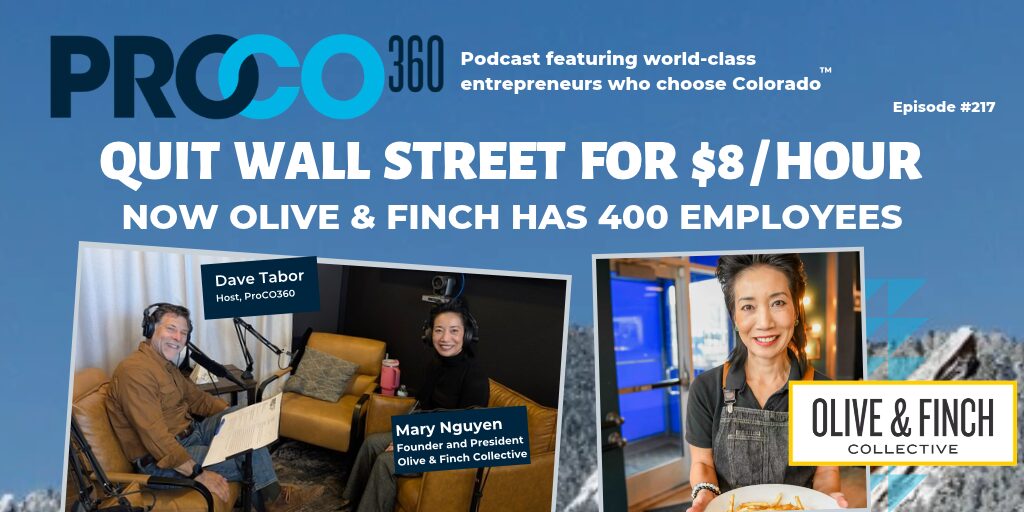
- Mary Nguyen left investment banking and commodities trading for an $8-an-hour restaurant job with no benefits – actually, three simultaneous jobs. Her parents thought she’d gone backwards. She went on to become the only female executive sushi chef in the country at the time, then opened Olive & Finch in 2013, serving chef-made food at prices people can afford. Today the Olive & Finch Collective has more than 400 employees, with restaurants, coffee shops, airport and stadium concessions, and its own food manufacturing business. Employees get full benefits and a 401(k) match… and you can still get a steak for $20. I wanted to know how that math works and how she manages the brand over multiple concepts and an expanded footprint. We also talk about her seat on the Governor’s new Competitiveness Council and what Colorado businesses need most right now. Mary is impressive, and a lot of fun to talk to.
Mary Nguyen 00:05
I worked at Starbucks in the morning. I worked at fine dining restaurant at night, and then during the day, I worked at a sushi restaurant where I was a sushi chef apprentice. And so I knew after location two is that for us to be able to be sustainable, to continue to grow, to continue to offer the quality product, and to be a values-driven company, we needed to make sure that we had economies of scale. I’m not trying to get 20x, you know, like there isn’t anybody telling me what I have to bring to the bottom line. I actually love that you said that because I think this is one of the reasons why, over the course of the last 13 to 14 years, we’ve still been this place where people really appreciate.
Dave Tabor 00:55
Welcome to the ProCO360 Podcast. This is the podcast for people who love Colorado and hearing stories of Colorado’s most inventive and successful entrepreneurs, I’m Dave Tabor. Today’s episode features Mary Nguyen, founder of the Olive and Finch Collective, a Colorado-based restaurant group built on chef-made scratch food at prices people can actually afford. Mary’s path here wasn’t a straight line. She went from a Wall Street finance job to becoming one of the country’s first female sushi chefs, then opened Olive and Finch in 2013. It’s now grown to several locations across Denver and expanded to include catering and wholesale. We’ll talk about how she’s managed that growth, including extending the brand while staying connected with customers and building a business people want to work for. And since this is a podcast focused on Colorado business, we’ll also discuss Mary’s interest and role in serving on the new governor’s competitiveness council. Mary, it’s a lot to dig into. So, welcome to ProCO360.
Mary Nguyen 01:52
Thanks so much, Dave. Thanks for having me here.
Dave Tabor 01:54
Yeah, I’m glad we could make this work. And I gave an overview, but you know, you know a lot more. So, tell us about Olive and Finch at a high level.
Mary Nguyen 02:02
Yeah, of course. So, Olive and Finch actually started as one restaurant in Denver that I opened in 2013, and the goal was really just to offer a place where you can get chef-crafted, gourmet, chef-driven, scratch-made food at an affordable price. You know, I think if you think about like dining in Denver in 2012, 2013, it was completely different. If you wanted a chef-driven, scratch-made meal, you had to go to a fine dining, full-service restaurant to have that experience. And I just felt that dining out had become such a commitment in time, diet, and money. And I was trying to find places where I can get a great meal, not spend an arm and a leg, not spend hours of time, and I just wasn’t able to find that. So I felt like I needed to create that.
Dave Tabor 02:46
Well, you know, that’s a there are a lot of interesting stories from people who you know wanted something that didn’t exist, so they created it. But like, how do you go from investment banking to making creating your own restaurant?
Mary Nguyen 03:00
Well, that’s interesting that you say that because it’s very different, right? Than a lot of people who go into hospitality industry. You know, I my path was very unconventional before Almfinch. I worked in high finance. I was investment banker, and then I was trading commodities. And when I say trading commodities, we were literally like creating our own software, you know, to to basically trade based on what was all the different all the different things happening in the world, right? Based on different algorithms. So I spent my career in a world where success was really, I mean, it was pretty easy to measure, you know. You’ve got transactions, you’ve got returns, you’ve got money, but I decided to leave that one day, and I went to work in a restaurant, literally making minimum wage with absolutely no benefits. So if you can imagine leaving a very white collar position where you know you have a glass office, you wear three piece suits, you know you have an assistant, and you have all the benefits in the world, and then going to make, you know, this is I’m going to age myself, but you know, like making $8 an hour with literally no payments or sorry, no benefits. Yeah. On paper, it looked, I’m sure, to everyone, including my parents, that I’d gone completely backwards. But that experience really, it truly changed the trajectory of my life for the first time, I experienced hospitality from the perspective of the people who are doing the work every single day. And not only did I see how physically demanding the work was, I also understood what it meant to live on those wages and to not have benefits. And I started thinking about how a business can be more than just the product itself. Right? That experience, I feel like it truly shaped not only my decision to build Olive and Finch, but also build the kind of company that I wanted it to become.
Dave Tabor 04:50
What were you thinking when you left this job? Why would you want to go work in a restaurant? What was driving that?
Mary Nguyen 04:56
Well, you know, my parents came here as Vietnamese refugees, and I. Grew up very much immigrant story, you know the American dream, and I was raised very much in that culture of get a great education, get a great job, make a lot of money because that’s security.
Dave Tabor 05:15
Doctor, lawyer, finance.
Mary Nguyen 05:17
Doctor, lawyer, finance, engineer. Yeah, you know, and make a lot of money and happy ever after. And I did all those things and made
Dave Tabor 05:26
your parents proud.
Mary Nguyen 05:26
Made them so proud. And it wasn’t happy ever after. I felt like I had so much more to give, and I felt like I had so much more impact.
Dave Tabor 05:38
But at an $8 an hour job, how was where was that taking you when you say I want to have more impact and you’re looking at where’s the where’s that intersection?
Mary Nguyen 05:49
Well, and I think you know I would be lying if I were to sit here and tell you that I knew the through line, right?
Dave Tabor 05:56
Yeah.
Mary Nguyen 05:57
I think that I realized that I wasn’t doing what I was passionate about, and that my parents had given up so much for me to be impactful, and I felt like I could be impactful in so many other ways. And truly, hospitality and service is a passion for me, and so I followed it.
Dave Tabor 06:18
Yeah,
Mary Nguyen 06:18
you know, I followed it in not knowing what that was going to lead to, but knowing that I wasn’t going to fail.
Dave Tabor 06:25
Huh? You make me think of this book by a guy who is an advertising guy. I wish I could remember his name, but it’s called How Starbucks Saved My Life. And it was a guy who was in his late 50s, and he was an advertising executive that got laid off because he was making too much money and he was destitute and he ends up going to work for Starbucks and he he finds it so fulfilling and grounding in a way that he never got in this corporate white collar world.
Mary Nguyen 06:55
Well, and I think you know, especially in this country, right? Like we we define ourselves by our careers, by our acquisitions, by keeping up with the Joneses, you know. But at the end of the day, you know, when you look at service, like when you can be at service to someone and make them happy, like I feel like that’s pretty worthwhile.
Dave Tabor 07:19
Yeah,
Mary Nguyen 07:20
and it’s funny that you actually even mentioned Starbucks because that was one of my jobs. So when I left finance, I literally quit my job, and I knowing
Dave Tabor 07:30
that you had a soft landing at $8 an hour.
Mary Nguyen 07:32
Yes, absolutely. And I got a job at Starbucks because I wanted to learn as much as I could about hospitality, and I really I started at the bottom everywhere I went, but I would literally wake up at three in the morning to go work at Starbucks and work the morning shift. And this was so long ago. This was like 20 some years ago when Starbucks was like the place to go. But also, it was the only place that I could get a position that offered benefits. And when you think about that, you know, and you think about even during COVID, right? Like you you look at the the industry of service workers who are required to work, right? You’re essential.
Dave Tabor 08:15
Yeah, a Starbucks worker is essential. You’re they’re essential, yeah,
Mary Nguyen 08:18
right. And yes, at Starbucks you can get benefits, but in a lot of other places that are in hospitality, that’s right. You can’t get benefits, and so that was really eye-opening for me to yes leave this very white-collar position and then make the transition to intentionally do this. And I had to work at Starbucks not only because I wanted to, but also it was the only place that I could find benefits. Yeah.
Dave Tabor 08:43
So, how did you make the transition to starting your own company?
Mary Nguyen 08:47
So, I started when I left finance. I also started my own small catering business because I knew I had contacts within the financial industry
Dave Tabor 08:57
to serve their needs to serve some of
Mary Nguyen 08:59
their needs. And so I worked at Starbucks in the morning. I worked at a fine dining restaurant at night, and then during the day, I worked at a sushi restaurant where I was a sushi chef apprentice, and did literally would wake up three in the morning, and then work the breakfast or the morning shift, go work the lunch shift at the sushi bar, and then work the night shift at the fine dining restaurant, and then go to bed at like 11 o’clock. Wake and do the same thing over again. Did that for about a year and a half, and did that until I had the opportunity to really focus on one location. Was offered opportunities to grow. Decided to stay with the sushi sushi restaurant, and it was a a chain of rest not a chain of restaurants, but it was a restaurant group. They were high volume, they were independently owned, and felt that I could learn a lot from them.
Dave Tabor 09:55
So they they saw they saw that you could be a you could grow within there.
Speaker 1 10:00
Yes,
Dave Tabor 10:00
their business, and they offered you an opportunity to start making a move.
Mary Nguyen 10:03
Yeah, start making a move, start moving into management, and that’s where I, you know, I stayed for a few years. And when I left to open up my first restaurant, I left, and I was the only female executive sushi chef in the country at the time. And so it’s, you know, it’s interesting if you know if you if you’re a sushi person, if you like sushi, just had sushi last
Dave Tabor 10:22
night. It wasn’t the best, but I had some. Okay,
Mary Nguyen 10:24
well, you have probably never had, or you can probably count on your hands how many times you’ve ever even had a female sushi chef.
Dave Tabor 10:33
I’m thinking. Yeah, reflecting back, you can see me looking up.
Mary Nguyen 10:36
Yeah,
Dave Tabor 10:37
yeah. So, all right. When you, so what I’m really interested is you left the finance world, and then you saw, like, as you made start made your way to start your own company. What about the finance world? You say I am never going to be like that. And what about the finance world? Are you actually using today?
Mary Nguyen 10:56
I think I use a lot of things that I’ve learned from the finance world. I mean, I think with any business, and and I think that small business owners sometimes don’t necessarily think about this, but you know profits matter.
Dave Tabor 11:08
Yeah,
Mary Nguyen 11:08
you know, like your product absolutely matters. And I think when you think about hospitality as well, or you look think about a chef opening up a restaurant or a sommelier opening up a restaurant, like they’re very passionate about what they do, right? And they’re very passionate about what they’re serving.
Dave Tabor 11:22
Yeah,
Mary Nguyen 11:23
and it’s very much them, you know. And I understand that, but that drives
Dave Tabor 11:28
costs too. If you’re, yeah, yeah, yeah,
Mary Nguyen 11:30
100%. And for me, I understand that drives costs, but I also understand that profitability matters. And when when I’m building a sustainable company, that profitability matters even more so because you know I’m I’m keeping my prices low. I’m making sure my employees have full benefits. They have a 401k plan that we match dollar for dollar ever since the day we opened. They have full medical, dental, vision if they choose, and you know you can get a stake in Denver for $20. Where in Denver can you do that? You know. So for us, sustainability matters, but profitability matters because if profits aren’t there, we’re not going to be sustainable. And right now, I mean, we to to your point earlier, like we have such a diverse company that allows us to be sustainable, and we’ve had to create efficiencies to be able to continue to do the work that we do by offering $20 a stake, you know, or offering full benefits for for all employees. Well,
Dave Tabor 12:36
you did. You’ve talked a lot just now about values, and I wanted to see what your take was because it seems like when you decided to start Olive and Finch, it was really purposefully based on values. Now, a lot of companies, almost every website now, it doesn’t matter whether you’re a plumber or you’re a restaurateur; they all talk about our values, you know. And that just seems like stylish now. But to what extent is that a motivator for you? And can you give well? Can you give an example of you mentioned $20 steak, right? But talk about building a business based on values as you saw it
Mary Nguyen 13:11
then. Well, when I opened Olive and Finch, it was in 2013. I had two other restaurant concepts at the time, and they were chef-driven concepts, full-service concepts, and Alden Finch was 100% a passion project. I wanted to open up this place that had great food, that was affordable, that was beautiful, but that you can get a great meal and pay at the time less than $13 for anything on the menu. And I felt that it was a need that I had, and if I needed it, hopefully somebody else needed it. And so it was a passion project. I ran the numbers, of course, because you wouldn’t be, you know, you shouldn’t do anything unless you run the numbers. But like, if if we broke even, I would be happy.
Speaker 2 13:58
Huh?
Mary Nguyen 13:59
And and and we did break even. How does that
Dave Tabor 14:02
conflict with your notion five minutes ago about profitability drives sustainability?
Mary Nguyen 14:06
Well, we had other concepts at the time. All right, we had two other concepts at the time. So they
Dave Tabor 14:10
were going to pay for Olive and Finch.
Mary Nguyen 14:12
Well, but if they if you’re breaking even,
Dave Tabor 14:14
yeah, I guess you don’t need yes, yes, okay. You know,
Mary Nguyen 14:16
like if you’re breaking even, you know, it’s not it’s not okay. It’s not a money loser. I guess that’s right.
Dave Tabor 14:21
It’s sustainable at zero.
Mary Nguyen 14:23
It is sustainable at zero. But that said, you know, we have had to make some changes. You know, as we’ve grown, we’ve opened up more locations. I actually sold those other two concepts so that I can focus. And that’s one thing that I learned is that you know, growth isn’t necessarily more and more and more, right? Growth is also making decisions so that you have capacity for that growth, and so we really focused on building the Olive and Finch brand, and we did that by starting a wholesale production and distribution company. I would think that
Dave Tabor 14:56
having wholesale, interrupting you, Mary, but having. Sale allows you to buy in quantities that allow you to offer a $20 steak, where other restaurants might not be able to do that. Absolutely,
Mary Nguyen 15:06
absolutely, and it also helps us solve the the labor problem. You know, we know labor is an issue. We know quality workers are are an issue. We know minimum wage is increasing every year. And you know, our first location was in 2013. Our second location was 2017. Our third location, which was a wholesale company, was 2018. And so I knew after location two is that for us to be able to be sustainable, to continue to grow, to continue to offer the the the quality product, and to be a values driven company, we needed to make sure that we had economies of scale and that we could be efficient.
Dave Tabor 15:43
That’s cool, and the wholesale positions you to to do that. That’s kind of cool. All right, I want to I want to take a quick break because I’ve got some great sponsors, and I want to thank them. You’re listening to ProCO360, named best Colorado business podcast the last six years. I’m your host Dave Tabor. This is the podcast for people who love Colorado and the stories of Colorado businesses and entrepreneurs. And in this episode, I’m joined by Mary Nguyen, founder of the Olive and Finch Collective. Do want to thank First Via Technologies. They host ProCO360, and all the great help that I get from their team is really appreciated. They have become Via has actively grown into the role of AI advisor for its clients. They’re helping them discover valuable ways to apply AI in their businesses, and they’re leading them to effective deployments. Got a couple of new sponsors: Philosophy Communications, Philosophy Communication. Oops, I’m going to fix that. We’ve got a couple of new sponsors: Philosophy Communication. I’m happy to partner with my longtime friend Jen Lester, CEO of Philosophy Communication, a marketing, PR, and digital agency. They have built a business managing Colorado’s top leaders, and believe if you don’t manage your reputation, someone else will. So take charge of your reputation. Contact them, my friends at Philosophy Communication, also PDS AI IT and Aerospace PDS is a staffing company specializing in serving clients in aerospace, defense, and IT. With Colorado’s emergence, actually, look in many ways, Colorado is now the leader in these sectors. I’m glad to have PDS supporting Colorado’s growth as a sponsor of ProCO360. All right, back to Mary. I want to talk quickly about what your footprint looks like now, and then really dive into more about your business itself. So, explain kind of your footprint. You mentioned locations of the restaurant and also wholesale. What else have you got going? Yeah.
Mary Nguyen 17:37
So we have. So I would say our retail brands first. So we have five verticals across the collective. So Olive Finch is, from my perspective, it’s a hospitality company. So we have retail brands. Those retail brands are composed of Olive and Finch, which is our restaurants. We have Little Finch, which is our coffee shops, and then we have Finch on the Fly, and those are micro stores. So micro stores that we put in institutional environments. In addition to that, we run concessions. We have concessions at sports stadiums as well as at the airport, and then we have the production and distribution company. So we actually manufacture pre-made food as well as pastries, ready to drink beverages, and we sell that to hospitals, hotels, grocery stores, and we sell them to ourselves as well as to a lot of different accounts in the travel leisure market.
Dave Tabor 18:33
You sell you sell you say this sell them to yourselves, meaning that that this manufacturing is a is its own profit center.
Mary Nguyen 18:41
It’s its own. Yes.
Dave Tabor 18:42
And so, when one of your other outlet, one of your other verticals buys from it, right? That’s just the way the business works.
Mary Nguyen 18:48
That’s just the way the business works. Yeah. Got it. And then our last arm is our hospitality management company. So we can ideate, create, and also manage concepts. We can do that for other people. We’ve done that with our current concepts, where you know we put in our location somewhere, and you know it’s it’s for it’s an amenity to a building, or and then we manage it. We have a whole back office, finance, marketing, PR, human resources, and we do that, you know, and that’s its own company that services our brands as well as other brands. So we’re truly a full you got a lot going on company, but it’s also you know it’s again it’s building sustainability, and I think that at the end of the day, you know, one thing that I also understand coming into this industry as someone who didn’t grow up in the industry and didn’t go to school in this industry is that, you know, there also is you know you age out of this industry. You know, you can only be a chef or a restaurant manager for a certain time period, but then there there’s got to be opportunities to grow. Yeah, right. Like, can you be a multi-unit? Can you be a director? You you know, and so we have opportunities for our team to grow also organically. Well, and
Dave Tabor 20:04
that’s that’s critical because good people want growth, or they’re going to leave.
Mary Nguyen 20:08
Absolutely. And
Dave Tabor 20:08
so you know that’s that may be well. I’m going to ask you this because I was about to lead you down a path, and I’d rather you go there if you wish. But and you heard me mention philosophy communication, and they one is one of our sponsors, they that so it prompts me to ask philosophy questions during this. So, what is your philosophy of growth? I mean, most most people that I talk to, and most people you read about in the Wall Street Journal, just want to grow, and they set these goals of we’re going to be X size by X and Y. So I always wonder, like, why? Why do you want to grow?
Mary Nguyen 20:43
Well, and this is a good question for you to ask me because I think that when you look at these companies that are trying to grow and trying to hit a certain X, maybe it’s because they want to get bought out, right? They want those private equity money that you know what I mean? Like they basic, or they want to go public, and I think which which is great.
Dave Tabor 21:04
Yeah, they have a right. That’s a means to an end for them.
Mary Nguyen 21:07
Right, it’s a means to an end for them. But I’m gonna say also that you know I think that success for an entrepreneur or a business owner sometimes goes backwards, right? Because when someone’s successful, you assume that like everything has been just like perfect and has been planned out, but in reality, you know, it’s it’s success isn’t necessarily a straight line, you know, and and you have to make a lot of mistakes. But you know, back to your original question is that you know our philosophy is 100%. I want to build a sustainable hospitality company. When you look across the spectrum of restaurants or hospitality businesses, at the end of the day, they become big, and then they’re bought out by private equity, and then that company takes them over, and they’re you know run to the ground because they’re trying to get 10x, and you know
Dave Tabor 22:00
TGI Fridays, you know, right? Exactly,
Mary Nguyen 22:03
and I think for us, you know, we are 100% owned. We do not have any investors. I have built this company by myself. You know, everything has been self-financed, so we don’t have anyone dictating what our costs need to be. And so, when I say sustainable, we are sustainable because I’m I’m directing what those profit margins are, and at the end of the day, I mean, truly, because people are always asking, like, how can you do all this and charge $20 a stake, but also pay the most expensive rents in the city? It’s like, well, I’m not trying to get something X, right? I’m not trying to get 20x, you know, like there isn’t anybody telling me what I have to bring to the bottom line because I don’t have to answer to anybody.
Dave Tabor 22:46
That’s you know that’s got to be freeing in a way, right? It
Mary Nguyen 22:50
is, it is. But at the same time, I work for my team. You know, like we have more than 400 employees now counting on us to be sustainable and profitable because they have families. They have, you know, they’re they’re they’re betting on
Dave Tabor 23:06
us. Okay, now I got to ask a question that I’ve been wondering and I’ve been planning to wonder and planning to ask you. And customers, this is my take and yours. It’s going to be different because you’ve got all these different channels, verticals that you’re in, and such. But if we just talk about Olive and Finch and you’re growing, and whether it’s Little Finch, Olive and Finch, the brand is expanding, and customers recognize that. And my belief is always that customers love new restaurant concepts. They kind of like discovering them. They relate to them. They feel some emotional connection. And then, like with you, you have this wonderful story, immigrant story, and so they they bond and they connect with that. Then in growth, a restaurant will go from one to two, and then at some point they go from being novel and and viscerally visceral feel it to their customer to being a chain. And and I don’t know that you could protect against that feeling as one scales, but what’s your philosophy on that? How do you grow in that way without losing that connection with your customer?
Mary Nguyen 24:09
Yeah, and I and I don’t know the answer to that. You know, we’re trying our best to continue to be that neighborhood place. You know, we choose locations where we know the the we well not necessarily know, but we hope that the neighborhood is going to support us. But we also hire, you know, we try to hire the right people who also believe in our values and who truly love hospitality. Because if serve, if you’re service first, it shouldn’t matter how corporate it feels, right? Because,
Dave Tabor 24:44
but it no, it does matter. You think so? Yeah, of course it does. But
Mary Nguyen 24:48
but what does corporate mean? Does corporate mean that you sold to private equity and now you know the the the cinnamon roll that you bought like five years ago when you were private was a lot bigger and now you’re. Trying to get 10x off of it, you know what I mean? Like, well,
Dave Tabor 25:02
I know I don’t know. Well, I will share an observation because I, I listen to what I told Mary I hadn’t been to a an olive and pinch until right before this interview. I wanted to. I’m like, I gotta go. You
Mary Nguyen 25:13
still have to tell me how it was because we didn’t get to that. It was great, but it was the one on
Dave Tabor 25:16
Bannock, and I had sort of an aha that was very interesting to me because most restaurant concepts sort of make it about at least what feels to me, and I’m not a restaurant person, but that they’re really trying hard to create a concept that people want to be part of, and and what struck me about the vibe at your Bannock location is that it seemed more like a setting for people than a concept, and everybody was just there, and it was it’s as if it didn’t matter what it looked like so much as it felt comfortable.
Mary Nguyen 25:56
Yeah. Well, I actually love that you said that because I think this is one of the reasons why, over the course of the last 13 to 14 years, we’ve still been this place where people really appreciate because we don’t dictate how you dine with us, you know. Whereas a lot of other restaurants do, you know. So, for example, when you walk into, and and again, I’m just saying this. If you’re walking into Taborneta, you know what you’re going to expect. You’re expecting full service fine dining experience. You know that you’re going to probably order a bottle of wine, maybe two, an appetizer, a salad, an entree, and dessert. And then that server has expectations of you, right? You have expectations of that server. You want your water filled. You want them checking on you, right? But then, say you go and you dine at a mod market, right? You go to a mod market. You know the expectations.
Dave Tabor 26:54
Yeah,
Mary Nguyen 26:54
they’ve created the expectations for you as well, right? It’s in and out. The food’s gonna be good. It’s gonna be fast, and you’re in and out. All of avenge is a little different. We don’t dictate how you experience us. You can come in, you can order from the table, from the QR code. You can sit at the bar and order from the bartender, or you can order with the cashier. We do breakfast, lunch, and dinner.
Dave Tabor 27:18
And I noticed happy hour.
Mary Nguyen 27:19
And happy hour. We have a full coffee bar. We make all those pastries in house, and we have a full bar. So, but you’ll notice when you go in, you have all types of people. You have businessmen having business meetings. You’ve got women having their, you know, the ladies who lunch. You have a mom coming in just to grab a cup of coffee with her with her kid before she goes to the art museum. You know, you’ve got a family coming in and having a dinner. We don’t dictate how you dine with us. You know, if you want to come in and grab something to go, you can. If you want to sit there for five hours with your computer, you can. And so I think that we provide a level of comfort because you know you’re going to get great quality, you know it’s going to be affordable, you know it’s going to be in a nice environment, but we’re not down your throats trying to sell you anything. We’re not trying to get you out the door.
Dave Tabor 28:10
Yeah, yeah.
Mary Nguyen 28:11
You know, and we’re not trying to get you to keep ordering.
Dave Tabor 28:13
Yeah, cool. Before I switch to Colorado, talking about that, I want to ask, where’s the name come from?
Mary Nguyen 28:22
So a finch is a bird that wakes up early in the morning and goes to bed late at night. It’s also very social and it’s kind of like a busybody, and that’s kind of our environment. So you know, we open at seven in the morning, we close at 9o’clock every night. We serve breakfast, lunch, and dinner, and typically we’re we’re busy and we’re bustling. And then an olive is an ingredient that can be served sweet and savory, and we do all of that. So since day one, we’ve had a full coffee or a full pastry program, and then we do savory foods as well.
Dave Tabor 28:56
Got it. Yeah, cool. Yeah. All right, let’s talk about Colorado. You are recognized as a leader in the business community of Colorado. You’re a native, right? You went to CU Boulder, so you know there has been a ton, and I know you’re going to have opinions about this. A ton of light shed on Colorado’s competitiveness. Colorado’s business climate has been eroding at an accelerating pace. There’s all kinds of data around that. Some high-profile business leaders, I’m sure you know, of hospitality and others, are extremely frustrated with what they believe is Colorado’s eroding, degrading business climate. And so now you’re part of the governor’s new competitiveness council. So Governor Polis stood this up just recently. So, what’s your take?
Mary Nguyen 29:43
Well, I think that I think when you well, and we’ve seen this right because we just had the elections.
Dave Tabor 29:52
Yeah, you know, yeah. And so,
Mary Nguyen 29:53
if people are going to argue that we are maybe not being as competitive, like you know, that’s we’ll see what happens in the. Next few years, but you know, I’m truly I’m optimistic, but I also am honest about where we are.
Dave Tabor 30:07
Yeah,
Mary Nguyen 30:07
you know, I think that you know, I grew up in Denver. I worked in public finance, you know, so I was very I was very involved in you know structuring the bonds for Coors Field and e4 70 for DIA, and so you know, I’ve seen the growth within our city and our state, but you know, it’s absolutely challenging right now. Absolutely, it is. But I’m also really optimistic because I think that you know, with any city, especially after COVID, you know, like there’s there’s ups and downs, right? And cities go in cycles, and I think that there there has to be an environment now where we think about regionalism and we think about cooperation and we think about how we can really all support the the businesses and the communities that are trying to make Colorado better.
Dave Tabor 30:57
Do you share the frustration of some of the high profile business leaders that have been really vocal.
Mary Nguyen 31:06
I think that there are truths in everything. You know, I think that things can be challenging. I think permitting can be challenging. I think that as a business, there are things that you have to really make sure you have, you know, and that’s predictability. That is making sure that also as a small business you have time and you know you understand the rules.
Dave Tabor 31:32
Well, there are in the in this. I’ll be more specific. In the council report, there are five principles of competitiveness: predictability, proportionality, which has to do with regulation, basically are these regulations serving an important enough purpose to make things difficult? Collaboration, compatibility with state and federal policy, and prosperity. It’s like, you know, as I look at, and I’ve been pretty well informed on Colorado’s political sort of business climate, and I look at the the new election results, and there’s now a super majority in Colorado. I told you once you get political that I won’t be party politically that way. But whenever one party controls everything in a dominating way, proposals tend to get even more difficult for business. Either party, it just gets hard, so I’m not as optimistic as you are right this minute. I hope you’re right.
Mary Nguyen 32:27
I hope I’m right too. You know, but I will say that I think that you know when you talk about those five, when you talk about those five different principles of competitiveness, like to me, the most important thing is predictability and proportionality because I feel like those are things that I’m feeling every day. How are
Dave Tabor 32:48
you feeling those
Mary Nguyen 32:49
as I’m running my business? So you know, predictability is about planning, right? So when I’m looking at a new location, we’re making commitments years out, right? We’re we’re looking at financing, we’re signing leases. We’re we’re you know doing construction and doing buildouts and we’re hiring and we’re doing all these things expecting right and predicting and that’s when it becomes challenging because that makes it hard if there isn’t any single rule yeah and so to your point right when there’s a super majority, or when things start getting legislated. Yeah, yeah, yeah, yeah, for sure. You know what I mean? Yeah, yeah, yeah. When the rules keep changing, that’s right. Right, and when the goalpost keeps changing, yep, that’s what makes it hard as a small business owner. Yes,
Dave Tabor 33:36
I, and that’s why you know, and that’s why I’m, you know, I hope I said I’m not hopeful. I hope I’m wrong because I really I I think it’s time for Colorado to stop moving the goalposts and create an energy or there’s always been energy and there still is around entrepreneurial activity in Colorado. But I think make Colorado a safer place for entrepreneurs to dig in, you know that’s what I’m what I’m hopeful.
Mary Nguyen 34:04
Yeah, well, and I think that there’s there’s a lot of talk about it, right? I think that everyone going into this election cycle in this state understands that we are at a crossroads, you know. And I think that that I think the narrative needs to be: we want a prosperous state. We want every single one of our citizens to be able to live a prosperous life. We want our kids to be able to buy a home. We want, you know, we want our kids to be able to have a better life than we did. At the end of the day, regardless of politics, regardless of how you vote, that’s the same thing. We all want that.
Dave Tabor 34:39
Yeah.
Mary Nguyen 34:39
How we go about it is a little different, but if we can maintain that as being the through line and the goal, then then we should be optimistic.
Dave Tabor 34:49
I hope so, and I I hope you’re right about that because I know you’ve got daughters, right? I do. Twins. How old are they?
Mary Nguyen 34:55
They’re 1111.
Dave Tabor 34:56
So, do you want them to be entrepreneurs? Would you be happy? Because I know you’ve dealt with your parents wanting something, and that you know that’s hard. Yeah,
Mary Nguyen 35:03
no, it is hard. It is absolutely hard. I want them. What I want is I want them to make an impact, and I want them to live with purpose. So if they do that through entrepreneurship, great. And if they do that in another way, great. But I think impact and purpose is really important.
Dave Tabor 35:22
So your girls, and we’re going to wrap up soon here. Your girls have watched you build the collective into something really big. This has to be a tough, tough balance for you. How do you? First of all, how do you manage it? What do the girls think?
Mary Nguyen 35:38
Oh gosh, they are so supportive, and I try to bring them in into everything I do. You know, so child
Dave Tabor 35:47
labor.
Mary Nguyen 35:47
I mean, I mean, they’re my kids, right? So it should be okay. That’s right. No one’s going to come after me because they’re my kids. That’s it. But you know, I actually would like them to start working with us. You know, when they’re about 13 or 14, but I think that when they can see that you can create something and you can build something, but you can also do that with impact. I hope that that gives them pause to understand that, like, the time away from me is worth
Dave Tabor 36:19
it. Hmm. Yeah. How do you balance that though? I mean, it’s your company.
Mary Nguyen 36:26
Yeah,
Dave Tabor 36:27
in a way, you’re you’re fortunate because you’re not reporting to shareholders. That’s one really good thing. Yeah, but still, how do you balance that?
Mary Nguyen 36:34
I’ve been really fortunate to have so much support around me. You know, I I have a great team. You know, I honestly, truly, I’m surrounded by people who are smarter than me that who know how to run a company better than me that I can rely on. And I’ve had to learn to grow that over the years. But it it takes a village, and 100%, those kids are being raised by a village,
Dave Tabor 37:01
really?
Mary Nguyen 37:01
Yeah. Do
Dave Tabor 37:02
they know
Mary Nguyen 37:03
it? I think they do. Yeah. Like
Dave Tabor 37:04
how? Why do you think that?
Mary Nguyen 37:06
Well, you know, I mean, we we have a lot of support. We have a lot of help.
Dave Tabor 37:10
But I mean, what does that look like to them? How do they see that?
Mary Nguyen 37:13
I don’t think that they. I don’t see that they think it’s weird because it’s always been the case. You know, like I mean, I had like I was pregnant with twins, right? And I have literally I never took one day off when they were born, and they were in the hospital for six months, and I worked completely through that every single day. So they’re used to the one they’re used to me working as much as I do. They’re they’re used to me being so committed to building something, and so that’s normal. And they’re used to a lot of people coming into their lives and supporting them, and you know taking them to school or picking them up or going to an event because you know I’m not there. So,
Dave Tabor 37:53
well, do you ever take vacation? Can you?
Mary Nguyen 37:56
I mean, but can any entrepreneur or small business owner?
Dave Tabor 38:00
It’s tough. It is. Even when I own my company, I took vacation. It was like I remember making a call from the middle of nowhere at a payphone that had a had a loose connection in in the outskirts of in Turkey. Oh wow! You know because like somebody wasn’t paying their bill.
Mary Nguyen 38:16
Yeah.
Dave Tabor 38:16
And yeah. Yeah. No, you never do get away.
Mary Nguyen 38:20
You don’t, you don’t. But I also think that this is. I think as an entrepreneur, and I think other entrepreneurs can understand this. Like, it’s it. It feels really good to build something. It feels really good to impact other people’s lives, and it feels good to to to be needed.
Dave Tabor 38:40
Yeah, that’s probably a good note to end on. Now I’m your host Dave Tabor, and today on ProCO360, you’ve been listening to my conversation with Mary Nguyen, founder of the Olive and Finch Collective. Mary, good to have you on ProCO360. What a fun conversation!
Mary Nguyen 38:54
Oh, thank you. I had a great time.
Dave Tabor 38:56
Good, listeners. Glad you’re here on ProCO360, where we say live, work, love Colorado, because you and I and my guests can be successful anywhere and choose Colorado. You make the show successful by subscribing to the ProCO360 podcast. If you haven’t yet, it’s a huge help if you submit a review in your app. Thanks again to our show sponsors via Technologies, Philosophy, Communication, and PDS and PDS AI, IT, and aerospace. That’s the show. Live, work, love. Colorado.